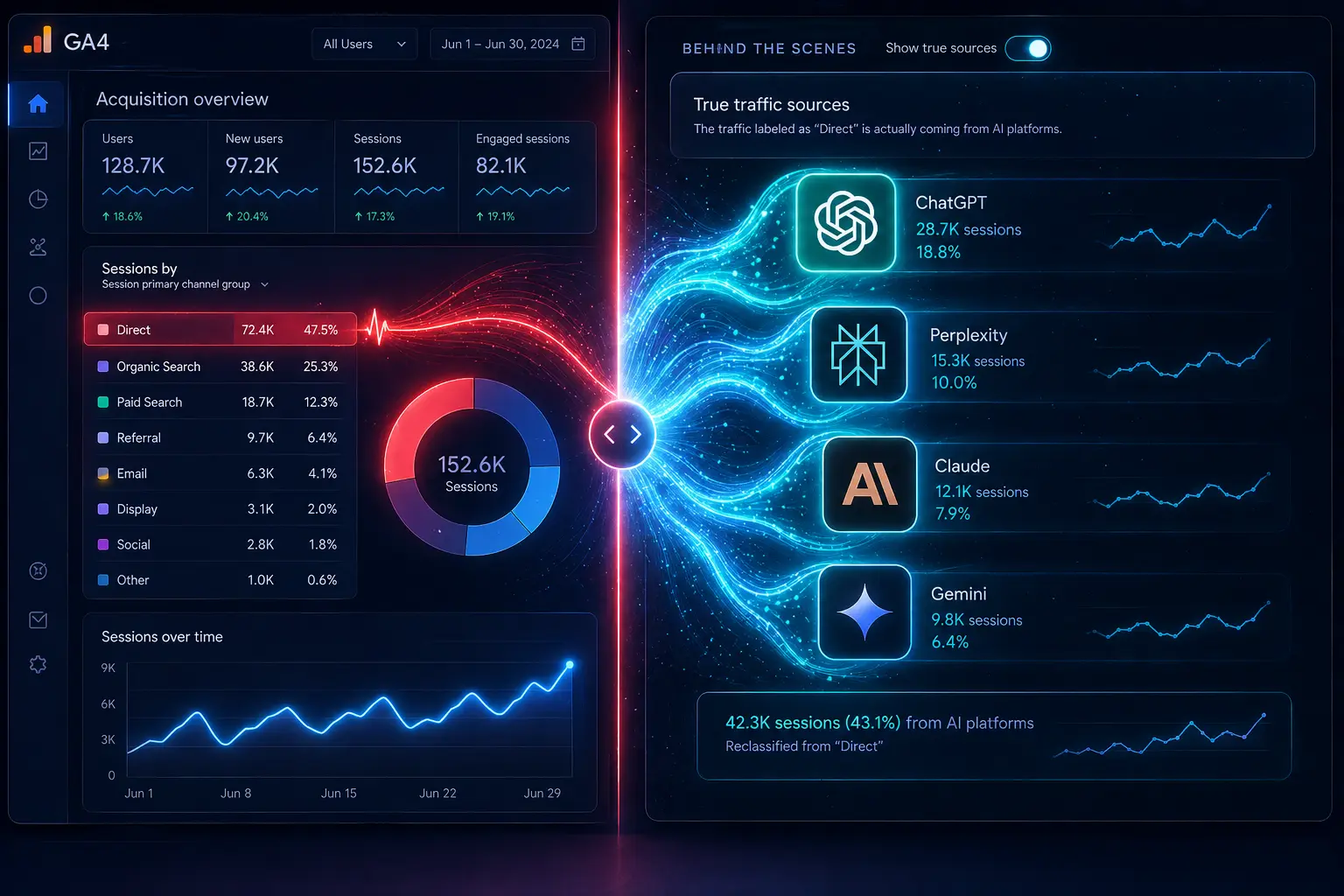
There is a number making the rounds in the SEO and analytics community this week, and it is so large that most marketers refuse to believe it on first read: 88% of organic search traffic volume so far in April has come from AI agents — up roughly 150% versus the previous month. The catch is that 70.6% of that AI traffic shows up in Google Analytics 4 without referrer headers, where it is silently bucketed as "Direct." The conversion rate of that hidden segment is around 10%, roughly four times higher than non-AI traffic.
If you are a web developer, agency, or in-house growth team and you are still measuring success by classical organic sessions, you are now flying with the wrong instruments. Your most valuable visitor in 2026 is an AI agent — or a human that an AI agent referred — and your dashboard is calling them "Direct."
1. Why AI Traffic Is Invisible in GA4
When ChatGPT, Perplexity, Claude, or Gemini cite your page, the citation typically opens in a new browser tab without a Referer HTTP header (privacy modes, embedded webviews, native app browsers). GA4 sees a session with no referrer, no UTM, and assigns it to "Direct / None." The same problem hits answer engines that send users via instant-answer panels — the user never even passed through a search result. You cannot optimize what you cannot see.
2. The New Top-of-Funnel: AEO and GEO
AEO (Answer Engine Optimization) targets being cited as a source by AI answer engines. GEO (Generative Engine Optimization) targets being inside the AI''s generated reply itself. Both rely on a different content shape than classic SEO: short, declarative answer blocks, FAQ schema, structured tables, and machine-readable language. Nearly a third of the U.S. population will use generative AI search in 2026, and AI referral traffic converts at 4–5x the rate of traditional organic.
But here is the part nobody likes hearing — you cannot skip classical SEO and jump straight to AEO/GEO. The AI almost always reads the top 10 organic results before composing its answer. SEO, AEO, and GEO are now a three-layer stack, and you need all three.
3. Concrete Wins for PHP / Database Engineers This Quarter
Add a custom-channel grouping in GA4 that classifies "Direct + landing page is content + UA contains ChatGPT/Perplexity/Claude/Gemini" into a new "AI Referrals" channel. It is a one-evening implementation.
In your PHP backend, log every request whose User-Agent matches an AI crawler or AI client (GPTBot, PerplexityBot, ClaudeBot, Google-Extended, OAI-SearchBot) into a dedicated ai_visits table. Index it on (date, bot_name, path).
Mirror your most-cited content into a /ai-summary/ route that returns a clean, schema-rich, 250–400-word answer block. Many teams are seeing their /ai-summary/ pages become the most-cited URLs, even when they did not advertise them.
For mobile app teams, embed the same content payload in your in-app help. According to Flutter''s 2026 user survey, 79% of Flutter developers are using AI assistants in development; the same trend on the user side means in-app AI helpers are now table stakes.
4. The GA4 Update That Actually Helps
Google''s April 2026 GA4 release introduced two AI advisors — Ads Advisor and Analytics Advisor — that respond to natural-language questions and surface hidden trends. Useful, but a reminder: the AI advisor is reading the same misclassified data your team is. Fix your channel grouping first; let the advisor work on clean data after.
My Take
Three years ago, the question was "how do we rank?" Two years ago, it was "how do we get featured?" Today it is: "how do we get cited, and then how do we measure that we got cited, when the citation doesn''t even leave a referrer?" The teams that win this year will be the ones who treat their analytics pipeline, content schema, and PHP backend as one continuous AEO/GEO surface. The classic split between marketing''s job and engineering''s job is over.
Sources
- Google Analytics News — April 2026 (Startup Edition)
- How to track and report AI traffic in Google Analytics 4 — Analytics Mania
- FAQ on GEO and AEO: Where AI search and SEO overlap in 2026 — eMarketer
- Answer Engine Optimization: Complete AEO Guide 2026 — Frase
- How Dart and Flutter are thinking about AI in 2026 — Flutter Blog