AI & Automation

AI Overviews Now Fill Half of Search Results: Watch Your Industry's Penetration, Not the 48% Average

2026.06.23 · 148 views
AI Overviews Now Fill Half of Search Results: Watch Your Industry's Penetration, Not the 48% Average

BrightEdge data shows AI Overviews on ~48% of results (up 58% YoY) — but Healthcare 88% and B2B 82% mean the average misleads SMB strategy.

Share:

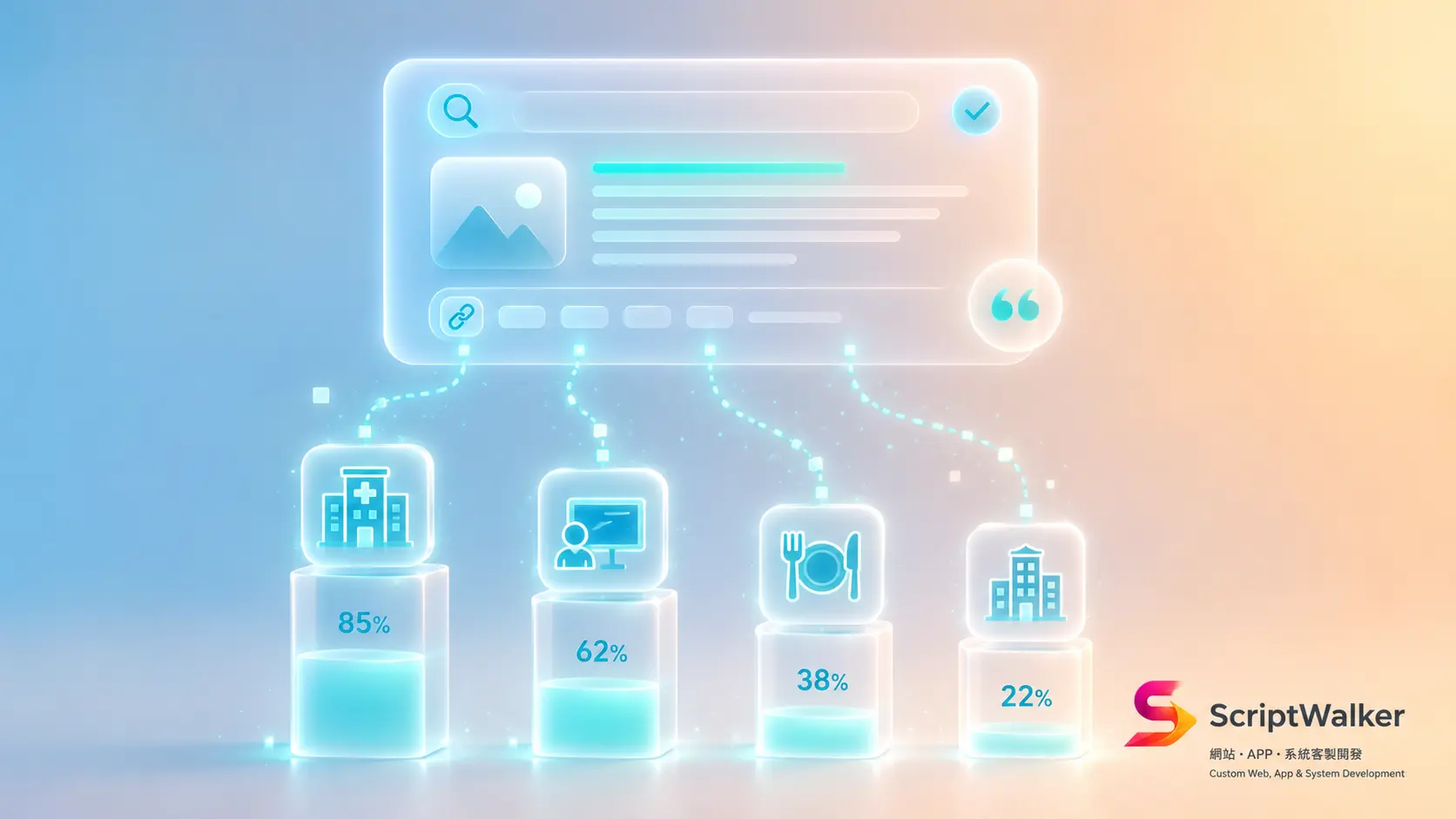
By 2026 the question "will AI affect my search traffic" no longer needs asking. Per BrightEdge's twelve-month tracking from February 2025 to February 2026, Google AI Overviews went from appearing on roughly 31% of results to 48% — up about 58% year over year. The figure spread through marketing circles after Search Engine Journal reported it. But what should stop a small-business owner isn't "half overall" — it's "your industry's rate": Healthcare already 88%, B2B Tech 82%, Education 83%, Restaurants 78%. The average lies to you: some industries are already AI-answer territory, others are still at a third.

To see why the curve is steep, look at what AI Overviews did this year. From limited 2024 trials, to broad 2025 rollout, to penetrating nearly half of queries in 2026 — over the same period Google's AI Mode crossed 100M monthly users. For a search entry point unshaken for two decades, that's structural: more users get satisfied at the "answer layer" and never click through. Education queries jumped from triggering Overviews 18% to 83%, restaurants from 10% to 78% — not "optimized," a different game.

Meanwhile the answer layer isn't Google alone. ChatGPT has about 900M weekly users handling ~2.5B prompts a day and roughly 17% of global digital queries; Perplexity sits near 45M standalone monthly actives, past 100M with distribution. Their cited sites barely overlap — Profound's 680-million-citation study found only ~12% of domains are cited by both ChatGPT and Perplexity. The category isn't converging; it's splitting into several entry points, each with its own temperament.

This piece solves one thing: when your industry's AI penetration is already 70–80%, what can a small business actually do without an enterprise SaaS subscription?

Event detail and full numbers

BrightEdge's twelve months (2025/02 → 2026/02) show AI Overview trigger rate rising from ~31% to 48%, up ~58% YoY. By industry, the nine most penetrated are roughly: Healthcare 88%, Education 83%, B2B Tech 82%, Restaurants 78%, Insurance ~63%, Entertainment ~37%, plus Travel, eCommerce and Finance. The most dramatic part is growth: Education 18%→83%, B2B Tech 36%→82%, Restaurants 10%→78%. Who benefits? Sites that get cited as the "answer source." Who loses? Sites betting everything on blue-link rank that never get cited — because users stop clicking. Crucially, about 52% of queries still trigger no Overview at all, so this is highly industry- and intent-dependent, not all-or-nothing.

Immediate actions for three readers

  • Brand owners / SMB founders: check your industry's Overview penetration, not the overall 48%. If you're in healthcare, education or B2B, treat the answer layer as the main battlefield; if you're a local service (local dining, repairs), focus on your Google Business Profile and citable local reviews.
  • Marketing / SEO operators: restructure content as "question-as-heading, answer up front" — studies show ~44% of LLM citations come from the first 30% of content (the intro). Add FAQs and structured data (FAQPage / Article schema) so machines parse your answers.
  • Developers / agencies: bake "citability" into delivery specs: semantic HTML, JSON-LD (Article + FAQPage), clear heading hierarchy, crawlable plain-text answers. See Google Search Central on AI features and structured data.

SaaS tool comparison

Tool Focus Rough pricing Best for
Profound AI citation tracking, cross-engine visibility Enterprise (high) Mid-large brands with budget
Scrunch AI Monitor brand presence and sentiment in AI answers Mid-high Teams focused on brand voice
Otterly.AI Track ChatGPT/Perplexity mentions and ranking Low-mid (SMB-friendly) SMB starters
Google Search Console (free) See your own clicks/impressions, validate traffic shifts Free Everyone should start here

What they won't tell you

First, "48% overall" misleads most. If you're in entertainment (~37%) or a low-penetration niche, pouring money into GEO may be premature; for healthcare and B2B it's table stakes. Don't decide on the average — decide on your industry's rate. Second, these GEO-monitoring SaaS mostly price by "tracked keywords × engines," and SMBs easily subscribe, underuse, then fear cancelling. For an SMB with a few core keywords, free Search Console plus manually checking your brand in ChatGPT/Perplexity is often enough to see the trend.

A "no SaaS subscription" alternative for SMBs

  • Use Google Search Console (free) to track impressions and clicks, comparing before/after you add FAQ and structured data.
  • Weekly, manually ask ChatGPT, Perplexity and Google AI Mode five "questions your customers ask," and log whether you're cited and who else is — the cheapest GEO monitoring there is.
  • Add FAQPage and Article JSON-LD to key pages (validate with the Rich Results Test) and put the answer in the first 100 words.

FAQ

If AI Overviews appear more, will my traffic necessarily drop?

Not necessarily. If your content gets cited as an answer source, you gain brand exposure at the answer layer; the ones who get hurt are sites that aren't cited and rely only on rank for clicks. So the goal isn't to resist Overviews but to become what they cite.

Which number should I check to decide on GEO?

Check "your industry's Overview penetration" and "whether your core keywords are cited in ChatGPT/Perplexity," not the 48% average. Healthcare, education and B2B are must-dos; low-penetration niches can wait and watch.

My SMB has no budget for GEO tools — what can I do?

Use free Search Console for traffic shifts, plus weekly manual checks of your brand and industry questions across the three big AI engines; add FAQs and structured data and put answers up front. These three near-zero-cost moves cover ~80% of the need.

Does structured data actually help?

It doesn't guarantee citation, but it helps machines parse your structure (which part is the question, which is the answer). Treat it as basic hygiene that lowers misreading risk, not a magic switch.

My take

The mainstream narrative is "buy GEO tools fast, AI-ify all your content." My judgment is the opposite: for most SMBs, the best move in H2 2026 isn't a third monitoring SaaS but deleting noise like "the overall average" from your decisions and watching only your industry's rate and your brand's citation. GEO tools face consolidation within 12–18 months because their core data (which engine cites you) will increasingly be covered by Google's and the engines' own free reports. For an agency like ScriptWalker, the real productized opportunity isn't reselling tool subscriptions but making "citability" a delivery standard — semantic structure, JSON-LD, answer-first — and offering a low-commitment, repeatable "quarterly GEO check-up," which fits real SMB budgets better than an expensive dashboard.

Sources

Share:
AI & Automation Back to Blog