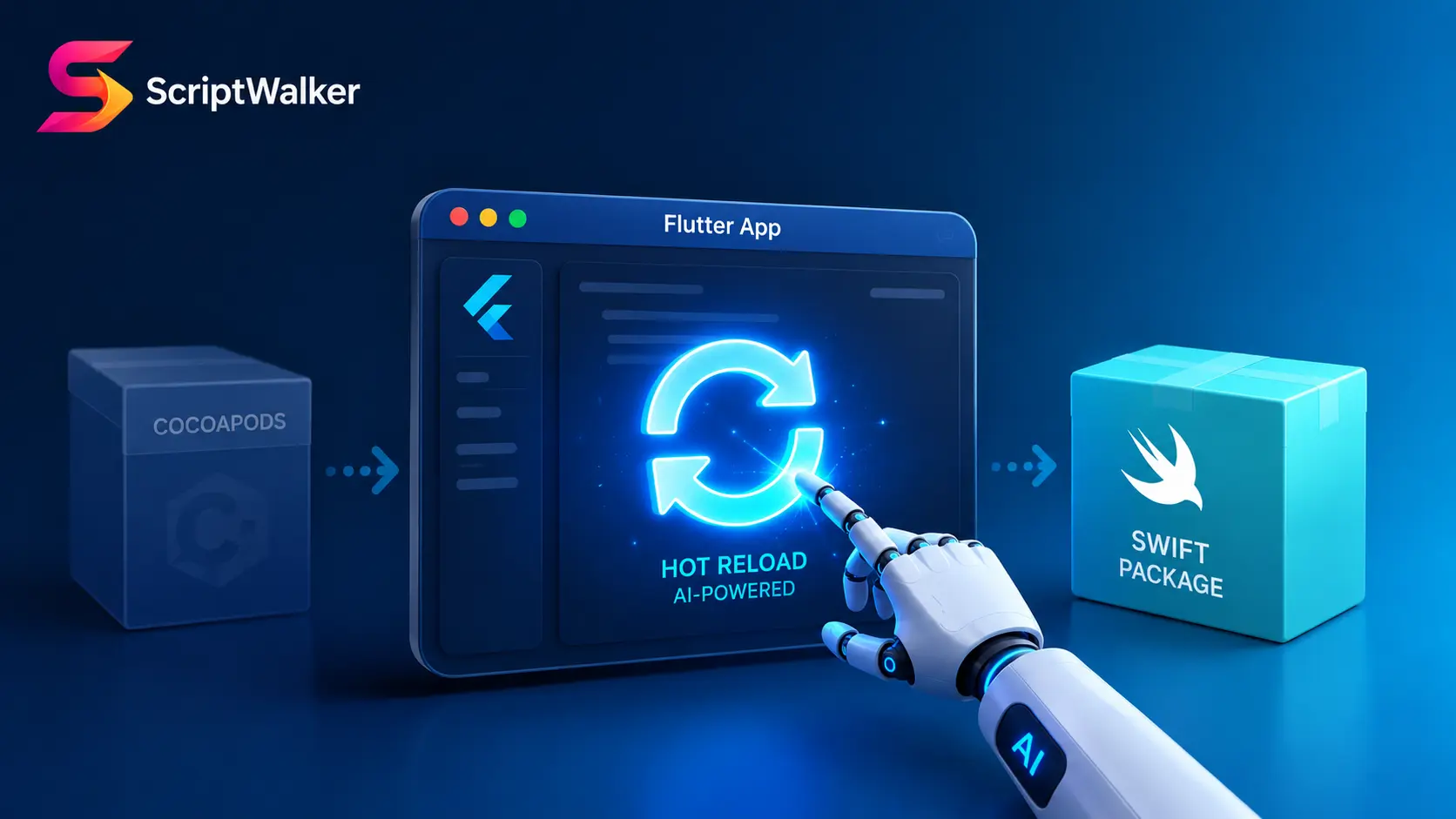
Flutter 3.44 landed alongside Dart 3.12 at Google I/O 2026. On the surface many filed it under a quiet release, but open it up and you find three deep changes happening at once: closing the loop on AI-assisted development, overhauling iOS dependency management, and loosening the architecture of the core framework.
1. Agentic Hot Reload
The most talked-about feature is Agentic Hot Reload. Through the Dart and Flutter MCP server, an AI coding agent can now automatically find and connect to your running app and trigger a hot reload after it changes the UI. The old chain — AI edits code, human manually reloads, human looks at the result — loses its manual middle link; the agent can edit, reload, and inspect the screen on its own. This is a key step in pushing Flutter into agentic development.
2. SwiftPM by default: the end of CocoaPods
Swift Package Manager (SwiftPM) is now the default dependency manager for iOS and macOS, effectively declaring the end of the CocoaPods era. SwiftPM ships bundled with Xcode, so you no longer need Ruby or the pod install headache; indexing is faster and the workflow is more Apple-native. Apple Silicon Macs no longer need Rosetta to run Flutter command-line tooling either.
3. A looser core: Material and Cupertino split out
The Material and Cupertino libraries are now code-frozen inside the core SDK and will move out of the flutter/flutter repository into independently versioned material_ui and cupertino_ui packages, so design-system updates can ship off the Flutter release cadence. Other updates: an opt-in Hybrid Composition++ (HCPP) for Android using Vulkan; a new CupertinoMenuAnchor widget; Widget Preview backed by the Dart Analysis Server, cutting the flutter tool memory use by up to 50% in IDE scenarios; DevTools defaulting to WASM; and multi-window desktop preview with Canonical as lead maintainer. On reach, the team called out the 2026 Toyota RAV4 multimedia system and an upcoming LG webOS SDK. In Dart 3.12, the headline feature is private named parameters.
My Take
I read 3.44 as the release where Flutter gets itself ready for AI. Agentic Hot Reload looks like a small developer-experience tweak, but it is really the socket that plugs Flutter into agentic workflows: when an agent can edit, reload, and verify on its own, Flutter shifts from a framework humans use to a framework humans and agents share. Meanwhile the two boring pieces of housekeeping — SwiftPM and the Material/Cupertino split — carry more long-term value. Pragmatically: adopt the pure wins (SwiftPM, the memory reduction) now, and try Agentic Hot Reload first on internal projects and well-tested modules rather than a critical customer-facing screen on day one.
Sources
- What's new in Flutter 3.44 — Flutter Blog
- Flutter 3.44.0 release notes — Flutter Docs
- Flutter 3.44 Highlights From Google I/O 2026 — DEV Community
- Flutter 3.44: The End of CocoaPods and the Rise of Swift Package Manager — Medium