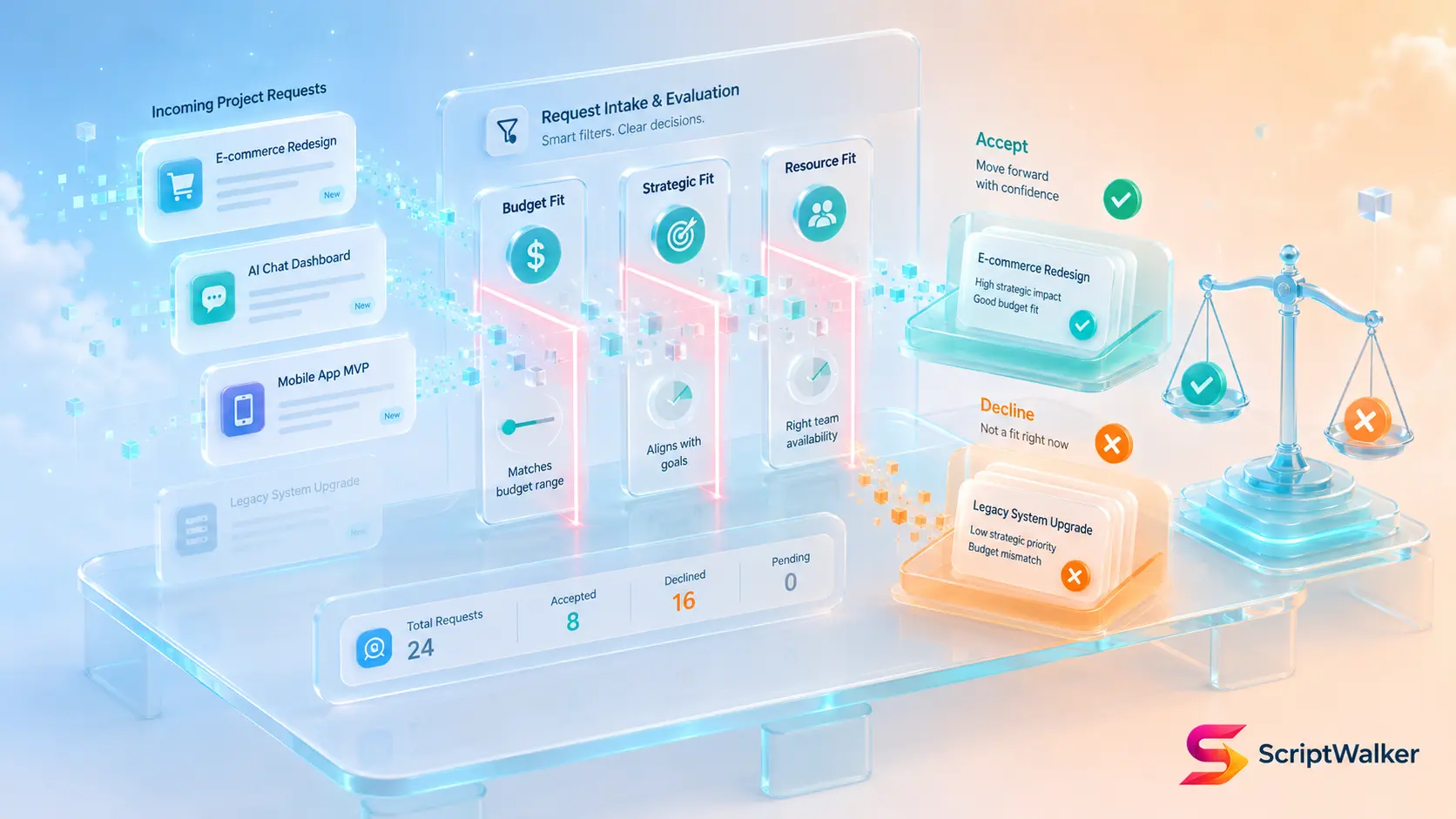
"Budget NT$150k, want an e-commerce site like Shopee, live in three weeks." We declined that inquiry. Not because we look down on small budgets, but because three red lines hide in it that would drag both sides under. A responsible agency's value isn't only in what it takes on — it's in what it dares to refuse. This piece lays out the four kinds of projects we've turned down over five years, because what a studio declines tells you more about its professionalism than what it accepts.
Breaking industry myths
- Myth 1: "Hire cheap first, switch if it fails." Truth: the hidden cost of switching (handover, refactor, re-understanding requirements) is usually 1.5–2x the original. The cheap first leg is often the most expensive.
- Myth 2: "We'll define requirements as we go." Truth: a project with no written scope is a breeding ground for scope creep. PMI research has long shown poor change management is a leading cause of project failure.
- Myth 3: "A vendor should revise infinitely until I'm happy." Truth: with no defined acceptance criteria, there's no finish line. Healthy engagements write revision rounds into the contract.
Core framework: the "three red lines" decision tree
We decide with three yes/no questions:
- Red line 1 - expectation gap: is the budget-vs-expectation gap over 3x? (e.g., NT$150k for a Shopee) → yes, run expectation alignment first; without it, decline.
- Red line 2 - decision black hole: is there a single decision-maker? If decisions must pass five people who can each veto → yes, decline or move to advisory.
- Red line 3 - integrity signals: is the client haggling from the start, demanding "build first, pay later," or disparaging the previous vendor? → yes, high odds of a repeat — decline.
Three typical scenarios
| Client type | Conclusion after red lines | Our recommendation |
|---|---|---|
| Startup, small budget but realistic expectations | Accept (scope down to MVP) | Build core first, expand in phases |
| Mid-size, decisions cross many layers | Cautiously accept (advisory + hands-on) | Start with process advisory, clarify decisions before building |
| Budget vs expectation gap over 3x | Decline (or heavily align) | Honestly explain real cost, offer alternatives |
Hidden cost of taking a bad project
- Opportunity cost: one draining bad project crowds out service time for 2–3 healthy clients.
- Infinite-revision cost: projects with no defined acceptance often blow 50%–100% past the quoted hours.
- Emotional and reputation cost: projects that can't align often end in negative reviews — the damage outlasts the revenue.
- Collections cost: clients with weak integrity signals often delay final payment; chasing it is invisible labor.
KPI scorecard for evaluating a vendor (reverse: how to pick people like us)
- ☐ Is the quote itemized rather than one vague total?
- ☐ Do they proactively ask "what we won't do" to clarify scope boundaries?
- ☐ Do they provide a written contract and acceptance criteria?
- ☐ Do they dare say "you don't need this"?
- ☐ Do they have verifiable past cases or clients?
- ☐ Do they specify warranty scope and response time?
- ☐ Do they honestly disclose technical limits and risks?
- ☐ Is communication punctual and well-documented?
If a vendor scores under five of eight, compare one more.
ScriptWalker's models + when we're not a fit
We offer four models: one-off project, monthly retainer, digital-process advisory, and long-term integrated outsourcing. But we're not a fit for clients who:
- treat outsourcing as a price to grind to the bone, not a partnership.
- need 24/7 mission-critical ops standby (use a dedicated MSP).
- have fully undefined requirements yet demand a fixed price without planning.
- expect "pay once, free maintenance for life."
Kickoff playbook (how a healthy engagement starts)
- Month 1: requirement interviews + written scope + itemized quote; both sides sign off on "what's in, what's out."
- Months 2–3: phased delivery, accept each phase before the next — no big-bang.
- Day-90 review: review deliverables and KPIs, decide whether to move to a retainer or the next project.
Decision checklist (should you take this engagement?)
- ☐ Is the budget-expectation gap reasonable?
- ☐ Is there a single decision-maker?
- ☐ Is scope defined in writing?
- ☐ Are payment terms clear (including final payment)?
- ☐ Do both sides agree on the definition of "done"?
- ☐ Are there no obvious integrity warnings?
FAQ
Aren't you afraid of losing business by declining?
Declining bad projects keeps time for good clients. A draining project crowds out more service capacity than the revenue it brings. Long term, studios that say no survive longer and earn more trust.
My budget really is small — will I always be declined?
No. Small budget with realistic expectations? We scope down to an MVP and expand in phases. What gets declined is "budget far below expectations and unwilling to align," not "small budget."
How do I tell if a vendor is professional?
See whether they dare to decline, whether they'll say "you don't need this," whether the quote is itemized, and whether there are written acceptance criteria. Score them with the KPI card above.
My requirements aren't clear — can I still come to you?
Yes, but start with "process advisory" rather than asking for a fixed quote. Spend 3–5 days clarifying requirements and priorities so the build doesn't get redone repeatedly.
Call to action
Want to know which category your project falls into under our red lines, or need a free 30-minute requirement clarification? Get in touch:
- Email: [email protected]
- Phone: 0916-224-047
- LINE: @ufv9089p