AI & Automation

Gemini Spark Goes Public: Google Just Put A 24/7 Agentic AI On Cloud VMs, And It Talks To Your Site Through WebMCP

2026.05.22 · 113 views
Gemini Spark Goes Public: Google Just Put A 24/7 Agentic AI On Cloud VMs, And It Talks To Your Site Through WebMCP

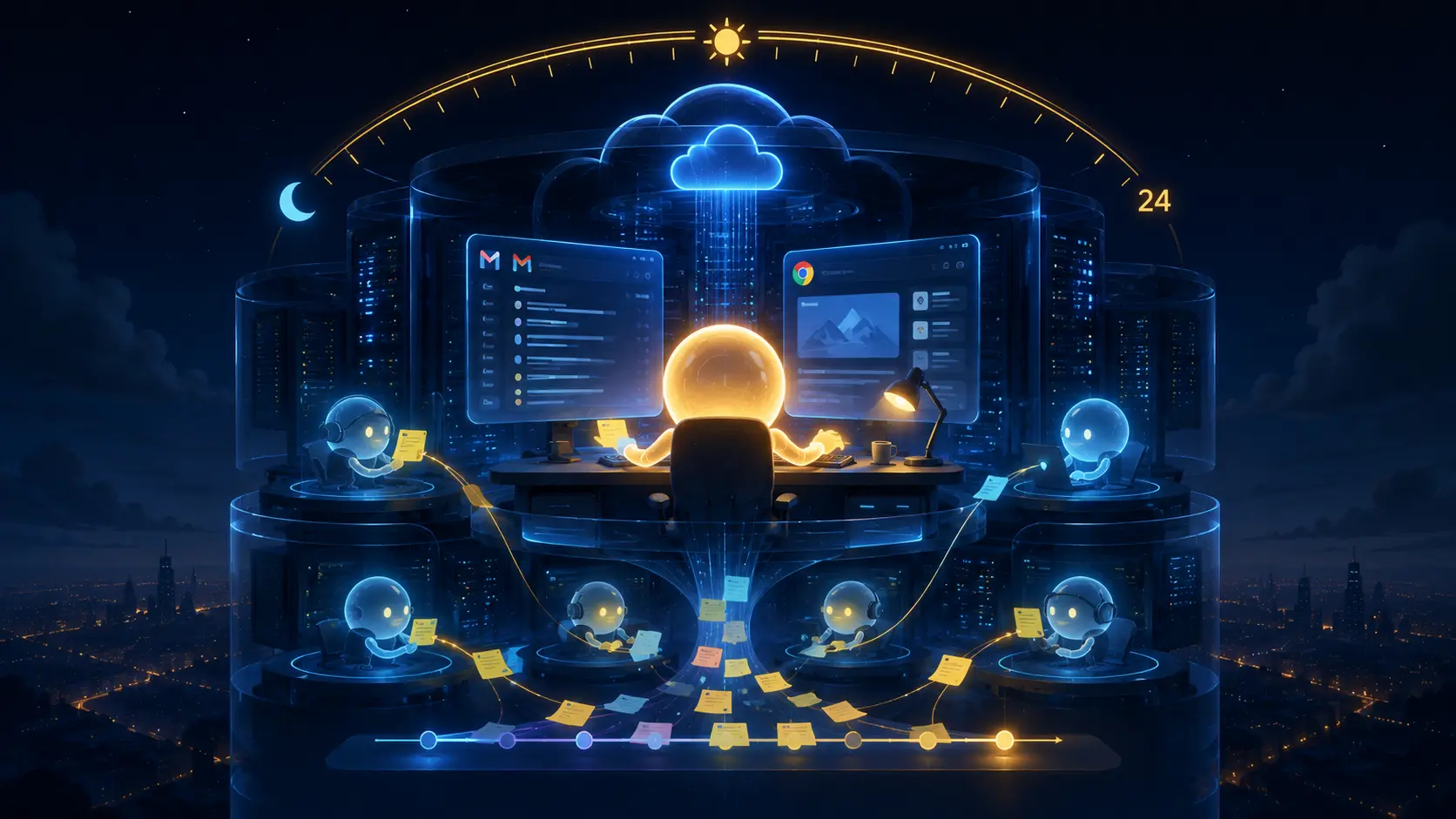
Spark is built on Gemini 3.5, runs on its own Google Cloud VM, takes tasks via Gmail, browses through Chrome, and persists across days. The interesting question for SEO, AEO, and digital agencies is: when an AI agent is the user, what does your "traffic" look like?

Google formally launched Gemini Spark at Google I/O 2026, with a beta opening next week for US AI Ultra subscribers and a wider summer rollout. The numbers around the product are striking — a 24/7 always-on agent, executing on its own cloud VM, harnessed by an internal framework called Antigravity, capable of taking tasks via email and acting through Chrome over multi-day timeframes — but the strategic story matters more than the spec sheet. For the first time, a major-platform AI agent is being shipped as something users delegate work to for hours and days, not minutes. That shape changes how content, search, and digital marketing all work.


1. What Spark Actually Does


Spark is a personal AI agent that lives in the Gemini app and is reachable via Gmail. You email Spark a task — "find me three flights to Tokyo under $900 next month and put them on hold" — and it runs the task in the background on a Google Cloud VM. It uses Chrome to browse, WebMCP to talk to sites that have declared tools, and Gemini 3.5 as its reasoning core. It comes back to you with a structured answer hours or days later. It can also create custom sub-agents, accept instructions over text or voice, and (in the summer release) operate as the user's primary browser session.


The piece that gets less attention: Spark is the first widely-deployed agent that does meaningful work while you are not at your computer. Past assistants were synchronous — you ask, it responds, the session ends. Spark is asynchronous and persistent, and that one architectural change is what makes everything else interesting.


2. Why The Cloud VM Architecture Matters


Spark's execution environment is a dedicated Google Cloud VM per user, not a shared inference server. That sounds like an implementation detail; it is not. A dedicated VM means Spark can have its own browser state, its own credentials (with user permission), its own filesystem to download spreadsheets into, and its own clock that keeps running while the user is offline. The agent does not have to start from scratch on every interaction. The cost of running this for millions of users is also enormous, and the only reason Google can ship it is the same Colossus 1-scale compute story that landed at Anthropic's London event the same week. The compute scarcity that capped agentic AI in 2024–2025 has effectively been resolved for the platforms that can pay for it.


3. What This Means For Search Traffic


Three concrete shifts that will land on your analytics dashboard in the next ninety days.


First, "agent traffic" becomes a real channel. Spark, Claude's managed agents, Perplexity Comet, and the OpenAI operator-style tools all show up as Chrome browser sessions, but with non-human dwell-time patterns and a strong correlation between visits and high-value conversions. Sites that segment this traffic in GA4 with a custom channel grouping will know what they are looking at; sites that do not will keep calling it "Direct" and undervaluing the most valuable visitors they have.


Second, the click economics of search change. When the user delegates a research task to Spark, the agent visits five or six sites instead of the user clicking on one. The sites that win the agent's selection do not necessarily win the user's attention — but they do win the citation, and the citation is what shows up in the structured answer. AEO and GEO stop being "alternative SEO" and start being primary SEO, because the agent is now the search session.


Third, conversion rates on agent-driven sessions are running materially higher than human-driven sessions on the same site. The reason is mundane — when Spark visits, it has already decided to perform the action. The agent is at the bottom of the funnel by the time it touches the page. The implication for marketers: shift attribution credit from "first-touch human" to "agent-selected" sources, because the agent did most of the qualifying.


4. What To Build This Quarter


The build list for an agency or in-house growth team:


  1. A WebMCP tool surface. This is now table stakes. Spark prefers WebMCP-enabled sites by design; not having a tool surface is choosing not to be in the agent's consideration set.
  2. A clean, structured "answer block" page for every major product or service. 250–400 words, schema.org-rich, FAQ-formatted. This is what the agent quotes back to the user, and the quote becomes the citation.
  3. A custom GA4 channel grouping that classifies likely agent traffic. User-agent contains "GoogleOther" or "Spark," referrer empty, dwell time atypical, conversion rate elevated. Send this segment to its own funnel report.
  4. A monthly review of "which agents are citing us" for every content surface. This is the new analog of monthly rank tracking. Spark, ChatGPT, Claude, Perplexity, Gemini, and Copilot all surface different content in different intents; you cannot win them all but you need to know which one you are winning.

5. The Compounding Effect Of Agent Memory


The detail that will most surprise marketers six months from now is that Spark remembers. When Spark finds a site useful for one task on Monday, the user's Spark increases the probability of revisiting that site for similar tasks on Tuesday and the following month. The agent has effectively built a personal SEO ranking based on actual task-completion success on that user's behalf. Sites that satisfy the agent on the first task get compounding returns. Sites that frustrate the agent — broken forms, missing schema, slow responses — get quietly dropped from the consideration set, and there is no SEO console that tells you you have been dropped.


This is what makes agent-readiness urgent. The work you do this quarter to be agent-friendly compounds; the work you do not do this quarter compounds in the opposite direction.


6. What Spark Cannot Yet Do (And What It Will Do By Q4)


Today's Spark is US-only, AI Ultra-only, and limited to roughly six tool categories (travel, shopping, research, scheduling, communications, finance read-only). It cannot yet move money without explicit per-transaction approval. It cannot yet operate in regulated workflows like healthcare or legal. The summer roadmap published this week adds a macOS desktop client, custom sub-agents, voice input, and the ability to act as the primary Chrome session — meaning Spark will be visible as the actual browser the user is "using" by Q3.


By Q4 2026, the realistic prediction is that Spark, Claude's Managed Agents, and at least two competitor stacks will be doing five-plus percent of all consumer browsing sessions on the public web. That is a market structural shift in two quarters.


My Take


The 2025 conversation about AI agents was largely speculative — "what would it look like if agents really did the work?" The 2026 conversation is observational — "okay, they really do the work, what does that mean for our funnel?" Spark is the most prominent, most production-ready answer yet. The shops that win the next year are the ones that treat their website as a tool catalog rather than a brochure: clean WebMCP surfaces, structured answer blocks, reliable APIs, fast responses, and explicit confirmation steps for anything irreversible. The shops that treat their website as a destination — hero image, marketing copy, contact form — will keep getting traffic, but the traffic will be lower-intent, lower-conversion, and quietly shrinking.


The agency-relevant version of this in one sentence: stop selling "we'll build you a website" and start selling "we'll build you a website that AI agents will choose to use." The price tag is the same; the buyer in 2026 already knows the difference.


Sources


AI & Automation Back to Blog