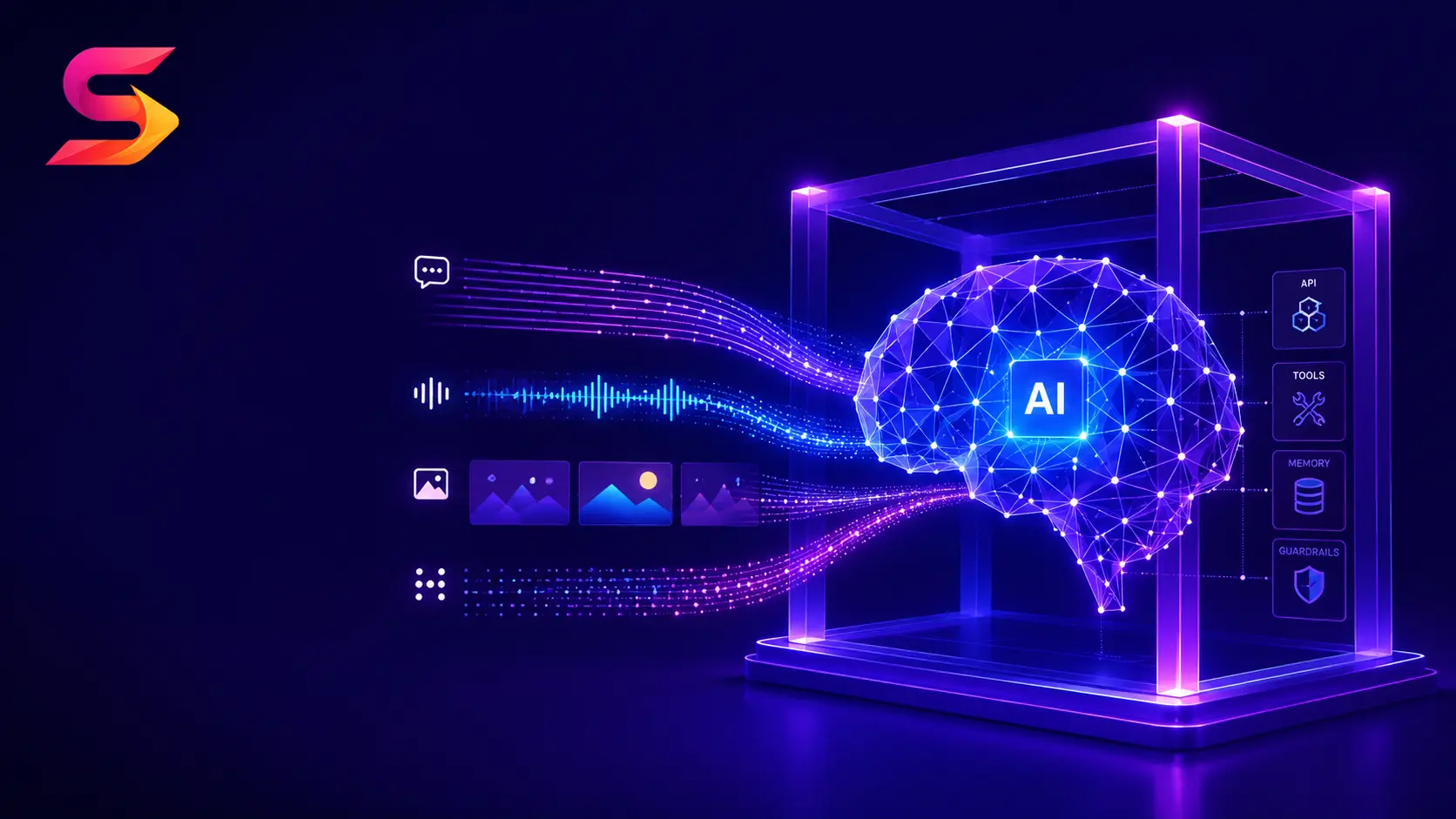
For the past two years, doing AI in web apps mostly meant installing a package and wiring up an API. Laravel 13 (released March 17, 2026; latest as of May is 13.11.2) does something more fundamental: it makes AI a first-class citizen of the framework itself. Laravel 13 ships a first-party Laravel AI SDK, a unified API spanning text generation, tool-calling agents, embeddings, audio, images and vector-store integrations. It also requires PHP 8.3 and drops older compatibility layers. For most existing projects, this is a low-cost-to-upgrade, high-capability-gain release.
1. Why this matters: the location of AI changed
The significance is not that Laravel gained some magic. It is that the location of AI capability has changed. When the official framework pulls agents, embeddings and vector stores into the core, developers no longer have to pick, assemble and individually manage keys and retry logic across a dozen third-party packages. Standardisation triggers two chain reactions: the barrier to adding AI features drops sharply, and the ecosystem converges around the official API, so tutorials, examples and best practices become far more consistent.
2. Not a solo move
This is not Laravel acting alone. At the same time, Flutter 3.44 built Agentic Hot Reload into the development loop, strengthening AI agent support in tools like Gemini CLI and Antigravity. In the front-end world, Frontend Nation 2026 (June 3 to 4, online and free) put AI alongside every major framework as a headline theme. Add the Laravel Cloud update due to be revealed on June 10 (widely expected to include a $5 plan, spend caps and faster scale-to-zero), and the signal is clear: in 2026, mainstream frameworks no longer treat AI as an optional plugin, but as default infrastructure.
3. What it means for enterprise automation
When call a model, do tool calls, retrieve from a vector knowledge base becomes a standard framework action, the engineering cost of wiring AI into support flows, document processing, internal queries and report generation drops noticeably. An integration that used to take two weeks might take two days.
My Take
I think framework-native AI will be one of the most underrated turning points of 2026, because what developers adopt is decided by the path of least resistance. But two risks. First, lock-in: binding agents and vector retrieval into the framework is convenient, but the flexibility to swap model providers, control cost and govern data must be designed in from the start. Second, can do is not should do: the framework lowers the barrier, which makes product judgement more important, because bolting AI onto a feature often just adds latency and cost. My advice is to nail one or two genuinely time-saving flows first, let the numbers speak, and then decide whether to expand.
Sources
- Release Notes | Laravel 13.x — Laravel Docs
- Laravel 13 Release Date, Features & What's New (2026) — Pegotec
- Frontend Nation 2026 Returns June 3-4 — Laravel News
- Laravel Cloud — Official site