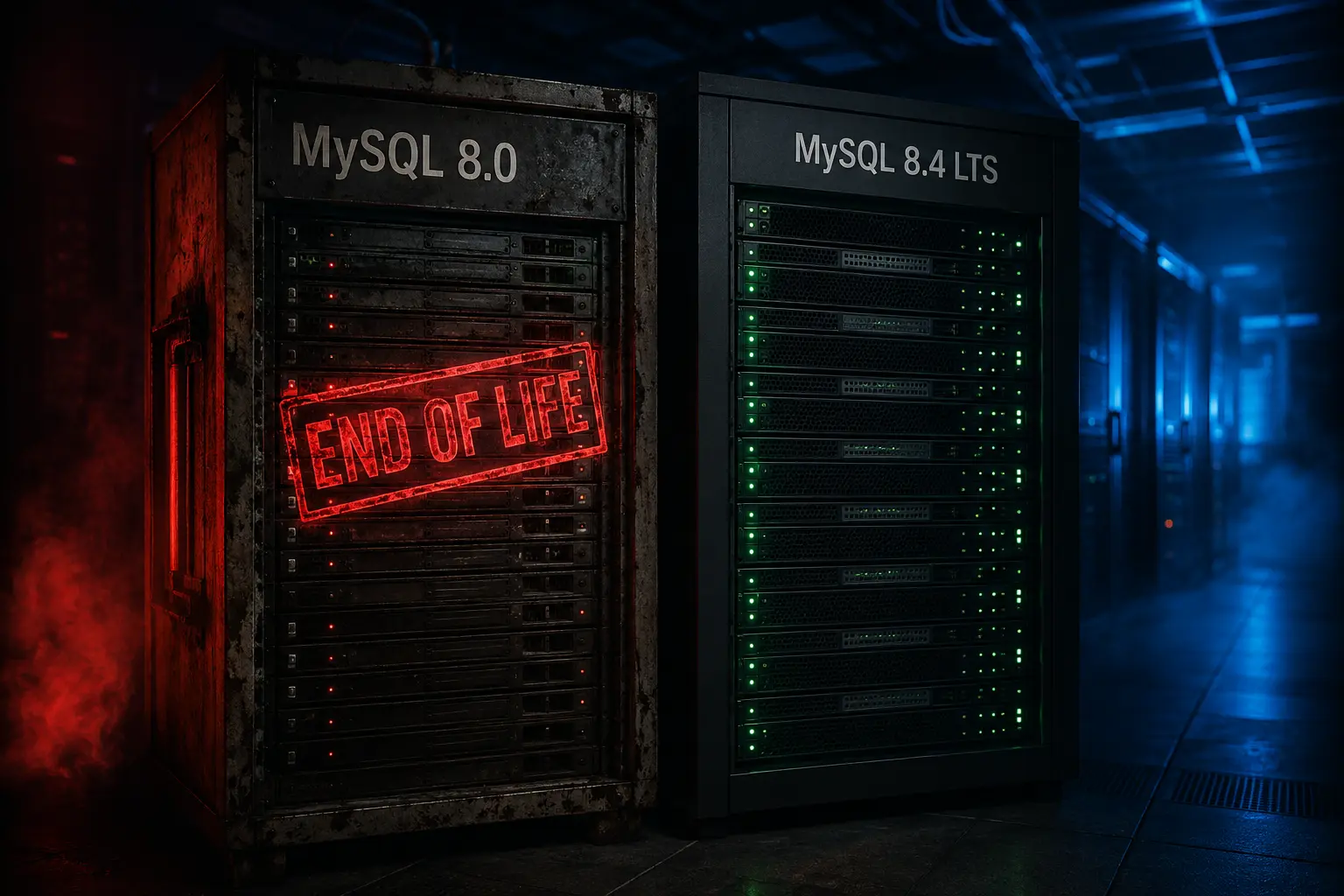
In the spring of 2026, the most talked-about database news isn't a flashy new feature — it's an obituary. MySQL 8.0 reached End of Life in April 2026 with version 8.0.46, and the May ecosystem buzz has been engineers staring at their server dashboards realising they are still on it. Oracle is no longer shipping security patches, bug fixes, or compatibility updates for 8.0. Every CVE filed against MySQL going forward is, for 8.0 users, permanent.
That matters for one specific community more than anyone else: PHP and Laravel shops. The default LAMP/LEMP stack that the entire small-and-mid-market web ran on for the last five years sits on MySQL 8.0. Magento merchants, WordPress publishers, Laravel SaaS founders — most of them have not migrated. The Atlas team's May 5 post and Percona's EOL guide both confirm what consultants are seeing in the wild: a large share of production workloads is still on 8.0, and ops teams are only now waking up to the deadline.
1. Why the Upgrade Is Actually Easy — and Why It Still Fails
MySQL 8.4 LTS is supported with patches through April 2032, six clean years of stability. The headline performance story is the InnoDB rework: tighter buffer-pool management, faster transactional throughput on demanding read/write workloads, and automatic histogram refreshing every time ANALYZE TABLE runs. For most Laravel apps this is a free 10–20% latency improvement on the busiest queries with zero code change.
But MySQL 8.4 also flips two defaults that bite tutorial-grade installs hard. First, the mysql_native_password plugin is disabled by default. Older PHP/PDO drivers, legacy .env files, and apps that hard-coded caching_sha2_password = OFF will fail to connect. Second, weak ciphers (RC4, 3DES, SSLv3) have been completely removed. Internal apps that talked to MySQL over TLS with ancient libraries silently break.
Replication users get a real upgrade too — Tagged GTIDs let you mark groups of transactions in multi-source replication, which is finally a sane way to do cross-region writes. Magento merchants in particular need to test thoroughly: order tables, EAV joins, and the catalog price index behave differently under 8.4's optimizer.
2. What Laravel Shops Should Do This Week
Run php artisan db:show against staging on 8.4. Watch for caching_sha2_password warnings in your driver. If you use Forge or Ploi, both already offer 8.4 LTS as a one-click. If you self-host on bare Nginx + PHP-FPM + MySQL, the safe sequence is: stand up an 8.4 replica, run your full test suite against it for two weeks, then promote during a low-traffic window. Never do an in-place upgrade on prod without a tested rollback.
For Magento merchants, MGT Commerce and Adobe's own April guidance is blunter — you must upgrade before peak season, because Adobe will eventually pin Magento 2.4.8 LTS to MySQL 8.4 and refuse to certify older databases.
3. Why Percona's Extended Support Is a Trap (For Most)
Percona is offering post-EOL support for MySQL 8.0 — back-ported security patches, basically. It is genuinely useful for organizations with regulated systems that physically can't move this quarter (banks, hospitals, defense contractors). For the rest of us — agencies, SaaS startups, e-commerce SMBs — paying a third party to keep an EOL database alive is the wrong economics. You will spend more in twelve months of extended support than the actual upgrade engineering would cost.
My Take
The MySQL 8.0 EOL is the single most under-discussed engineering risk in the PHP world right now. Everyone is talking about Laravel 13's AI SDK and FrankenPHP worker mode. Meanwhile, the database underneath those shiny new features has stopped receiving patches, and most teams haven't noticed.
If I am running a small agency in May 2026, my client communication for this week is one paragraph: "Your MySQL is end-of-life. Here is what unpatched means. Here is our migration estimate. Here are three dates we can do it." Sell the upgrade as risk management, not as an exciting technical project, because it isn't exciting — it is hygiene. The agencies that bill this work in May and June will be the ones that don't get an angry phone call in August when a CVE drops on 8.0 and there is no patch coming.
Sources
- MySQL 8.0 End of Life: Plan Your Move Before Support Runs Out — Atlas
- MySQL 8.0 EOL April 2026: Complete Upgrade Guide to MySQL 8.4 LTS — JusDB
- MySQL 8.0 EOL: Upgrade to 8.4 or Get Post-EOL Support — Percona
- MySQL 8.0 End of Life: The Magento Store Upgrade Guide for April 2026 — MGT Commerce
- MySQL release lifecycle — endoflife.date