Web Development

Native CSS Is Quietly Eating JavaScript — The Calmest Front-End Revolution of 2026

2026.06.04 · 39 views
Native CSS Is Quietly Eating JavaScript — The Calmest Front-End Revolution of 2026

Popovers, dialogs, scroll-driven animations, anchor positioning and container queries are landing in Baseline — and every line of JS you don't write is a maintenance debt you'll never owe

For over a decade, the unwritten rule of front-end was simple: if the browser can't do it natively, reach for JavaScript. Dropdowns needed JS. Modals needed JS. Pinning one element next to another needed JS. Scroll-triggered animations were JS's home turf. The result was projects buried under third-party packages, polyfills and hacks — heavier pages, harder maintenance. In 2026 that rule is being quietly rewritten, and not by some new framework, but by the browser itself.


You can't talk about CSS this year without one keyword: Baseline. Baseline is a cross-browser compatibility signal that tells you when a feature is ready across all major browsers and safe to ship to production. It turns the old "can I use this yet?" anxiety into a clear green light, dramatically lowering the cost of deciding.


What Native CSS Now Replaces


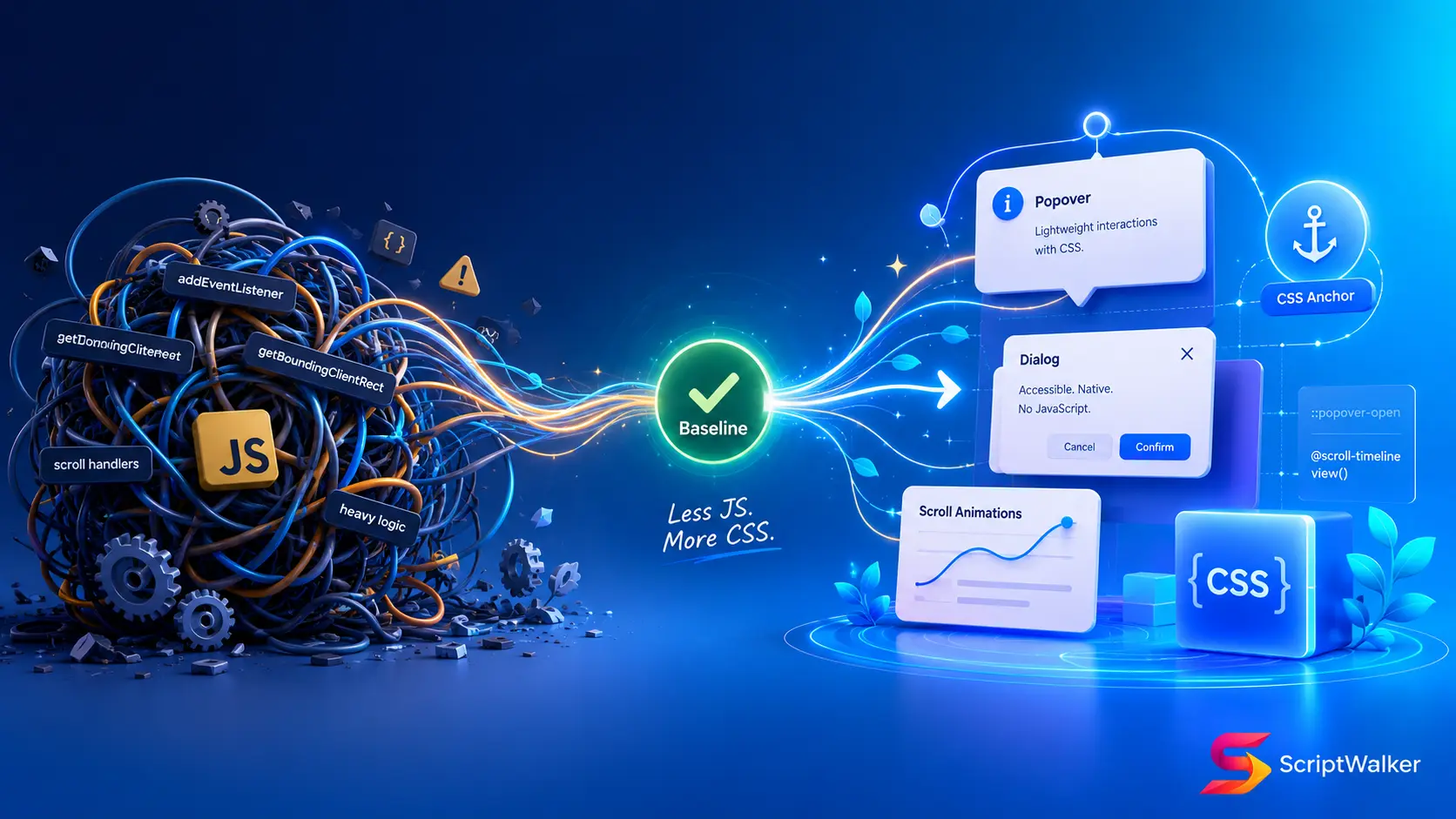
Behind that green light is a batch of capabilities that used to require JS and are now pure CSS / native HTML: the native Popover API and the dialog element make overlays and modals package-free; scroll-driven animations replace piles of scroll listeners; anchor positioning aligns tooltips and menus without JavaScript coordinate math; the :has() "parent selector" expresses interaction logic that used to mean manipulating the DOM; and container queries let a component adapt to its container's width instead of just the viewport.


Frameworks Hug the Platform


Tailwind CSS v4's new Oxide engine pushed build speeds several times faster, with incremental builds over a hundred times faster, and its philosophy increasingly lets utility classes work alongside native CSS rather than around it. Google's I/O 2026 likewise leaned into strengthening native browser capability. Front-end is slowly handing back to the browser the work it once outsourced to JavaScript.


My Take


I treat this wave as a chance to put a project on a diet, not a trend you must chase. For agencies and outsourcing teams, every chunk of JavaScript replaced by a native capability is one fewer package conflict, one fewer security patch, one less maintenance burden to hand over. My approach: first, on new projects use Baseline as the "can I use it" test and prefer native over a package; second, don't overhaul old projects, but swap in native equivalents whenever you refactor a component so debt decays naturally; third, sell clients "lighter, faster, cheaper to maintain," not jargon. As native capability grows, the teams that win treat "writing less code" as a craft.


Sources


Web Development Back to Blog