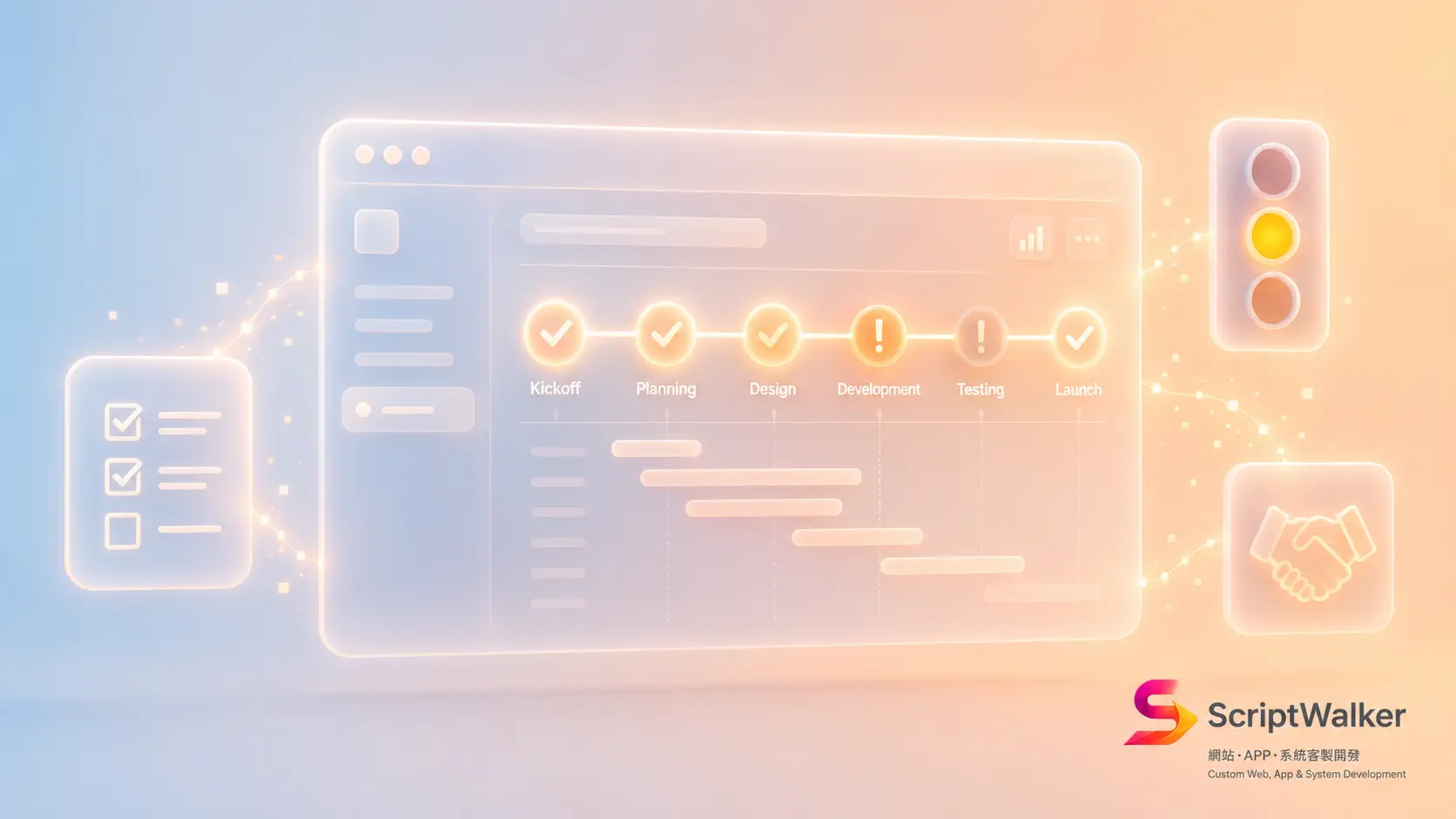
An NT$800k system project discovers in month 5 that "the two sides understood the acceptance criteria completely differently," drags on for half a year, and ends with both sides bruised. The common thread isn't that the tech was too hard — it's that "the warning signs appeared early, but no one called a stop." From an agency's perspective, this piece breaks down the five most common bad endings and the early signals each shows three months before launch — so whether you're the client or the vendor, you can pivot before the budget burns.
Industry myths, broken
- Myth 1: "Signing the contract makes it safe." Reality: a contract governs how you settle after things go wrong, not the gradual drift of expectations during the work. What truly prevents failure is a verifiable deliverable every two weeks, not contract thickness.
- Myth 2: "The more detailed the spec, the fewer errors." Reality: a hundred-page spec makes everyone "assume it's all agreed" without confirming a shared understanding line by line. A working prototype aligns expectations better than a spec.
- Myth 3: "If we're behind, add people to catch up." Reality: adding people to a project whose communication already misfires is often slower (Brooks's Law). The root cause is usually churn in requirements, not headcount.
- Myth 4: "The lowest quote is the best deal." Reality: a quote far below market usually means the vendor under-counted some work, and the gap returns later as "extras" or quality cuts.
Core framework: the failure early-warning scorecard
Every two weeks, score the project's "health" — the more hits, the more danger:
- ☐ Two consecutive milestones with "nothing verifiable to show" (only verbal "almost done")
- ☐ The same requirement changed 3+ times with no change log
- ☐ The key decision-maker never attends meetings; a relay answers for them
- ☐ Message replies went from "same day" to "3+ days"
- ☐ A growing "deal with it later" backlog
- ☐ The two sides can't state the same definition of "done"
0–1 hits: healthy; 2–3: yellow light, hold an alignment meeting; 4+: red light, stop work and clarify scope before continuing.
Three typical scenarios compared
- Early-stage startup (scope undefined): most prone to "requirement churn." Counter: validate with short-cycle, disposable prototypes; price monthly rather than one fixed price.
- 50-person traditional firm (decision-maker too busy): most prone to "key person absent." Counter: contractually define a single decision window and reply deadline.
- Mature enterprise (rigid process): most prone to "everyone defines acceptance differently." Counter: write acceptance criteria as a checkable list and sign off line by line before kickoff.
The hidden cost list (the real price of a bad ending)
- Rework cost: a core requirement changed late in development often costs 3–5× the hours of confirming it early.
- Opportunity cost: a team stuck on a misfiring project forfeits income from other work in the same window.
- Trust-repair cost: after a failed engagement, rebuilding the relationship or finding a new vendor is usually measured in months.
- Data-migration cost: switching vendors mid-stream often adds 15–25% of the original project in handover and migration hours.
KPI scorecard for evaluating an outsourcing partner
When picking a vendor (or self-assessing), score each 1–5:
- Do they offer a "verifiable deliverable every two weeks" cadence?
- Is the quote itemized (rather than one lump sum)?
- Do they proactively list "not suitable / not recommended" parts?
- Is there a written change + re-quote process for requirement changes?
- Do they explain acceptance criteria and exit clauses?
- Is there a single contact window with a reply-time commitment?
- Do they guarantee post-launch maintenance and data portability?
- Are past cases backed by verifiable results?
A total < 24 (of 40) suggests renegotiating or switching.
ScriptWalker's matching options + when we're not a fit
We offer four engagement models: one-off Project, monthly Retainer, Advisory, and Full outsourcing. But we'll honestly say when we're "not a fit":
- Requirements wholly undefined while demanding a fixed total price and fixed deadline — a combination doomed to misfire.
- Clients who treat outsourcing as "the cheapest labor" and won't invest any alignment time.
- A "I say one sentence, you guess the other nine" working style.
- Scenarios needing 24/7 on-site staffing (we're a studio, not a staffing agency).
Transition / kickoff playbook
- Month 1: establish a single communication window, set a verifiable deliverable every two weeks, write acceptance criteria as a checkable list.
- Months 2–3: run the failure-warning scorecard every two weeks; hold an alignment meeting on 2+ hits.
- Day 90: review the scope-change log, re-estimate remaining hours and budget, decide to keep or adjust the engagement model.
Decision checklist
- ☐ Do we share one checkable definition of "done"?
- ☐ Is there a verifiable deliverable every two weeks?
- ☐ Is there a single decision window and reply deadline?
- ☐ Are requirement changes logged and re-quoted in writing?
- ☐ Is the quote itemized?
- ☐ Does the contract have exit and data-portability clauses?
- ☐ Do we run a health score regularly?
- ☐ When the warning goes red, will both sides stop to clarify?
FAQ
How do I tell an outsourced project is heading for failure?
The single most reliable signal is "two consecutive milestones with nothing verifiable to show." Healthy projects have something you can open and try every two weeks; when delivery becomes only verbal "almost done," plus requirement churn and an absent key person, that's a red light. Running this article's scorecard every two weeks works best.
Can adding people catch up when we're behind?
Usually not — it's often slower. New people need time to gain context and consume the existing team's communication (Brooks's Law). The root cause is usually requirement churn or unclear acceptance, which needs a stop-and-align, not more headcount.
Why is the lowest-quote vendor actually higher risk?
A quote far below market usually means under-counted work (testing, store submission, compatibility maintenance), and those gaps return as "extra quotes" or quality cuts. Compare itemized quotes, not the lump-sum number.
If we really must switch vendors mid-stream, what should we protect most?
Protect "data portability" and "handover docs." Confirm the contract has a data-portability clause and that source code and deployment docs are delivered clearly. Mid-stream handover and migration often add 15–25% of the original project in hours; agreeing upfront greatly reduces the loss.
Call to action
Want a project health check before the budget burns? ScriptWalker offers a free 30-minute consult, using the scorecard above to call your red/yellow/green light:
- Email: [email protected]
- Phone: 0916-224-047
- LINE: @ufv9089p