AI Industry Use Case

AI in SaaS and Software: 50-70% Support Deflection, Churn Early-Warning, and Feature-Request Clustering — The 4-9 Month Payback Priority

2026.07.09 · 30 views
AI in SaaS and Software: 50-70% Support Deflection, Churn Early-Warning, and Feature-Request Clustering — The 4-9 Month Payback Priority

Software firms sell tech but adopt it last internally. Benchmarks, five use cases, two anonymized cases, tool stack, an ROI model, and the traps that keep 73% of AI support stuck in pilots.

Share:

SaaS and software companies sell technology, yet are often the last to apply AI to their own operations. The pains are consistent: support tickets drowning a small team, onboarding friction causing churn, and discovering at renewal that a customer stopped using the product long ago. The numbers speak — in 2026, a well-implemented SaaS AI support system reaches 50-70% ticket deflection in the first 90 days, with AI resolutions averaging about US$0.62 versus about US$7.40 for a human agent (McKinsey 2026 sample). But the same data warns that only 27% of enterprises actually put AI support into production — most are stuck in pilots. This piece covers what SaaS/software firms should do first, how to compute payback, and which traps land you in that 73%.

3-5 Typical AI Use Cases

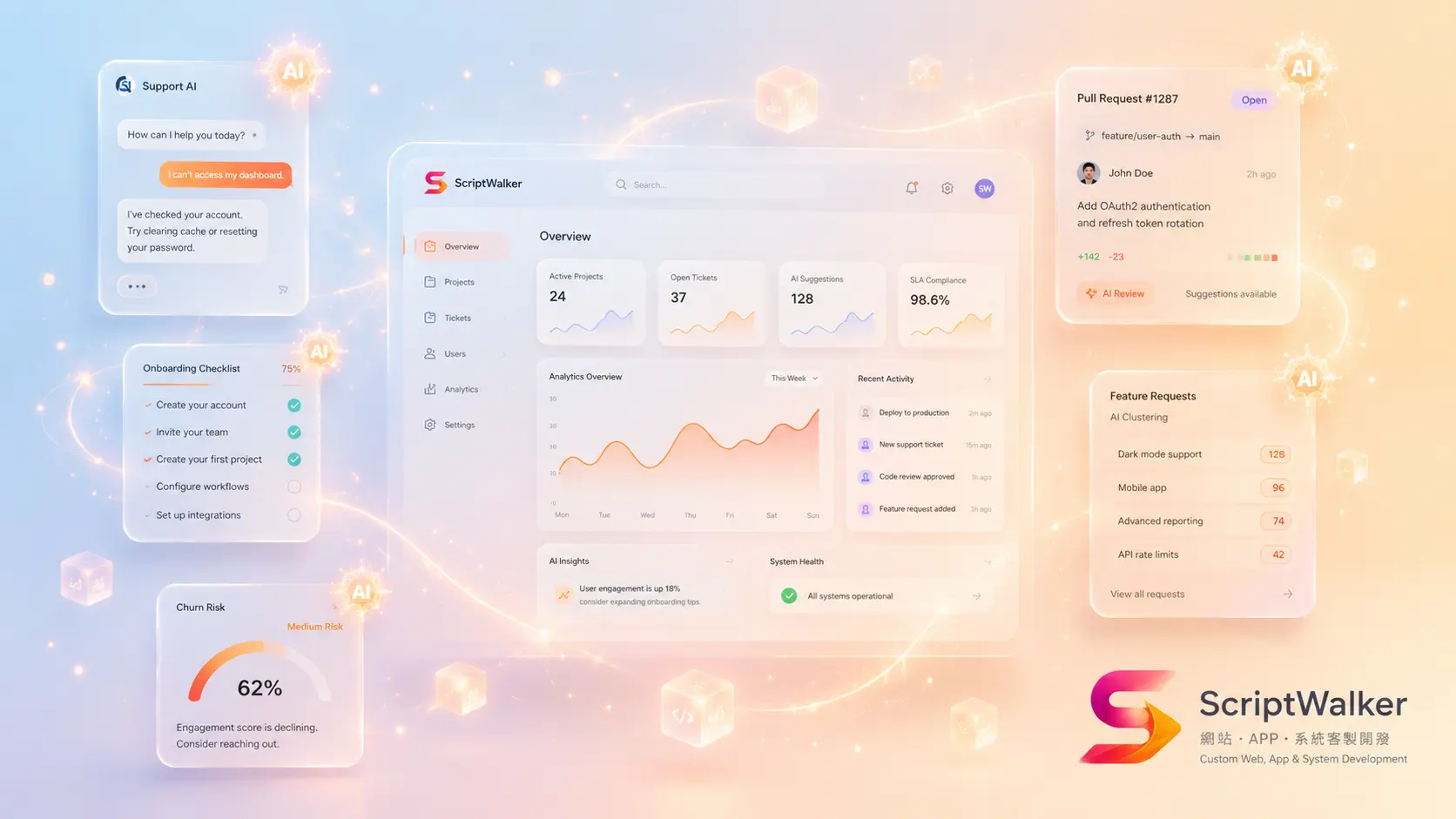
  • AI support knowledge base (KB bot): wire docs, ticket history, and FAQs into RAG so AI handles first-line, high-structure questions — password resets, accounts, how-tos.
  • Onboarding assistant: guide new users through key activation steps in-product to reduce friction churn.
  • Churn early warning: use behavior signals (login drop, features unused) to auto-flag at-risk customers for CSMs to intervene early.
  • Feature-request clustering: auto-categorize and de-duplicate requests scattered across tickets, email, and community so product sees the real priorities.
  • AI-assisted code review: a first pass on PRs for style and obvious errors so engineers focus on architecture.

Real Cases (Anonymized)

Company A, a 20-person B2B SaaS: support drowned in password, account, and how-to questions. After deploying a RAG KB bot, it handed roughly 60% of first-line tickets to AI self-service in the first three months, letting humans focus on complex cases — response time dropped without hiring another agent. Trap hit: they first treated "deflection rate" as the success metric, only later realizing the metric that matters is "true resolution," because a bot can end a ticket without solving it.

Company B, a 50-person dev-tools company: could never catch renewal churn early. Using behavior data, they built a churn early-warning that auto-flags accounts with "login drop in the last 30 days plus core features unused" to CSMs. In the first quarter they saved several customers who would have quietly churned. Trap hit: the model over-alerted at first, fatiguing CSMs — stabilizing meant raising the threshold to push only high-confidence alerts.

Recommended Tool Stack

  • Model layer: OpenAI API (cheap Terra/Luna-class models for classification and support) or Claude (long documents, coding).
  • Orchestration: LangChain or n8n to wire RAG flows and sources without reinventing the wheel.
  • Retrieval: a vector database (pgvector/Pinecone) for KB embeddings.
  • Rule: for support tasks, a cheap model plus good retrieval beats brute-forcing an expensive one — the cost gap can be tens of times.

ROI Model

  • Investment: KB bot build about NT$150,000-350,000 (KB cleanup, RAG wiring, testing); monthly ops including model API and hosting about NT$5,000-20,000/month for small setups.
  • Return: at 1,000 tickets/month and about US$25 each, 70% deflection saves about US$17,500/month (Fin 2026 benchmark); Taiwanese SMB SaaS is smaller, but the savings are mostly "not hiring another agent."
  • Payback: most SaaS support bots pay back in 4-9 months, driven by KB quality more than model strength.

Rollout Timeline

  • Phase 1 Assess (1-2 weeks): inventory ticket types and KB state, pick one high-structure scenario (e.g., password/account) first.
  • Phase 2 Build (3-5 weeks): clean the KB, wire RAG, set the human-escalation threshold.
  • Phase 3 Trial (2-4 weeks): go live on low traffic, evaluate by "true resolution" not "deflection," iterate prompts and knowledge.
  • Phase 4 Scale (ongoing): expand scenarios, add churn warning and other advanced uses, establish KB maintenance.

Common Failure Modes and How to Avoid Them

  • Old, messy KB: garbage in, garbage out. Clean the KB and remove stale content before the bot.
  • Watching deflection, not true resolution: 90% deflection can mean only 40% actually solved. Measure true resolution and satisfaction.
  • No human-escalation threshold: AI forcing complex cases enrages customers. Define exactly when to hand off to a human.
  • Churn warning over-alerting: CSMs fatigue and ignore it. Raise the confidence threshold and push only high-certainty alerts.
  • Piloting forever: set launch criteria and an owner so it does not stall in experiment mode.

Where AI Is Not a Fit

  • High-emotion support, refund disputes, contract conflicts — these need human empathy; forcing AI harms the brand.
  • Companies with essentially no KB and no near-term ability to build one — fix the docs first.
  • Very low ticket volume (single digits a day) — human handling is cheaper; the build cost will not pay back.

ScriptWalker's Offering

We offer "SaaS AI support and automation integration": from KB cleanup and RAG support bots to churn-warning rollout, with a single-scenario POC to validate true resolution before scaling. KB bot projects start at NT$150,000, including KB inventory and escalation-threshold design.

FAQ

Will an AI support bot hurt customer experience?

It comes down to threshold design. Hand high-structure questions to AI and escalate complex, high-emotion cases to humans immediately, and experience improves; forcing AI on everything is what hurts.

Should I use an expensive model or a cheap one?

For support, a cheap model plus good retrieval is usually enough, with a cost gap of tens of times. Spend on KB quality rather than a pricier model.

Does a high deflection rate mean success?

Not necessarily. Deflection measures whether a ticket ended; true resolution measures whether the problem was solved. Judge by true resolution and satisfaction.

How soon is payback?

Most SaaS support bots pay back in 4-9 months, depending on ticket volume and KB quality, not model strength.

Decision Checklist + Call to Action

  • ☐ Are over half my first-line tickets repetitive, high-structure questions?
  • ☐ Do I have a usable, not-too-stale knowledge base?
  • ☐ Can I tell "deflection" from "true resolution"?
  • ☐ Do I have a clear human-escalation threshold?
  • ☐ Do I have early behavior signals for churn?
  • ☐ Do I plan to pilot only, or go to production?
  • ☐ Am I willing to start with a single-scenario POC?
  • ☐ Do I have someone to maintain the KB?

Want to assess which AI scenario your SaaS should tackle first? Contact ScriptWalker for a free consultation:

Share:
AI Industry Use Case Back to Blog