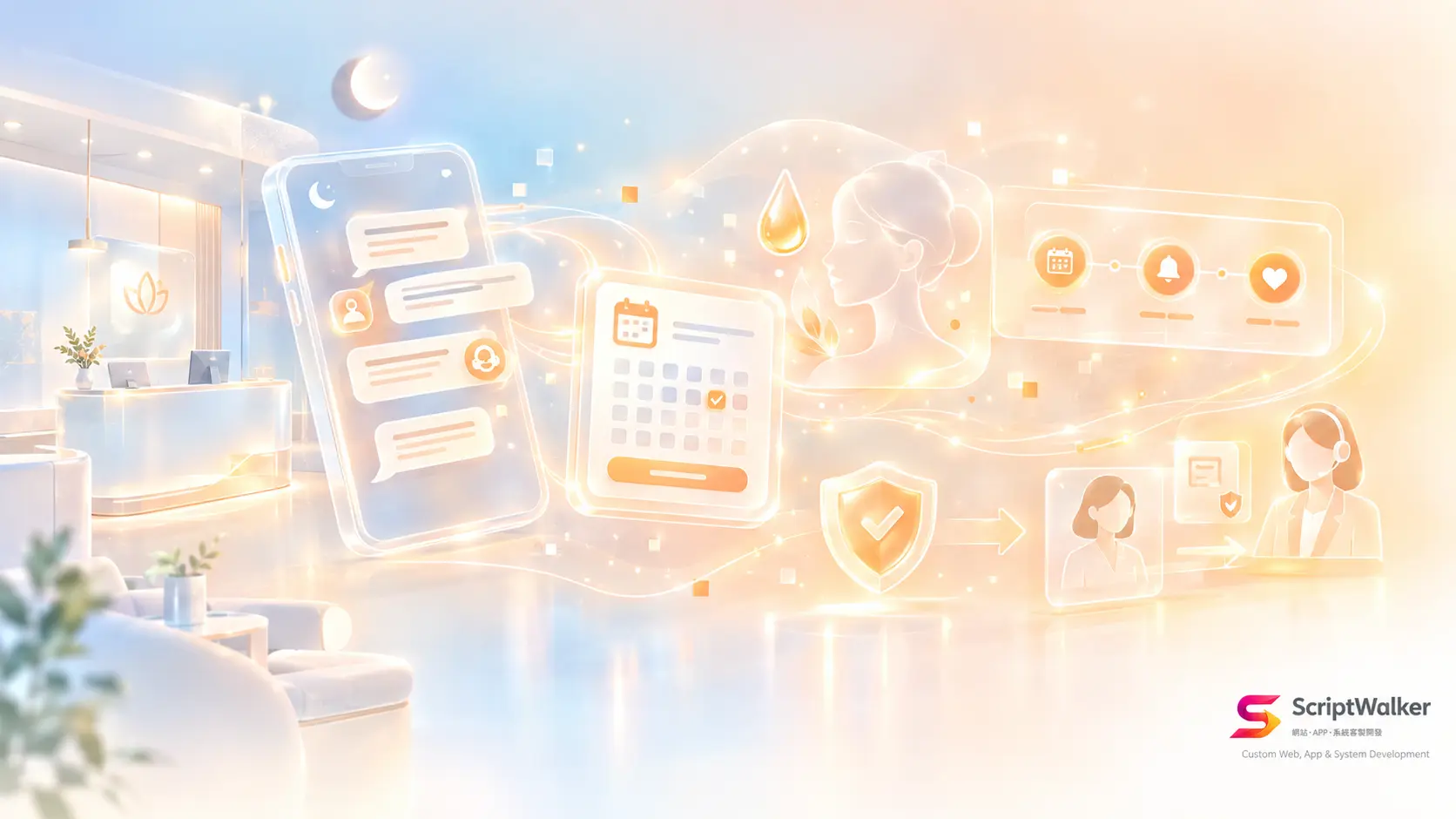
Short answer: An aesthetic clinic's first AI projects should be LINE inquiry pre-screening plus booking, and post-treatment aftercare reminders, not anything that touches diagnosis. For a clinic with 2–3 doctors, expect about NT$250k–450k to build and roughly NT$10k a month to run, with payback in 6–9 months, provided the AI answers only whitelisted content and every question about results or suitability goes to a human.
Industry snapshot
Aesthetics combines high inquiry volume, a long conversion path and strict regulation, so AI is most valuable before and after the doctor's consultation. The American Med Spa Association reports the US medical spa industry has passed $17 billion in annual revenue, growing by more than $1 billion a year. Taiwanese clinics share the same pain: LINE inquiries surge after 9 p.m., consultants reply the next day after the client has already asked three competitors, and aftercare calls depend on someone remembering to make them.
Four typical AI use cases
Start with the four use cases that involve no medical judgment yet directly affect revenue and return visits.
- LINE pre-screening and booking: answer price ranges, treatment steps, parking and hours, collect needs, then hand off to a consultant with a time slot booked.
- Aftercare and follow-up reminders: send care instructions and follow-up reminders on days 1, 7 and 30, escalating any reported problem to a nurse immediately.
- Consultation summaries: transcribe consultation audio into key points so the doctor grasps the client's goals in one minute.
- Ad-copy compliance pre-checks: against the advertising limits of Article 85 of Taiwan's Medical Care Act, flag high-risk words like "guaranteed" or "most effective" before human review.
Cases (anonymized composites)
The two cases below are compiled from common rollout scenarios and anonymized; the point is the process and the pitfalls.
Clinic A (Greater Taipei, two branches)
Overnight AI pre-screening on LINE cut first-response time from about 4 hours to under a minute and lifted inquiry-to-booking conversion from about 18% to 24%. The pitfall: in week one the AI replied that "results last two years", which a consulting manager caught; afterwards it could only choose from whitelisted answers, and all questions about results went to a human.
Clinic B (central Taiwan, dermatology and aesthetics, three doctors)
Automating aftercare schedules raised return-visit rates by about 10 percentage points and cut post-treatment complaint calls by a third. The pitfall: clients first uploaded aftercare photos straight into LINE, scattering them across chat histories; uploads moved to an access-controlled back end with a retention period.
Recommended tool stack
Mature components are enough; what matters is keeping data in the clinic's own back end.
| Purpose | Tool | Why |
|---|---|---|
| Conversation channel | LINE Messaging API | Main inquiry channel for Taiwanese clients |
| Language model | OpenAI or Claude API | Reliable whitelist Q&A and summaries |
| Workflow automation | n8n (self-hostable) | Aftercare schedules and hand-off alerts without data leaving your server |
| Back end and permissions | Custom Laravel back end | Tiered access and audit logs for photos and health-related data |
ROI model
For a clinic with 400 inquiries a month and two consultants, the monthly benefit is about NT$69k, paying back in roughly six months.
- Investment: NT$350k to build; about NT$10k a month (LINE Official Account plan, model API, hosting).
- Hours saved: 2 hours per consultant per day × 2 consultants × 22 days = 88 hours, about NT$26k at NT$300 an hour.
- Conversion lift: booking conversion 18% → 24% means 24 more visits a month; at 30% close rate, NT$15,000 average ticket and 40% margin, about NT$43k.
- Payback: (NT$26k + NT$43k − NT$10k) ≈ NT$59k a month; NT$350k ÷ NT$59k ≈ 6 months, or about 9 months if the conversion lift is halved.
Rollout timeline
From assessment to full launch takes about 4–5 months in four phases.
- Phase 1 | Assess (2 weeks): review three months of LINE inquiries and draft the top 50 FAQs with whitelisted answers.
- Phase 2 | Pilot (4 weeks): enable AI pre-screening only after 9 p.m., with daily spot checks by consultants.
- Phase 3 | Launch (4–6 weeks): enable all hours, add aftercare schedules and hand-off rules.
- Phase 4 | Expand (8 weeks): consultation summaries, ad-copy compliance checks and past-client segments.
Common failure modes and how to avoid them
Failures usually come from compliance and data, not model capability.
- AI promising results → allow only whitelisted answers; keywords about results or suitability route to a human automatically.
- Personal data leaks → aftercare photos are sensitive data under Article 6 of Taiwan's Personal Data Protection Act; store them in an access-controlled back end.
- Expired promotions → maintain whitelisted answers and promo prices in the back end, with automatic expiry.
- Consultant resistance → position AI as the "night-shift assistant" and keep sales credit with consultants.
Where AI does not belong
Anything requiring medical judgment or emotional handling should stay with people.
- Deciding whether a client suits a treatment or dosage
- Advice on post-treatment redness, pain or other complications
- Price negotiation and complaint disputes
- Small studios with fewer than 100 inquiries a month
ScriptWalker's offering
ScriptWalker (a Taiwan-based Laravel/Flutter custom development studio) offers AI Consultation and Aftercare Automation for Aesthetic Clinics starting at NT$250,000, including FAQ whitelist preparation, LINE pre-screening and booking, aftercare schedules, hand-off rules and a permission-controlled back end.
Frequently Asked Questions
Can a clinic let AI answer questions about treatment results?
Not recommended. Results and suitability involve medical judgment and advertising rules; AI should answer only whitelisted content and hand these questions to staff.
How much does an AI assistant for an aesthetic clinic cost?
For a 2–3 doctor clinic, about NT$250k–450k to build plus roughly NT$10k a month for the LINE plan, model API and hosting.
Can post-treatment photos be collected via LINE?
They can, but shouldn't stay in chat history. Health-related photos are sensitive personal data and belong in an access-controlled back end with retention limits.
Decision checklist and next step
If five or more apply, an adoption assessment is worthwhile.
- ☐ More than 300 LINE inquiries a month
- ☐ Over 30% of inquiries arrive after 9 p.m.
- ☐ First replies often take more than 2 hours
- ☐ Aftercare depends on staff memory
- ☐ Stable FAQs and price ranges exist
- ☐ Consultant turnover is high
- ☐ Someone can maintain whitelisted answers weekly
- ☐ You're willing to pilot overnight-only for 4 weeks
Bring a month of LINE inquiry logs (names masked) and in 30 minutes we'll estimate your payback period.
- Email: [email protected]
- Phone: 0916-224-047
- LINE: @ufv9089p