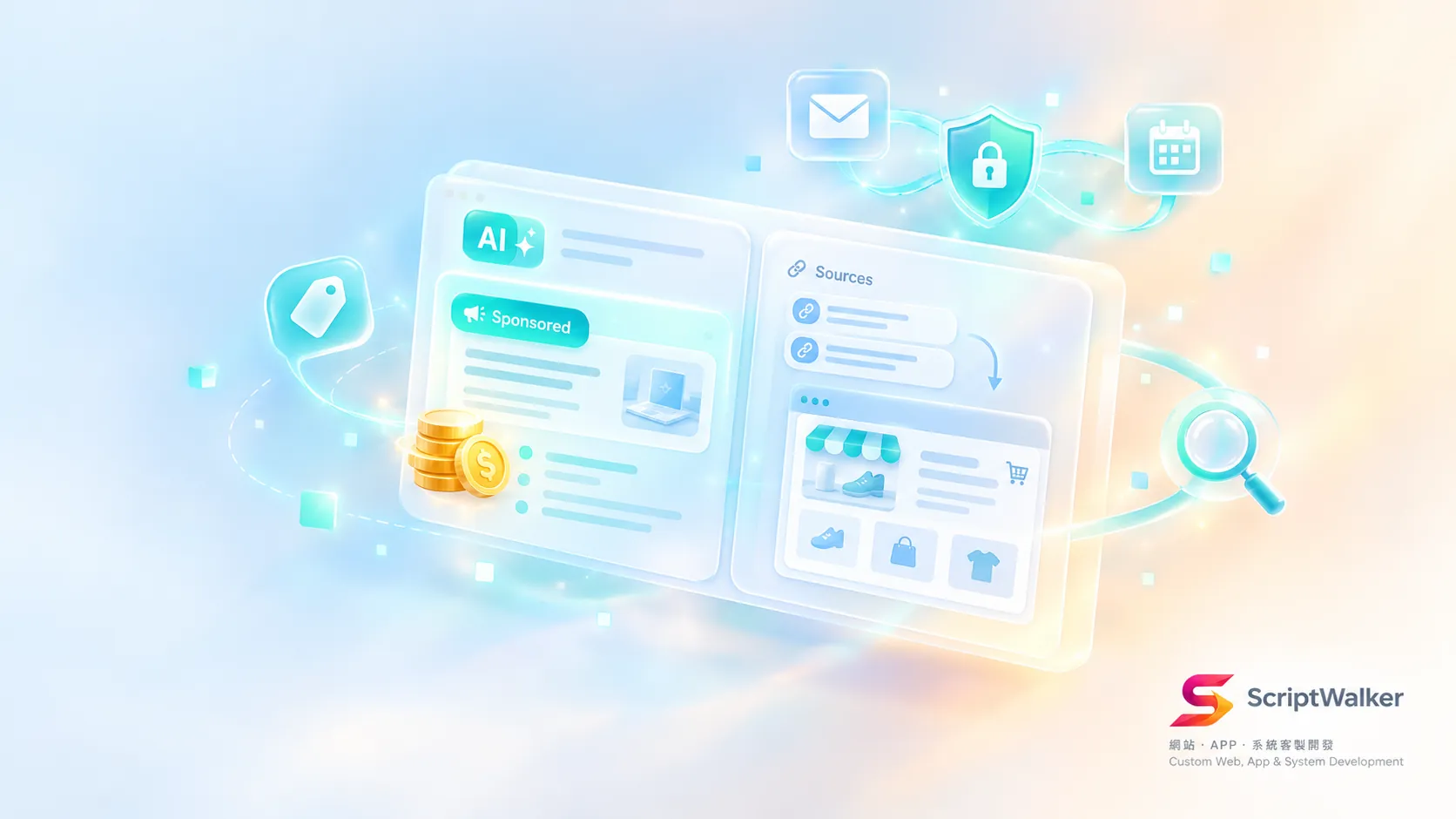
Short answer: Not yet. On October 16 Google began testing personalized ads in AI Mode that can draw on connected apps like Gmail, and ChatGPT now has about 60,000 advertisers. But a 50,032-keyword sample found roughly 88% of AI Mode advertisers were not cited in the AI answer, so small businesses should earn citations first and test ads with a small budget.
On October 16, Search Engine Land reported that Google has started testing ads in AI Mode for users who turned on Personal Intelligence. These users connect Gmail and Google Calendar to Search, and ads may now be personalized using summaries and inferences from that connected data; Google updated its privacy policy to match. The striking part is the timing: in March, Google said people who connect their apps "currently" see no ads. Seven months later, that changed. The same week, The Information reported that ChatGPT's advertiser count roughly tripled in about six weeks to around 60,000. AI answers are now ad inventory.
Why now? Google launched Personal Intelligence in January for US paid subscribers and expanded it to free US personal accounts in March. Regular ads in AI Mode were already live in tests: SE Ranking sampled 50,032 commercial keywords at the end of June and found ads on 29.45% of them, rising to 53.56% for keywords with CPCs of $10 or more. Search ads are Google's largest revenue line, while OpenAI's ad business hit a $1 billion annualized pace by late August and ChatGPT reaches 1.2 billion people a week. Once a rival is selling ads inside conversations, Google has little reason to keep its most personal answers ad-free.
How do competitors compare? OpenAI began testing ChatGPT ads in the US in February and on October 5 added image ads plus more than a dozen measurement partners. Its ad team is about 140 people, nearly half hired in Q3, with Meta the biggest source. One agency founder says his B2B software clients pay about $5 per ChatGPT click versus $30 to $50 on Google. On the other side, AI visibility tracker Profound became a unicorn in September with a $180 million Series D. The category is splitting in two: paid placement in AI answers, and GEO work to earn citations.
Small businesses in Taiwan will not feel this directly yet: personalized AI ads are US-only, and whether ChatGPT Ads accepts Taiwanese advertisers should be checked in its ad console. But these moves are setting the rules for who gets seen in AI answers. Below: the details, actions for three types of readers, a tool comparison and a no-subscription plan.
What Google changed, and what it did not
Bottom line: Google changed who sees ads and what data can shape them; advertisers got no new controls.
| Item | March position | From October 16 |
|---|---|---|
| Ads for users with connected apps | None for now | Testing |
| Personalization signals | Query, answer context, interests | Plus summaries and inferences from connected apps |
| Reads Gmail inbox or Photos directly | — | No, and no sensitive categories |
| Advertiser access to user data | — | None |
| New advertiser controls or wider rollout | — | Not announced |
Winners are businesses already running Google Ads with solid conversion tracking; losers are sites that rely on organic rankings but are not cited in AI answers. Google's Search Help page states that summaries and inferences from connected content "may be used to show you ads," while advertisers cannot see Gmail or Photos.
What three types of readers should do now
Bottom line: owners should review budgets, marketers should fix measurement, and developers should fix landing pages and conversion data.
- Business owners: Check whether you run Performance Max or AI Max campaigns, which may already appear in AI Mode. Keep spend on any new channel under 10% of your search budget.
- Marketers and SEOs: Each month, run 20 core questions through AI Mode and ChatGPT and log "we were cited" separately from "a competitor ran an ad."
- Developers and agencies: Move conversion events to server-side delivery and publish pricing, specs and booking steps as plain-text pages that both ads and citations can use.
AI search ads and visibility tools compared
Bottom line: the only channels a small business can buy directly today are Google Ads and ChatGPT Ads; monitoring tools are mostly enterprise-priced.
| Tool / channel | What it does | Price signal | Best for |
|---|---|---|---|
| Google Ads (AI Mode) | Existing Search and Shopping campaigns can serve in AI answers | Auction, based on existing keyword costs | Current Google search advertisers |
| ChatGPT Ads | Labeled ads in chats and image generation, self-serve console | About $5 per click, per one agency | High-ticket offers testing a new channel |
| Profound | Tracks AI citations and brand mentions across platforms | Enterprise quotes | Large brands and agencies |
| Google Search Console | Organic search and AI feature performance | Free | Every website |
What nobody will tell you
Bottom line: cheap clicks and personalized ads still come with unsolved measurement and trust problems.
- You can buy placement, not citation: In SE Ranking's sample, only 11.53% of advertisers on ad-bearing keywords were also cited by the AI answer.
- $5 clicks are an early-market price: Advertisers tripled in six weeks, so auctions will get pricier. And the $5 figure comes from one agency, not an official average.
- Results come from small samples: Case studies such as WeightWatchers' 15.3% lower acquisition cost than paid search come from limited test groups; OpenAI's announcement gives no platform-wide average.
A no-subscription plan for small businesses
Bottom line: a spreadsheet, one form question and a small test budget show how AI affects your business.
- Manual audit sheet: List 20 questions customers ask. Each month, log whether you were cited, which page, and whether a competitor ad appeared.
- Citable pages: Publish price ranges, service scope and booking steps as plain text with FAQ structured data, and reuse them as ad landing pages.
- Source survey: Add "How did you hear about us?" to your inquiry form, with "AI search / ChatGPT" as an option.
- Small test: If you try AI ads, cap one month at about NT$3,000 to 5,000 and judge only cost per inquiry.
FAQ
Can users in Taiwan see personalized ads in Google AI Mode?
No. Personal Intelligence is US-only, and Google has not announced an expansion date.
Should a small business buy ChatGPT ads now?
Most should wait. Confirm the console accepts your market, then run a small test judged on cost per inquiry.
Will buying Google ads make AI answers cite my site more?
No. Ads and citations are separate; nearly 88% of sampled advertisers were not cited.
Do AI ads read my customers' Gmail?
Not directly. Google says ads are not based directly on inboxes or Photos, and advertisers cannot access them.
My take
The common view is that AI ads are new and cheap, so get in early. I think the opposite: over the next 12 months, AI ads are the worst-value AI budget for small businesses in Taiwan. Personalized placements are US-only, click prices will climb as advertisers pile in, and trust in an AI answer comes from being cited, while ad placement and the citation list run on separate systems. As AI answers start to look more like a social feed, citable website content becomes scarcer and more valuable.
For ScriptWalker (a Taiwan-based Laravel/Flutter custom development studio), the service opportunity is an "AI search readiness kit": turn a client's pricing, specs and booking flow into citable pages, add FAQ structured data and server-side conversion delivery. It pays off whether the client later earns citations or buys ads, and it is steadier than managing an ad channel that is still in testing.
Sources
- Google Search Help: Connect your Google content apps
- Google Blog: Personal Intelligence in AI Mode (2026-01-22)
- OpenAI: New ChatGPT ads format and measurement (2026-10-05)
- OpenAI: Our approach to advertising (2026-01-16)
- Search Engine Land: Google begins testing ads in AI Mode for Personal Intelligence users (2026-10-16)
- Search Engine Land: Google says AI Mode stays ad-free for Personal Intelligence users (2026-03-17)
- Shopifreaks (citing The Information): ChatGPT advertisers reach about 60,000 (2026-10-15)
- SE Ranking: Google AI Mode ads study
- TechCrunch: Profound raises $180M Series D (2026-09-15)