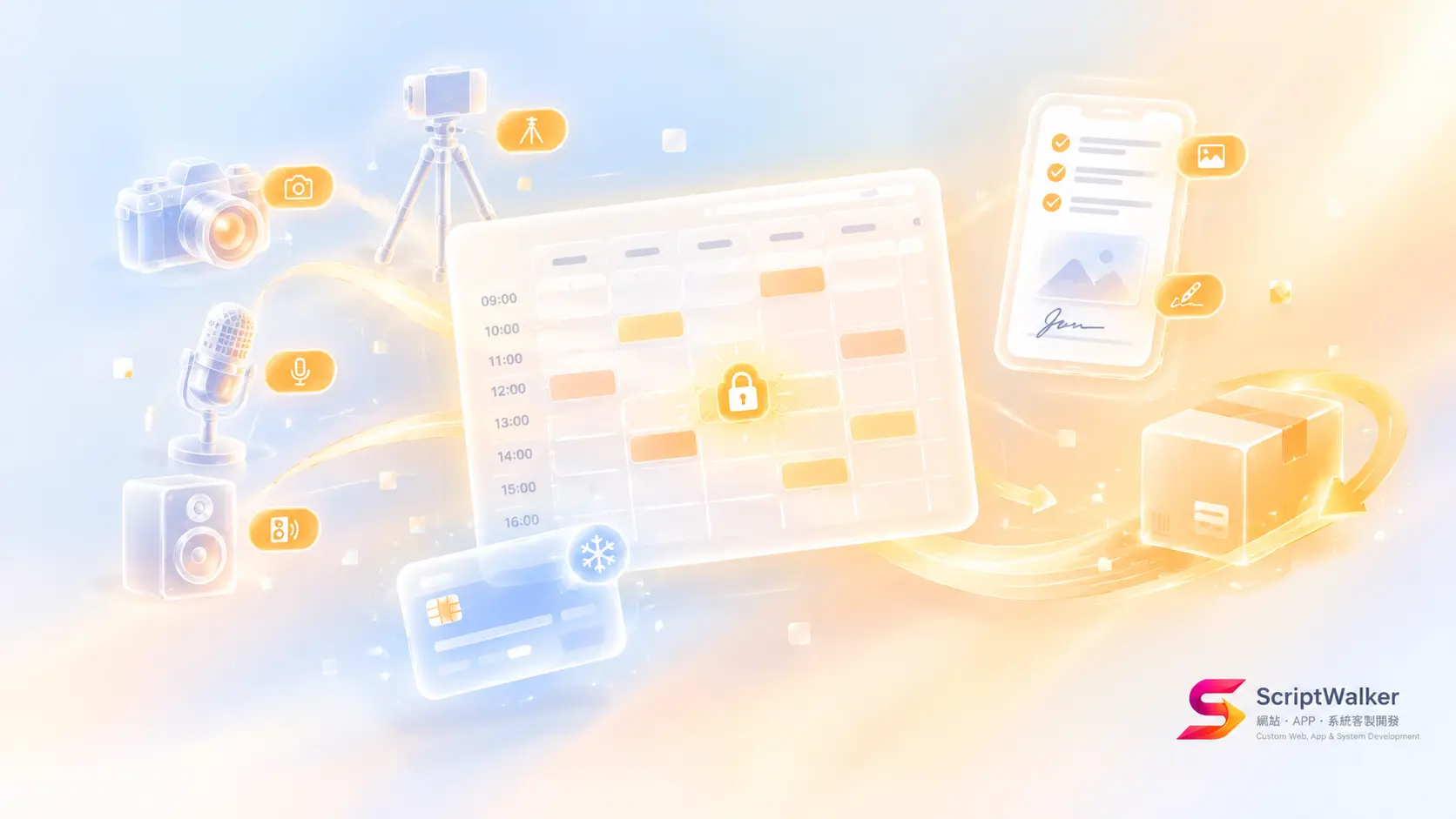
An event and camera equipment rental company schedules 220 items in one shared Excel sheet. Last month it double-booked six times: the same camcorder went to two customers, forcing a last-minute loan from a competitor that cost NT$3,000 to NT$8,000 each time. Deposits come in and go back by bank transfer, so finance spends half a day a week reconciling. Items come back missing batteries or with scratched lenses, and with no photos taken at pickup, the company eats the loss. This piece breaks down how to plan an equipment rental management system: availability calendar, deposit pre-authorization, return inspection and the real cost.
When It Fits × When It Doesn't
| A rental system fits | Not yet |
|---|---|
| 50+ items and 100+ rentals a month | Fewer than 20 items; a calendar is enough |
| The same item is rented 3+ times a month and double-bookings cost real money | Seasonal business with only a few rentals a year |
| You collect deposits and charge late fees and damage | Long-term leases only (one year at a time), where contracts matter more than schedules |
| You want customers to check availability, book and pay online | A handful of fixed corporate clients who book by phone with sales |
Alternatives Matrix
| Option | Pros | Cons | Cost range |
|---|---|---|---|
| Excel / Google Calendar | Free, instant | Double-bookings, no deposit flow, no inspection records | NT$0 |
| Overseas rental SaaS (e.g. Booqable) | Usable same day, online store included | Limited local payments, e-invoicing and Chinese support; monthly fees | About NT$1,000–10,000/month |
| E-commerce platform + booking plugin | Fast to launch, payments ready | Inventory by unit, not by time slot; deposits and late fees are awkward | NT$30,000–80,000 |
| Custom rental system | Availability, deposits, inspections and invoices all follow your rules | 10–14 weeks to build; needs maintenance | NT$250,000–600,000 |
Full Process Breakdown
- Weeks 1–2: Rule inventory. List categories, bundles, buffer times and deposit rules. Deliverables: rental rulebook (Notion), equipment master list (Google Sheets).
- Weeks 3–4: Flow and screen design. Five flows: availability calendar, booking, pickup, return, inspection. Deliverables: Figma wireframes and clickable prototype.
- Weeks 5–10: Development. Laravel back office and availability engine, overbooking locks, online payment and deposit pre-authorization, LINE notifications, e-invoice integration. Deliverable: staging site.
- Weeks 11–12: Inspection and acceptance. Phone photos, accessory checklist and customer signature; damage automatically creates a claim. Deliverables: UAT scripts and production site.
- Weeks 13–14: Migration and soft launch. Import the next 3 months of bookings and run old and new in parallel for two weeks.
Real Cost Breakdown
- Development: basic (single location, availability + online payment) from NT$250,000; full (multiple locations, bundles, inspections, late fees) NT$450,000–600,000.
- Payment fees: credit cards cost about 2.75%–2.8% (depending on your contract with providers such as ECPay). If you charge the deposit and refund it later, the fee usually isn't returned, a cost many people miss.
- Pre-authorization limits: it freezes funds without charging, but it expires; for example, Stripe holds online card authorizations for about 7 days, so longer rentals need a security deposit or re-authorization.
- Other: hosting and backups NT$1,500–3,000/month, LINE and SMS fees; maintenance NT$8,000–15,000/month.
Implementation Reality vs Client Expectations
- Expected: availability is just a calendar. Reality: bundles are the hard part; a 7-item "livestream kit" can't be sold if any one piece is out.
- Expected: just collect a deposit. Reality: you must choose pre-authorization, a real charge or a credit line, each affecting fees and refund timing.
- Expected: no more double-bookings after launch. Reality: if phone, LINE and walk-in bookings don't all go into the system, they still happen.
- Expected: photos are enough. Reality: you need an accessory checklist and customer signature for a claim to stand.
Common Pitfalls × How to Avoid Them
- No buffer time. → Set inspection hours per category and block the slot automatically.
- Simultaneous bookings cause overbooking. → Lock the slot at checkout and hold it for 15 minutes for payment.
- Hard-coded late-fee rules. → Make them adjustable parameters in the back office.
- Serial numbers not tracked. → Give every item a serial number and repair history.
- Manual deposit refunds. → Release the authorization or create a refund automatically once inspection passes.
Success Metrics + 90-Day Post-Launch Roadmap
- Day 30: double-bookings at zero, share of online bookings, average booking time; tune availability and bundle rules.
- Day 60: utilization (rented days ÷ available days), average days to refund deposits; consider selling items below 20% utilization.
- Day 90: damage claim success rate, repeat rental rate; adjust peak-season pricing and bundles based on data.
Decision Checklist
- ☐ Do you have more than 50 items?
- ☐ Any double-bookings in the past 3 months?
- ☐ Do you collect deposits or security payments?
- ☐ Do you rent bundles or kits?
- ☐ Does every item have a serial number?
- ☐ Do you photograph items on return?
- ☐ Do you charge late fees?
- ☐ Do you have two or more pickup locations?
- ☐ Would customers want to check availability online?
- ☐ Do you need to issue e-invoices?
- ☐ Can you assign one person to own the rule inventory?
- ☐ Can the budget accept NT$250,000 or more?
Seven or more checks usually means custom beats SaaS.
FAQ
Should a rental system use pre-authorization or a direct charge for deposits?
Short rentals (within 7 days) suit pre-authorization, which freezes funds without refund fees; long rentals or high-value items suit a security deposit or a credit-line agreement because authorizations expire.
Can I run equipment rentals on an e-commerce platform?
You can take payments, but e-commerce inventory counts units while rentals need time slots; bundles and late fees are hard, and double-bookings follow once volume grows.
How do I claim for damaged equipment in the system?
Photograph items and tick an accessory checklist with the customer's signature at both pickup and return; the system compares them, creates a claim and deducts it from the deposit or bills it separately.
Call to Action
ScriptWalker offers an Equipment Rental Management System package from NT$250,000, including rule inventory, availability engine, deposit pre-authorization and mobile inspection. To find out whether your rental flow suits SaaS or a custom build, bring your current spreadsheet to a free 30-minute consultation:
- Email: [email protected]
- Phone: 0916-224-047
- LINE: @ufv9089p