Taiwan lodging recorded 82.09 million guest-nights in 2025, with foreign guest-nights at 20.761 million. The same release also shows average occupancy of just 45.73%, an average rate of NT$2,984 for hotels and NT$2,438 for licensed homestays, and licensed homestay rooms up 9.43% over three years to 53,628. Inbound arrivals reached 8.57 million, up 9%. Supply is rising, rates are flat, occupancy slipped. More travellers, spread thinner. The least-captured segment is the independent overseas guest who researches, compares and books alone.
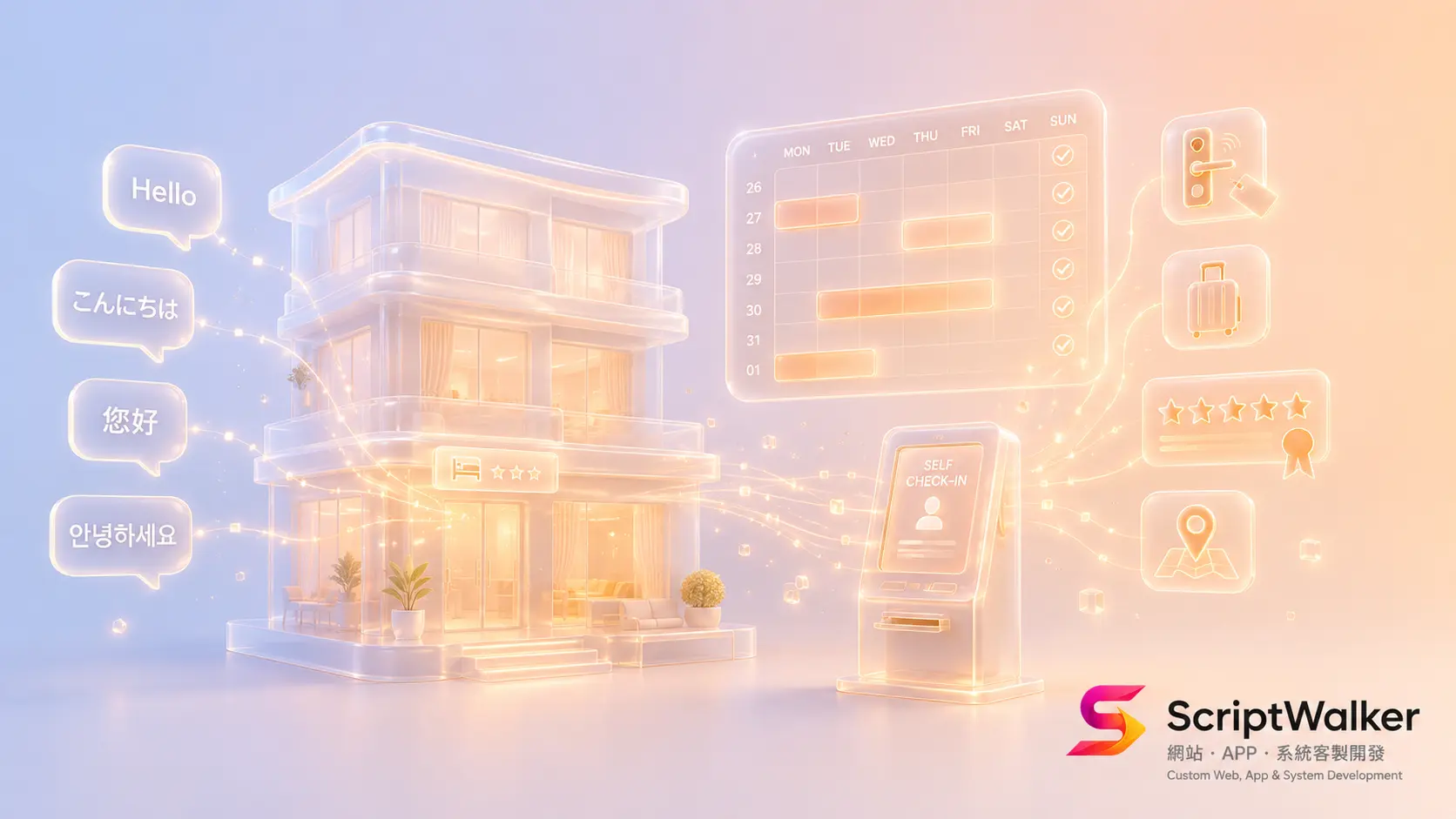
OTA commission is not the subject here. This piece covers one thing: letting those guests find you in their own language, book, add extras, and walk into the room at midnight on their own.
What Your Guests Actually Search
- 宜蘭包棟民宿推薦 (comparison intent)
- 花蓮民宿訂房 (transactional)
- 墾丁海景飯店官網訂房 (transactional, already seeking direct)
- 包棟villa 12人 烤肉 KTV (transactional, headcount equals requirement)
- 溫泉飯店 一泊二食 (package intent, high ticket)
- 台中親子飯店 溜滑梯 (comparison)
- 民宿 寵物友善 包棟 (filter intent, low competition)
- 日月潭民宿 接駁 (ancillary intent)
- 九份民宿 行李寄放 (local long tail, high conversion)
- 台北車站附近飯店 提早入住 (ancillary intent)
- taiwan homestay english booking (overseas transactional)
- hotel near Taipei 101 with kitchen (overseas long tail)
- 台湾 民宿 予約 日本語 (Japanese transactional)
Non-Negotiable Website Features
- Live availability plus online card payment, not an enquiry form
- Chinese, English, Japanese and Korean, with room and policy pages human-translated and correct hreflang and x-default
- A dedicated URL per room type: size, bed dimensions, extra-bed rules, maximum occupancy, 8 to 12 real photos
- An ancillary module: early check-in, late checkout, transfers, extra bed, BBQ set, pet cleaning fee
- Deposit and cancellation terms shown at checkout, not buried in an FAQ
- A complete Google Business Profile plus free booking links, which cost nothing per click
- A transport page covering transit, parking and luggage storage
- An automated flow: booking confirmation, three days before arrival, review invitation after checkout
- LodgingBusiness structured data, with mobile LCP under 2.5 seconds
Competitor sketches: one boutique hotel group (hotelday.com.tw) runs English and Japanese sites and drives direct bookings with a website-only high-speed-rail add-on rather than a discount; one business hotel chain (checkinn.com.tw) advertises self check-in with a key card in about three minutes; one hot-spring resort (jresort.com.tw) moved to an unmanned self-service counter from 1 May 2025. The common move: shift labour from the desk to the guest experience.
Worth Adding vs Not Yet
| Worth adding | Not yet |
|---|---|
| Ancillary module (margin far above room revenue) | Own-brand member app |
| Rate calendar with minimum-stay rules | Full-property 720-degree VR tour |
| Smart-lock codes auto-sent on arrival day | Self-built PMS and room control |
| Review invitations plus a 48-hour reply SOP | Points and membership tiers |
| Dual-track support on LINE and WhatsApp | Homepage intro animation |
| Human translation of room pages | Site-wide machine-translation plugin |
Three Budget Tiers (NT$)
- Entry, NT$80,000–150,000: responsive site, SaaS booking-engine integration, Chinese and English, Business Profile and free booking links set up, basic structured data. Fits a 5 to 10 room homestay.
- Standard, NT$250,000–450,000: four human-translated languages, ancillary module, rate calendar and minimum-stay rules, channel sync, automated messaging, review invitations, GA4 conversion tracking. Fits 15 to 40 rooms.
- Advanced, NT$600,000–1,200,000: multi-property, package store, self check-in via smart-lock API or kiosk, housekeeping scheduling, PMS integration, ADR and RevPAR dashboards.
Do not forget recurring cost: booking engine NT$1,500–4,000 per month; card fees based on ECPay's standard 2.75% rate plus tax; translation upkeep NT$15,000–40,000 a year; hosting and CDN NT$12,000–36,000 a year.
Stack Choices and Why
- Next.js: ISR on room pages balances live rates against speed, and i18n routing lets four languages share one template instead of four sites.
- Laravel: add-ons, orders, invoicing and permissions change constantly; a mature framework costs less to maintain than a bespoke one.
- SaaS booking engine first: building your own means owning overbooking risk and card-data security. Below roughly 50 rooms it does not pay back.
- Dual payment rails: ECPay locally, Stripe added for overseas cards, so a declined Japanese or Korean card does not push the guest back to an OTA.
- Smart locks with an API: codes must be generated per booking and expire automatically; an offline lock still needs a human, which is not automation.
Six Traps Specific to Lodging
- Site-wide machine translation. One wrong Japanese honorific or room-size unit destroys trust. Fix: human-translate room, policy and refund pages, machine-translate the rest, and always add hreflang and x-default.
- A direct rate no better than the OTA. Fix: hold price parity and add value platforms cannot list — late checkout, transfers, local experience vouchers.
- Beautiful photos, no specifications. Unclear bed types and occupancy drive bad reviews and refunds. Fix: publish size, bed dimensions, extra-bed rules and maximum occupancy per room type.
- Cancellation terms in Chinese only. Overseas disputes escalate to chargebacks. Fix: repeat them at checkout and in the confirmation email in the guest's language.
- Nobody answers at night. Fix: self check-in with codes auto-sent on arrival day, plus self-serve pages for transport and luggage.
- Replying only to five-star reviews. Fix: reply to everything within 48 hours using apology, specific remedy, invitation to return.
The 30/60/90-Day Roadmap
- Days 1–30: launch the multilingual site, complete the Business Profile, submit free booking links, publish three add-ons, automate the confirmation email, and record three baselines — direct-booking share, ancillary attach rate, mobile LCP.
- Days 31–60: introduce the rate calendar and minimum-stay rules; send a pre-arrival message three days out carrying add-on remarketing; email a review invitation 24 hours after checkout; publish one local content piece per top room type; launch the negative-review reply SOP.
- Days 61–90: connect smart locks or a kiosk for self check-in, wire housekeeping schedules to booking data, run low-season offers segmented by language, and target ancillary gross margin at 5% to 8% of room revenue.
How ScriptWalker Works With Lodging Operators
We split lodging projects into modules you can buy in stages:
- Multilingual website plus booking-engine integration: from NT$120,000
- Ancillary module and pre/post-stay automated messaging: from NT$60,000
- Business Profile, free booking links and structured-data audit: from NT$25,000
- Self check-in plus housekeeping scheduling, including smart-lock API: from NT$180,000
FAQ
Do we really need four languages?
Look at your source markets first. If Japanese guests dominate, start with Japanese and human-translate only the room, policy and transport pages. Machine translation is fine elsewhere, but hreflang and x-default must be correct or Google may ignore the whole language cluster.
Can our direct rate be cheaper than the OTA?
Most platform contracts restrict publishing a lower public rate. The safe practice is parity on price and more on value: website-only late checkout, transfers or local experience vouchers. Guests compare total value, not the headline number.
Does self check-in create legal or security problems?
Self-service does not mean skipping registration. Identity verification and guest registration still apply, so the system must upload ID images, retain records and set a retention period. Door codes must be bound to the booking and expire at checkout.
We only have six rooms — is a NT$250,000 site justified?
Run the payback first. At the 2025 average homestay rate of NT$2,438, adding 100 direct room-nights a year with an 8% ancillary uplift lands near NT$260,000. With few rooms, start at the entry tier and put the money into add-ons and automated messaging.
How long before direct bookings grow?
Add-ons and automated messages usually move the attach rate within 30 days. New direct bookings from organic search and Google free booking links need 90 to 180 days to show a stable trend.
Decision Checklist
- ☐ Can a guest pay by card and complete a booking, rather than wait for a reply?
- ☐ Does every room type have its own URL and bed specifications?
- ☐ Are the English and Japanese versions human-translated or plugin machine-translated?
- ☐ Have hreflang and x-default ever been configured?
- ☐ Does your Business Profile carry rates and a booking link?
- ☐ Are there at least three purchasable add-ons on the site?
- ☐ Do cancellation terms appear at checkout and in the confirmation email?
- ☐ Is a review invitation sent automatically after checkout?
- ☐ Can a guest arriving at midnight check in alone?
- ☐ Can you state last month's direct-booking share and ancillary attach rate?
Fewer than seven ticks means traffic is not your problem — the process that catches traffic is. For a diagnostic on your own property, get in touch:
- Email: [email protected]
- Phone: 0916-224-047
- LINE: @ufv9089p