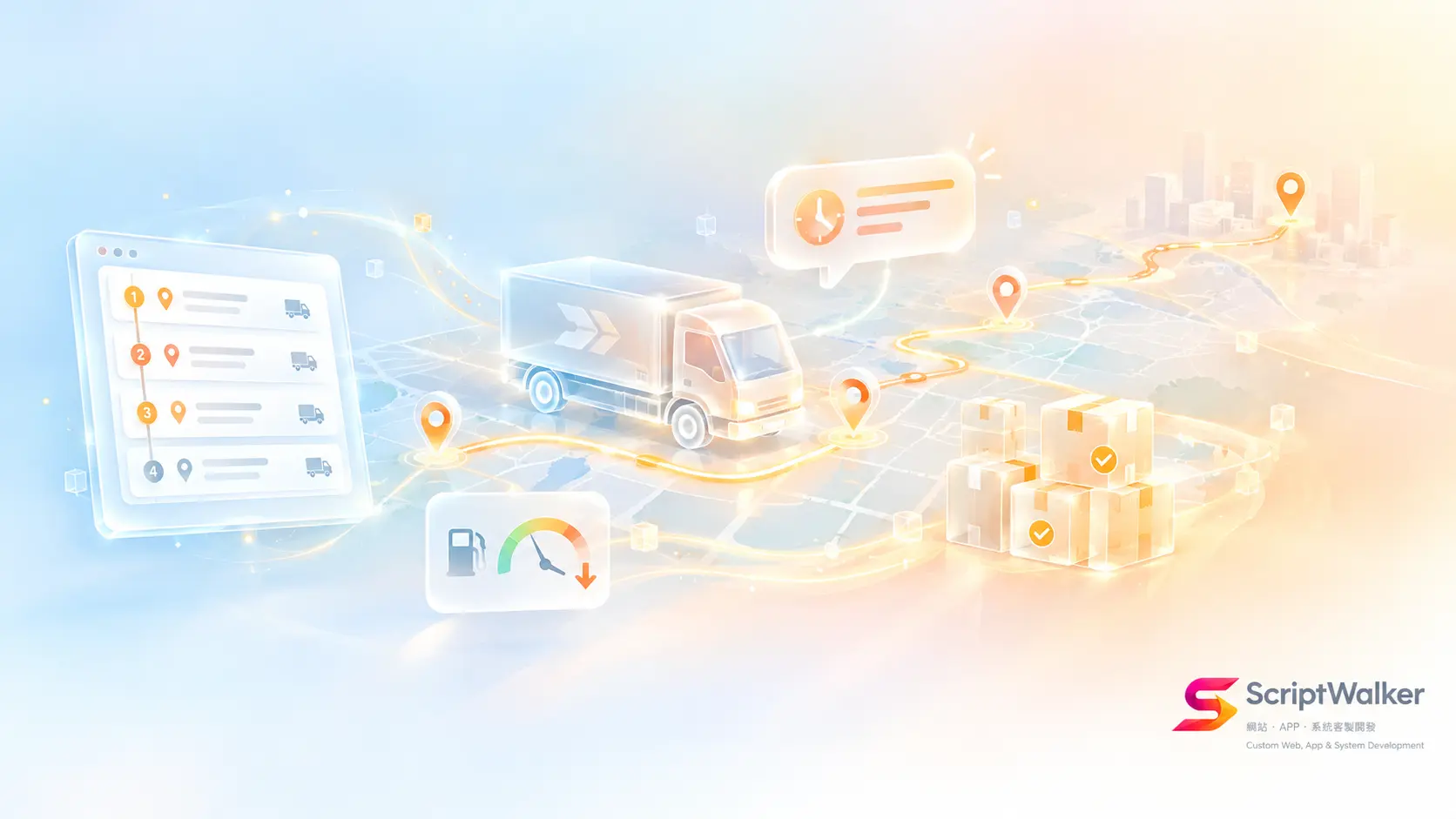
Short answer: Start with route planning. A 20-vehicle regional delivery fleet that replaces manual dispatch with a routing engine usually cuts daily mileage 8–12%; with a build cost of about NT$350,000–600,000, payback takes roughly 6–9 months. Automating "where's my shipment?" replies on LINE comes second.
Snapshot: AI in logistics
Bottom line: logistics pain is "drivers are scarce and cost per kilometer keeps rising," so AI should first save mileage and dispatch hours.
According to Highway Bureau figures presented to Taiwan's legislature in 2024, the three main freight associations run about 77,700 heavy trucks and widely report driver shortages, while bus operators are short more than 5,000 drivers. Most small fleets still rely on senior dispatchers who spend 2–3 hours a day planning routes and another 1–2 hours answering "where's my delivery?" calls.
Four typical AI use cases
Bottom line: routing and ETA replies pay back fastest; demand forecasting needs a year or more of data.
- Route planning: assign and sequence stops by address, time window and load; dispatchers only handle exceptions.
- Automated ETA replies: customers send an order number on LINE and AI answers with an arrival window from the driver's live location.
- Waybill and proof-of-delivery capture: photos are read for order number, piece count and signature, cutting manual entry.
- Volume forecasting: predict weekly vehicle needs from seasonality and customer history, reducing last-minute subcontracting.
Real cases: a giant fleet and a small one
Bottom line: big carriers prove routing saves miles, and small fleets can pay back with a tenth of the sophistication.
- UPS (public case): after full U.S. rollout of its ORION routing system, UPS projected about 100 million fewer miles, roughly 10 million gallons of fuel and over $300 million saved each year. The hard part wasn't the algorithm but years of getting drivers to trust system routes.
- A cold-chain fleet in central Taiwan (anonymized illustrative scenario): 22 vehicles, about 380 stops a day. A simulation on 3 months of orders showed manual plans added about 11 km per vehicle. In a 5-vehicle pilot, senior drivers overrode 40% of routes, mostly because "this store only receives in the afternoon." After adding receiving windows, overrides fell to 12% and fleet mileage dropped about 9%.
Recommended tool stack
Bottom line: use an existing routing engine rather than writing algorithms; use AI models only for understanding and answering text.
- Routing engine: open-source Google OR-Tools (free, self-hosted) or the Google Maps Route Optimization API (pay per use, better traffic data).
- Back office: Laravel for orders, vehicles and time windows; a Flutter driver app for routes and photo proof of delivery.
- Customer replies: LINE Messaging API plus the OpenAI or Claude API to interpret questions and look up ETAs.
- Integration: n8n to connect order forms, ERP and daily reports.
ROI model
Bottom line: with a NT$350,000–600,000 build, a 20-vehicle fleet nets about NT$50,000–80,000 a month and pays back in 6–9 months.
| Item | Before | After | Monthly difference |
|---|---|---|---|
| Daily fleet mileage (20 vehicles) | 3,000 km | ~2,700 km (-10%) | Fuel and wear: save ~NT$30,000–45,000 |
| Dispatch planning time | 3 hours/day | 1 hour/day | Save ~NT$10,000–15,000 |
| "Where's my shipment?" calls | 60/day | 20/day | Save ~NT$10,000–20,000 |
| Monthly running cost | — | APIs, hosting, maintenance | ~-NT$8,000–15,000 |
Rollout timeline
Bottom line: from data audit to full fleet takes about 13–17 weeks, and the pilot is not optional.
- Phase 1 | Data audit (2–3 weeks): clean 3 months of orders, addresses, time windows and capacities.
- Phase 2 | Routing simulation (3–4 weeks): compare engine routes with manual plans on mileage and on-time rate.
- Phase 3 | Pilot (4–6 weeks): 5 vehicles live, with logged manual overrides.
- Phase 4 | Full rollout (4 weeks): whole fleet, ETA replies and weekly reports.
Common failures and fixes
Bottom line: routing projects fail on data and driver buy-in, not on algorithms.
- Messy addresses: five spellings per customer → build an address master with coordinates before launch.
- Missing receiving windows: routes hit closed docks → make time windows and unloading limits mandatory fields.
- Driver distrust: forcing system routes → allow logged overrides and review them weekly.
- Made-up ETAs: AI guessing arrival times → let it read only system data and hand off to a human when data is missing.
Where AI doesn't belong
Bottom line: fixed routes, low volume or judgment-heavy work aren't worth the spend yet.
- Dedicated vehicles running the same route every day.
- Fleets under 5 vehicles or fewer than 50 stops a day.
- On-site handover decisions for valuable or special cargo.
- Major complaints and claims negotiations, which need a person.
ScriptWalker's offering
Bottom line: we start with a routing simulation to prove the savings before any full rollout.
ScriptWalker (a Taiwan-based Laravel/Flutter custom development studio) offers a Dispatch Routing and ETA Notification package: a routing simulation report on your historical orders from NT$45,000, and a dispatch back office + driver app + LINE ETA integration from NT$350,000, buildable in phases.
FAQ
Bottom line: logistics owners care most about payback speed and driver acceptance; here are the three most common questions.
Is AI routing worth it for a small fleet?
Usually yes at 5+ vehicles and 50+ stops a day. Below that, manual planning may cost less than a system.
Do we have to buy Google's routing API?
No, open-source OR-Tools can be self-hosted for free. Consider the paid API if you need live traffic and better drive-time estimates.
What if drivers ignore system routes?
Allow overrides but log the reason. Most overrides come from missing data such as receiving windows and drop once it's added.
Decision checklist and next step
Bottom line: if 5 or more of these 8 are "yes," start with a routing simulation.
- ☐ 5 or more vehicles
- ☐ More than 50 stops a day
- ☐ Routes change daily
- ☐ 3+ months of digital delivery orders
- ☐ Dispatchers plan for 2+ hours a day
- ☐ 30+ "where's my shipment?" calls a day
- ☐ Willing to pilot with 5 vehicles
- ☐ Someone can review overrides weekly
Export one month of delivery orders and we'll assess a routing simulation for free:
- Email: [email protected]
- Phone: 0916-224-047
- LINE: @ufv9089p