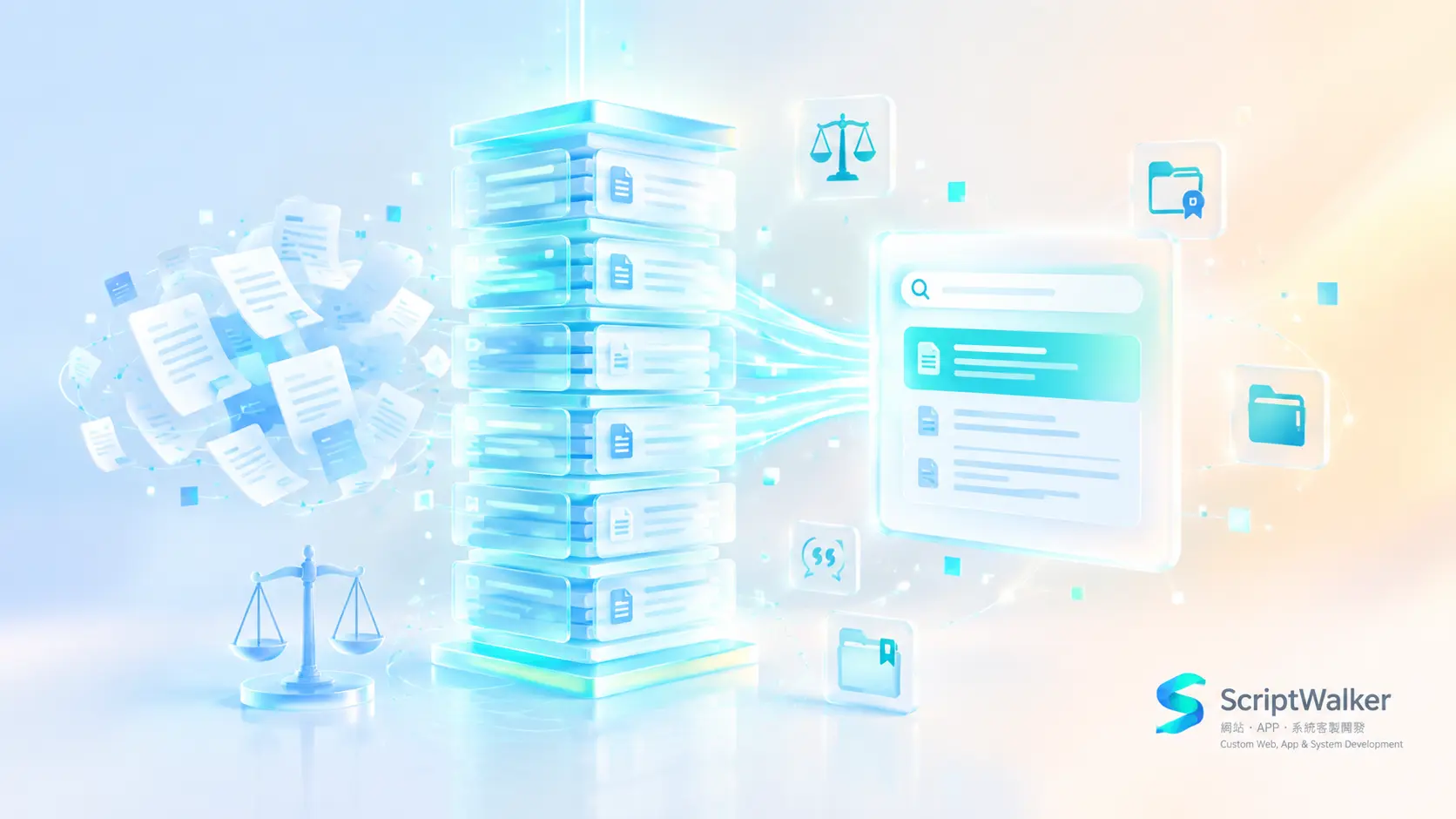
On 18 September 2026, OpenAI shipped Astra for Law. Most coverage led with "OpenAI enters legal." The line that actually matters is the one shipped alongside it: OpenAI has built its own US legal search index spanning more than 230 million URLs — case law, statutes, regulations, court rules and administrative decisions, with sources added daily. OpenAI's published benchmark: at the highest reasoning effort, Astra for Law passed the overall correctness check on 54.0% of questions, against 38.7% for the same GPT-6 Astra using ordinary web search. Roughly a 40% relative lift.
That number matters more to people doing SEO and GEO than to lawyers. For two years the entire AEO/GEO industry has rested on one assumption: when a large language model answers a question, it retrieves from the open web — so if your content is well-structured, authoritative and widely cited, you have a shot at appearing in the answer. That assumption is now being dismantled. Legal is the richest slice of vertical AI: Harvey raised $200M at an $11B valuation in March 2026 and $550M at $15.5B in September, with annualised revenue climbing from $190M in January to over $350M. Sweden's Legora raised $550M at $5.55B and has passed $100M ARR with more than 1,000 customers. The legal AI software market sits around $5.59B in 2026, inside a global legal tech market of roughly $31.1B. That is enough money to justify building your own index.
The shape of the race changed accordingly. Harvey and Legora are the application-layer leaders; Thomson Reuters defends the old ground of professional database plus workflow with CoCounsel and HighQ. OpenAI did not attack them head-on — it dug a layer beneath them, shipping 26 plugins at launch from partners including Thomson Reuters, Harvey, Legora and iManage. Which means a company valued at $15.5 billion is now an accessory on OpenAI's platform. Thomson Reuters' official response was carefully worded: as AI becomes more open and interoperable, the value is not in connectivity alone. Translation: we would rather not be a plugin.
What does this have to do with a small business? One question: is your industry next to be indexed? If yes, the GEO work you are doing now is about to lose much of its value. If no, you are about to inherit a lighter battlefield. What follows: how to tell which side you are on, what three kinds of readers should do this week, and the DIY route that needs no SaaS subscription.
What Actually Shipped: Not a Model, an Access Question
The technical framing first. Astra for Law is not a new base model. It is GPT-6 Astra configured for legal work: a dedicated legal search index, custom instructions for legal analysis and drafting, and firm-level governance controls. Per OpenAI's documentation, selected firms get access first through a Trusted Access programme in ChatGPT and Codex, with the API arriving later as gpt-6-astra-law.
Two other things landed the same day. ChatGPT for Word went generally available, letting users proofread, take suggested edits and flag formatting issues inside Word. And GPT-5.5 was scheduled for retirement from ChatGPT, ChatGPT Work and Codex on 14 October 2026. Almost nobody wrote about the second one, but for any company that hard-coded GPT-5.5 into an automation, that is a 26-day countdown.
Back to the index. What does 230 million URLs mean? Not "we crawled a lot of pages" — it means structured coverage of the authoritative sources of one jurisdiction, refreshed daily. Historically only century-old database companies like Westlaw and LexisNexis did this; the barrier was never technical, it was licensing and maintenance. OpenAI choosing to build it signals a judgement: in high-value verticals, retrieval quality is capped by the index, not the model. 54.0% against 38.7% is the evidence — same model, different index, fifteen percentage points.
What Three Kinds of Readers Should Do Now
Brand owners and SMB leaders
- Run an index-risk check: does your industry have a public, structured, authoritative source set — regulations, patents, drug approvals, standards, public filings, government tenders? If yes, you are on the list.
- If you are on the list: stop investing in "more explainer content" and start investing in becoming a source the index will ingest — trade association filings, official registries, standards participation.
- If you are not on the list (local services, B2B manufacturing, consumer brands): the open web remains the main battlefield, and competition should ease over the next two years as budget concentrates into verticals.
Marketing and SEO practitioners
- Add a column to your AI visibility reporting: was this query answered from open-web retrieval or from a platform-owned index? The optimisation levers are entirely different.
- Track the composition of citations, not just whether you were cited. When citations concentrate into a handful of institutional sources, that query cluster has been indexed.
- Make first-party data your primary raw material — on-site search terms, support tickets, sales objections. Platform indexes cannot reach any of it.
Developers and agencies
- Grep every project for hard-coded model strings. GPT-5.5 retires on 14 October; hard-coded references will fail silently that day.
- Move model names into environment variables or config, and write a minimal regression set per AI feature — 10 to 20 fixed prompts with expected output shape. One run tells you what broke.
- Start selling private vertical indexes instead of "hook me up to ChatGPT." The latter is a week of work; the former is a retainer-bearing asset.
Tool Comparison
| Option | Positioning | Scale / valuation | Best fit |
|---|---|---|---|
| OpenAI Astra for Law | GPT-6 Astra legal config + owned 230M-URL index | 54.0% correctness vs 38.7% open web | US jurisdiction, firms already on ChatGPT |
| Harvey | Application-layer leader, agent-oriented | $15.5B valuation, $350M+ annualised revenue | Large firms and enterprise legal departments |
| Legora | Collaborative legal workspace | $5.55B valuation, $100M+ ARR, 1,000+ customers | Mid-to-large legal teams valuing collaboration |
| Thomson Reuters CoCounsel + HighQ | Professional database plus matter context and governance | Incumbent inside a ~$31.1B legal tech market | Institutions needing regulated-grade audit trails |
| Self-hosted RAG (open source) | Private index over your own documents | Monthly cost under NT$2,000 is achievable | Non-US jurisdictions, internal documents, no public index available |
The first four will converge on features fast. What separates them is who owns the index and who carries the liability for errors.
What the Announcement Doesn't Say
Counterpoint one: the other side of 54.0% is 46%. And that is at the highest reasoning effort. "40% relative improvement" is a flattering frame, but in absolute terms nearly half the questions failed the overall correctness check. In legal work that is not "pretty good" — it is "verify every sentence." Anyone using this number to justify one fewer hire has done the arithmetic wrong.
Counterpoint two: no API date, no pricing. OpenAI openly states both are still undetermined. For anyone who has to set a budget, this launch is a placeholder rather than a purchasable product. Historically, products that claim the position first and price later do not price cheaply.
Counterpoint three: 230 million URLs is coverage, not validity. The hard part of legal research was never finding the case — it is knowing whether the case is still good law. The documentation emphasises daily additions but says little about how overturned authority is flagged. High coverage with weak validity signalling produces a dangerous illusion: it looks sourced.
Counterpoint four: the ecosystem partners are also the competitors. Harvey is valued at $15.5 billion and is now one of 26 plugins. "You are my channel and my rival" structures rarely stay stable past two years. Thomson Reuters already put its marker down in its response.
The No-Subscription SMB Alternative
If nobody has built an index for your industry, build a small one. In 2026 the cost has fallen far enough that hesitating is the expensive choice:
- Week 1 — Source inventory: list 20 to 50 authoritative sources in your field — regulator announcements, trade association documents, standards, vendor specification sheets, plus your own historical proposals and support Q&A. This step is human work, not machine work.
- Week 2 — Ingest and normalise: schedule a daily pull of each source, convert to plain text, and retain the source URL and fetch date. An entry-level VPS is enough.
- Week 3 — Hybrid retrieval: pair vector search (open-source embeddings) with keyword search (PostgreSQL full-text or BM25) and rerank the merged results. Pure vector search performs badly on proper nouns and product codes.
- Week 4 — Citation and freshness flags: every answer carries a source URL and fetch date, and marks whether that source has been superseded. This is the one place your index can beat a giant's — you know which document expired.
Monthly cost can stay under NT$2,000 (VPS plus open-source models). It will never be bigger than OpenAI's index. It only has to be more accurate than the open web inside your domain.
FAQ
Can Astra for Law be used for legal questions outside the US?
Its index covers the US jurisdiction — case law, statutes, regulations, court rules and administrative decisions. Applying it to another jurisdiction means retrieving from the wrong index, which raises the error rate rather than lowering it. For other jurisdictions the options today are a self-built index or a local vendor.
Does this mean GEO and AEO are dead?
No — it means GEO splits into two battlefields. In verticals where the platform owns an index (legal today, plausibly pharma, accounting and public procurement next), the lever shifts from content quality to source admission. In verticals without one, open-web retrieval still dominates, existing tactics still work, and competitive pressure should decrease.
GPT-5.5 retires on 14 October. What should I do?
Search every project for model-name strings and move hard-coded values into configuration. Then build a 10-to-20 prompt regression set per AI feature and diff the output after switching. The common failure is not "the model disappeared" — it is "the model changed and nobody noticed the output changed with it."
How many hours does a private vertical index take?
A minimum viable version covering 20 to 50 sources with daily refresh and citation flags runs roughly 80 to 120 hours. The ongoing cost is not development — it is maintaining the source list, which needs someone who knows the industry to review it quarterly.
My Take
The consensus read is "OpenAI enters legal, Harvey is in trouble." My read is different: OpenAI did not enter the legal business. It entered the index business. Legal is simply the first domain where a vertical index demonstrably beats the open web, because it satisfies three conditions at once: authoritative structured sources, extremely high cost of error, and customers who can pay. Pharma, accounting and tax, public procurement, and medical-device and food regulation all satisfy the same three.
So the contrarian call: within 18 months OpenAI will ship at least two more vertical indexes, and each one zeroes out the GEO value of the open web in that domain. Any agency currently selling "AI visibility monitoring" as its flagship product is selling a gauge that will be switched off domain by domain — not because the gauge is inaccurate, but because the thing it measures will stop existing in specific verticals.
For a Laravel + Flutter studio like ScriptWalker, the implication is concrete and unusually friendly to small teams: stop taking "connect us to ChatGPT" projects and start selling private vertical index build-and-maintain. The stack is not hard — Laravel with PostgreSQL pgvector and full-text search gets you started. The hard part is the industry source inventory, and that is exactly the asset an agency accumulates after years with a client. API integration is one-off revenue. Index maintenance is a monthly fee. The second one is what is actually worth chasing here.
Sources
- Primary: OpenAI — Introducing Astra for Law
- Primary: OpenAI Help Center — Astra for Law
- Primary: Harvey — funding announcement at $11B valuation
- Primary: Legora — passing $100M ARR
- Secondary: The Next Web — Harvey raises $550M at a $15.5B valuation
- Secondary: Artificial Lawyer — OpenAI Launches Astra For Law
- Secondary: LawSites — OpenAI Releases Astra for Law
- Secondary: The Next Web — OpenAI launches Astra for Law and its own legal research index
Want to Turn Your Documents Into a Searchable Asset?
If you hold large volumes of internal specs, quotes, contracts and support Q&A but rely on human memory to find them, we build and maintain private vertical indexes from NT$120,000 — including source inventory, hybrid retrieval and citation freshness flags.
- Email: [email protected]
- Phone: 0916-224-047
- LINE: @ufv9089p