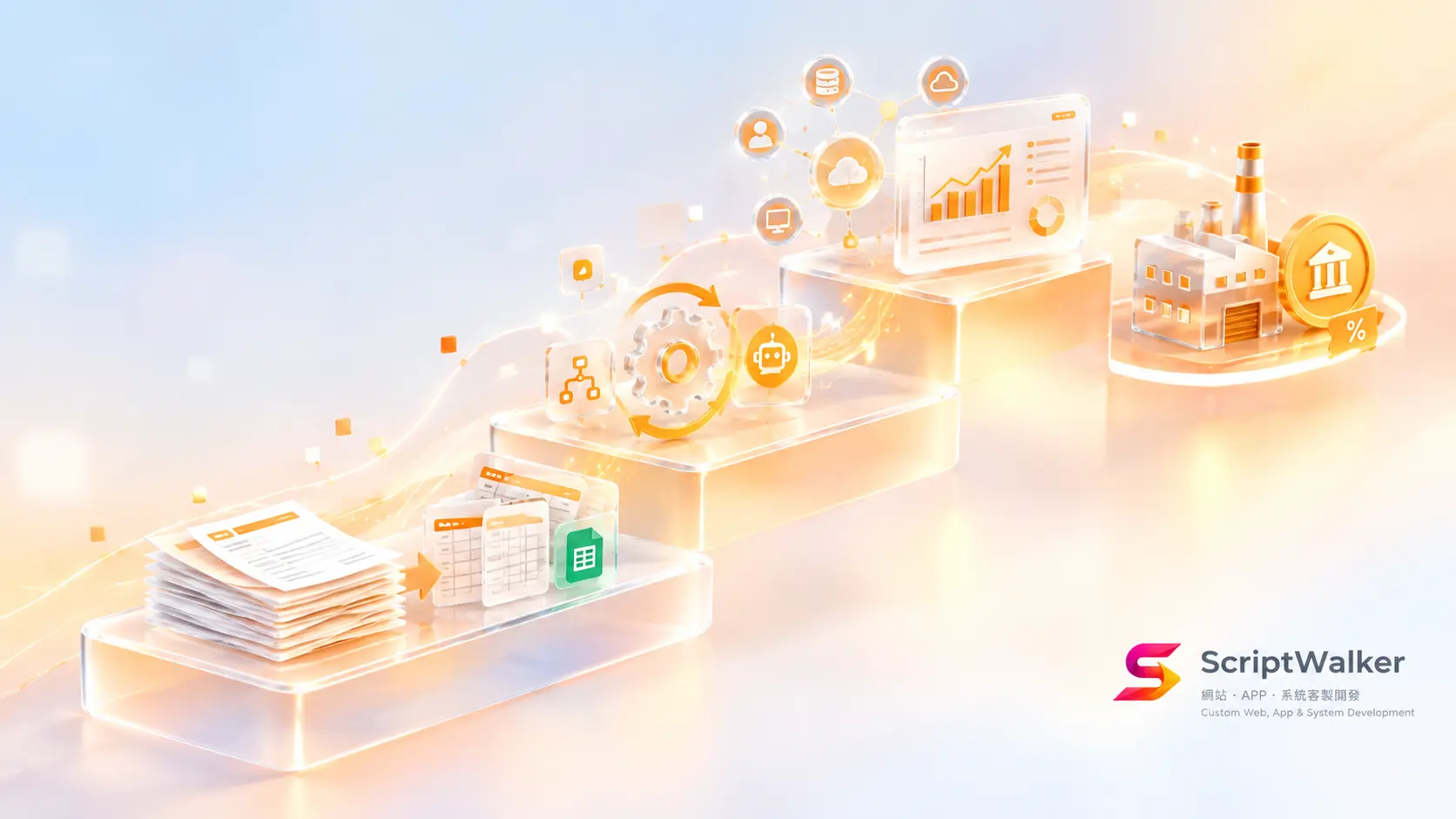
Short answer: The first step for a traditional business is to consolidate order and customer data scattered across paper, Excel and LINE into one system, not to buy a big ERP. Stage one costs about NT$80,000-300,000, and most SMEs see faster order lookups and shorter reconciliation within 3 months.
The Pain: Competitors Went Digital, and We're Still on Paper
Bottom line: transformation anxiety usually comes from data you can't find, not from missing new technology.
A 25-person hardware parts factory receives orders by fax and LINE; sales copy them onto work orders by hand, then accounting types them into Excel. When a customer asks whether last month's batch shipped, it takes 20 minutes to check; month-end reconciliation takes four days. The owner hears competitors adopted ERP and wants to transform too, but doesn't know where to start.
The Direct Answer: Transformation Isn't One Big Leap
Bottom line: digitize data first, then automate processes, then integrate systems.
| Stage | What | Budget | Timeline | Measurable benefit |
|---|---|---|---|---|
| 1. Digitize data | Orders, customers and product master data in one system | NT$80,000-300,000 | 6-10 weeks | Order lookup from 20 minutes to under 1 |
| 2. Automate processes | Quotes, shipping notices, reconciliation | NT$200,000-600,000 | 2-4 months | Month-end reconciliation from 4 days to 1 |
| 3. Integrate systems | Accounting, e-invoices, ERP, reports | NT$500,000+ | 4-8 months | Owner sees live margin and stock daily |
The Full Roadmap: Costs and Benefits by Stage
Bottom line: each stage needs its own payback case; you don't have to do them all at once.
- Stage 1, digitize data: standardize customer tax IDs, product codes and order numbering. It's the most skipped and most important step. The benefit: data you can find, and customer records that stay when a salesperson leaves.
- Stage 2, automate processes: automate anything repeated more than 10 times a day, such as quote generation, LINE shipping notices and bank deposit matching. One admin saving 2 hours a day is about 500 hours a year.
- Stage 3, integrate systems: connect accounting, e-invoices and existing ERP to produce margin and inventory turnover reports. Do it after stages 1 and 2 have run smoothly for 6 months.
Reference prices from ScriptWalker (a Taiwan-based custom Laravel and Flutter development studio): websites from NT$15,000, systems from NT$80,000, apps from NT$150,000. Stage one usually starts with a system plan.
Government Subsidies: Where to Look
Bottom line: subsidies lower costs, but don't pick the wrong system to qualify.
- The Small and Medium Enterprise and Startup Administration's digital transformation subsidy for manufacturers with 30 or fewer employees is the first stop for small factories.
- The SME multi-revitalization platform guide summarizes point-based and adoption subsidies.
- Taiwan Cloud Marketplace point subsidies (such as the 2026 industrial cloud program) suit testing SaaS first.
- Custom systems with R&D content may qualify for the SBIR innovation program.
Amounts, eligibility and application windows change every year; follow the official announcements and confirm your vendor meets program requirements before applying.
Common Mistakes
Bottom line: the costliest failure is a system nobody uses.
- Buying a big ERP first: without clean data, staff keep using Excel and the system becomes decoration.
- Doing everything at once: the budget is spent, no results appear in year one, and the owner pulls the plug.
- No owner: transformation needs an internal lead investing at least 3-4 hours a week.
- Chasing subsidy amounts: choosing an ill-fitting plan to qualify raises maintenance costs later.
- Skipping training: if floor staff aren't trained before launch, they return to paper within a month.
Decision Checklist: Where Should You Start?
Bottom line: three or more yeses among the first four means start at stage 1.
- ☐ Orders arrive through more than 2 channels (phone, fax, LINE, email)
- ☐ Finding an old order takes over 5 minutes
- ☐ Customer data lives on salespeople's phones or laptops
- ☐ One product has several names or codes
- ☐ Month-end reconciliation takes over 2 days
- ☐ The same data is typed in more than once a day
- ☐ The owner can't see this month's margin in real time
- ☐ Someone can serve as the internal project lead
Frequently Asked Questions
How much does SMB digital transformation cost?
Stage one, digitizing data, runs about NT$80,000-300,000; process automation NT$200,000-600,000; integration often NT$500,000+, and it can be spread over years.
How soon will I see results?
Stage one usually shows results within 3 months, such as faster order lookups and fewer days of month-end reconciliation.
Must a traditional business adopt ERP?
No. Companies under 50 people often start with a custom order or inventory system and evaluate ERP once processes stabilize.
How do I find transformation subsidies?
Check the Small and Medium Enterprise and Startup Administration website for this year's programs; amounts and eligibility change yearly.
Next Step: A Free Assessment of Where to Start
Bottom line: spend 30 minutes mapping where you are before setting a budget. Send us your current order process or a photo of a work order, and we'll tell you for free which stage to start with and roughly what it costs.
- Email: [email protected]
- Phone: 0916-224-047
- LINE: @ufv9089p