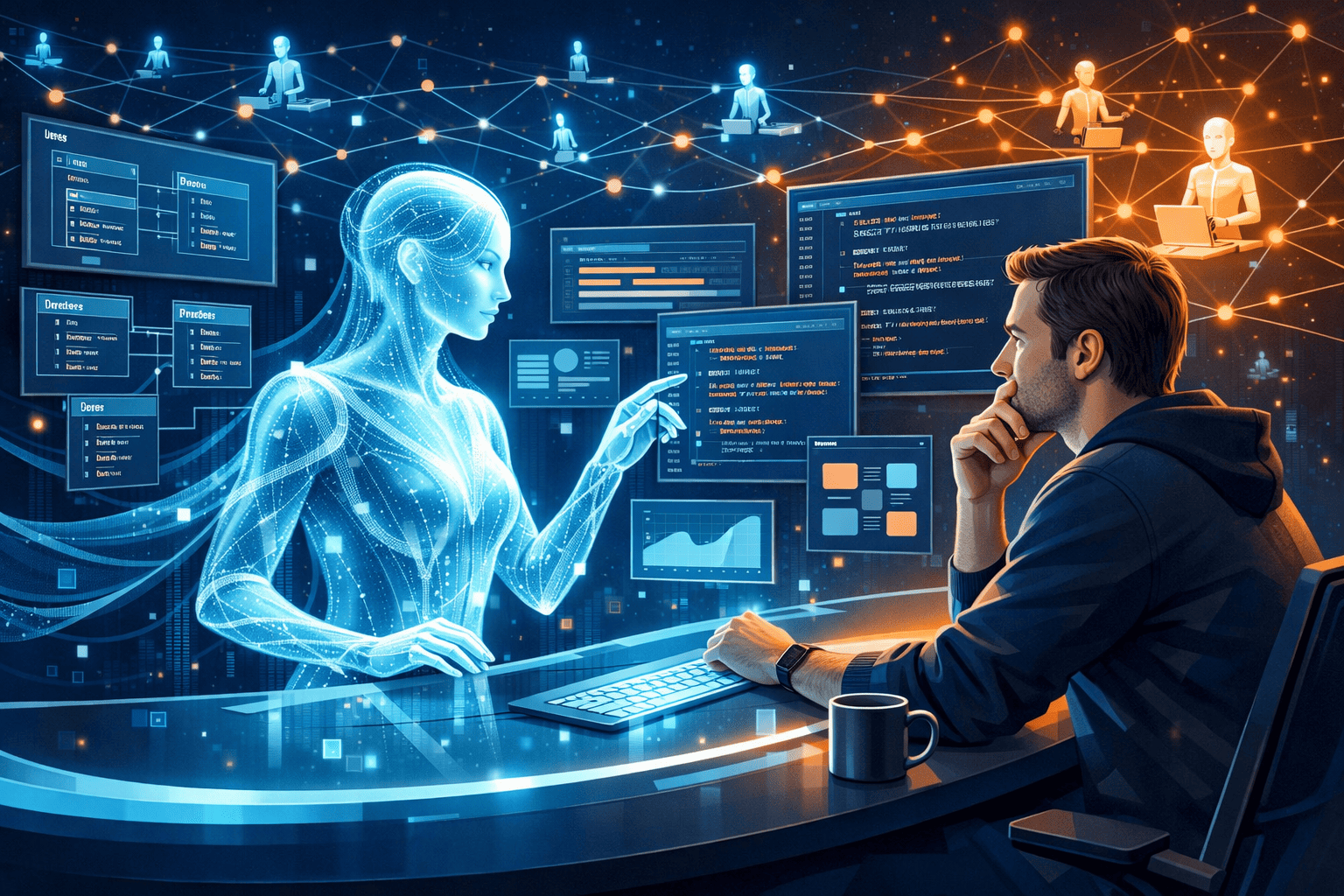
In 2025, the tech world was captivated by "Vibe Coding" — developers described their ideas to AI, and AI spat out code. The process felt like collaborating with a fast but careless intern. It was exciting, chaotic, and nobody fully understood why the code worked when it did.
A year later, the landscape has shifted entirely.
According to recent data from Databricks, AI agents on their Lakebase service now create roughly four times more databases than human users. This is not a lab experiment — it is happening in real production environments right now. AI agents are autonomously spinning up database instances, creating branches for testing, running experiments, and tearing everything down when finished. No human intervention required.
Meanwhile, a 2026 report from Belitsoft reveals that enterprises now run an average of 12 AI agents, a number expected to reach 20 by 2027. But here is the catch: half of those agents operate in complete isolation, with no coordination with other systems or agents. We have entered the explosion phase of AI agents, but orchestration has not caught up.
From Tool to Teammate: A Qualitative Shift in Development
In the past, AI played the role of an autocomplete engine in software development — you wrote a line of code, and it guessed the next one. Today's AI agents work in a fundamentally different way. They accept a high-level task description and then autonomously plan their execution: traversing entire project folders, creating multiple files, refactoring architecture, running tests, and even debugging and retrying when things fail.
JetBrains Central, launched in late March, is a landmark product in this space. Designed specifically for "agentic software development," the platform enables AI agents to execute multi-step workflows directly within a developer's IDE. It is no longer a chatbot assistant in a sidebar — it is a digital colleague capable of completing tasks independently.
A Stack Overflow survey reinforces the trend: 84% of developers are using or planning to use AI tools, and more than half of professional developers regularly use AI in their daily coding. More notably, 68% of developers use AI to "generate" code, not merely "assist" with it. That shift in verb choice carries profound implications.
The Silent Revolution in the Data Layer
If the AI transformation of frontend development is already visible, the data layer is undergoing a deeper but less discussed revolution.
Traditional ETL (Extract, Transform, Load) pipelines are being replaced by a new paradigm: EAI (Extract, AI-process, Integrate). In this model, AI dynamically detects data anomalies, enriches field attributes, harmonizes disparate schemas, and adapts transformation logic in real time. This means data engineers are shifting from "writing pipelines" to "designing strategy and overseeing quality."
Gartner predicts that by the end of 2026, 40% of analytics queries will be generated through natural language. Imagine this: business teams no longer need to learn SQL. They simply ask questions in everyday language, and AI automatically generates the queries, produces visualizations, and even provides narrative explanations of the results.
What does this mean for the industry at large? The democratization of data is no longer a slogan — it is becoming reality.
My Perspective: The Biggest Challenge Is Not Technology — It Is Organization
As someone who closely follows the intersection of AI and development, I believe the most important concern for 2026 is not that technology is advancing too fast, but that organizations are adapting too slowly.
Reports indicate that most enterprises will not achieve production-grade maturity for agent applications until 2028. The gap is not about AI models being insufficiently powerful. It is about workflow redesign, team upskilling, and — most fundamentally — trust.
When AI agents can autonomously create and destroy databases, does your team have the governance mechanisms to ensure security? When half of your agents operate independently, can your architecture support coordination between them? When developers transition from "people who write code" to "people who supervise AI," have your hiring criteria and performance evaluations evolved accordingly?
The best developers of 2026 will not be those who can write code faster than AI. They will be those who know what questions to ask, who can spot problems in AI output, and who understand when to trust their own judgment over the machine's recommendation.
This is not a story about a technology upgrade. It is a story about how humans and machines are renegotiating the division of labor. And that story is just getting started.