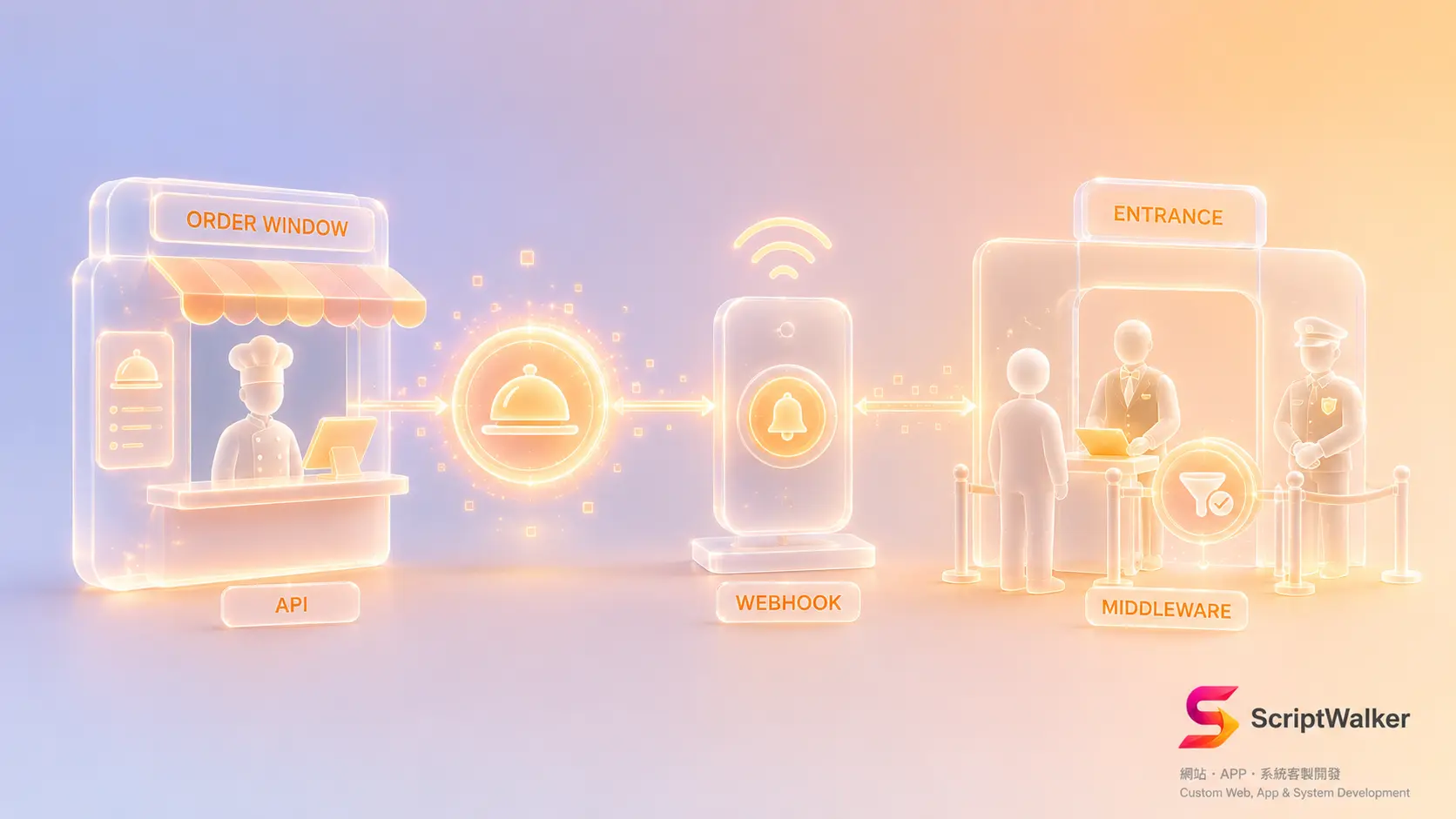
You get a quote for a website or system, and it reads integrate payment API, set up an order webhook, add a middleware layer for permissions. You know each word, but together you have no idea what you are paying for, and it feels awkward to ask. These three terms appear constantly on backend quotes and are tightly related, so we cover them in one piece using three everyday analogies, a restaurant, a doorbell and a security host, so by the end you can judge whether a vendor's price is fair.
Term 1: API, the order window between systems
One line: an API is a standard window for two systems to communicate, you order by the rules and it serves by the rules.
Everyday analogy: an API is a restaurant's order window. You do not rush into the kitchen to cook, you order at the counter by the menu (the rules), and the kitchen sends your dish back through the window. You need not know how the kitchen works, just order in the right format and it replies in the right format. AWS's official explanation of an API uses a similar service-window idea.
Real example: say you run a tutoring center and the site must show whether a class has open seats. The site does not store seat data; it asks your enrollment system via API how many seats are left, gets a number, and displays it. When you pay by card, the site also uses an API to send the amount to the payment company and receive payment success or failure.
Term 2: Webhook, the other side ringing your doorbell
One line: a webhook is the mechanism where the other side notifies you when something happens.
Everyday analogy: if an API is you calling the restaurant to ask is my food ready (you ask), a webhook is the restaurant ringing your doorbell when it is done (it notifies you). You need not keep calling, it is efficient and real-time.
Real example: at that same tutoring center, after a parent pays online, the payment company rings the doorbell (sends a webhook) to tell your system the payment is received, and the system auto-updates the student to paid and issues a receipt. Without a webhook your system would have to ask the payment company every few seconds, inefficient and easy to miss.
Term 3: Middleware, the host and security at the restaurant door
One line: middleware is the layer between a request and the system core that handles shared checks.
Everyday analogy: middleware is the host plus security at the door. Before each guest enters, they are checked, do you have a reservation, does your attire meet the rules, and only then let in. It does not cook (core business) but governs who gets in, who does not, and who must sign in. Laravel's official docs explain middleware exactly as filtering incoming requests.
Real example: only teachers can see student contact details in the tutoring back office. When someone opens that page, middleware intercepts and checks are you logged in, are you a teacher. Yes, allow; no, block. Login verification, permission checks, rate limiting and audit logging, the shared work every request needs, all go to middleware.
How the three relate (concept map)
Walk one parent online payment through and the wiring is clear:
- Step 1 (Middleware): the parent opens the payment page; the request first passes middleware for identity and permission checks, like being seated at the door.
- Step 2 (API): once cleared, the system uses an API to send the amount to the payment company, like ordering at the window.
- Step 3 (Webhook): after processing, the payment company uses a webhook to notify your system payment received, like the restaurant ringing your doorbell.
One-line memory aid: Middleware guards, API asks, Webhook reports.
Concrete impact on your decisions
Understanding these three helps you avoid pitfalls on price and timeline:
- Cost: API integration hours go mostly to exception handling (timeouts, duplicates, format changes), not connecting itself. Ask whether exception handling is included, the price gap is large.
- Security: a webhook without source verification may accept a forged payment success notice; skimped middleware can create permission holes. Do not cut these two.
- Timeline: third-party APIs (payment, logistics, invoicing) often need application and review, and that wait must be scheduled in, it is not about how fast the engineer codes.
5 questions to ask your vendor
- Which APIs does this quote integrate, and does it include exception handling and testing for timeouts, duplicates and format changes?
- Does the webhook include source verification to avoid forged notices?
- What does middleware handle (login, permissions, rate limiting, logging), and who maintains the permission rules?
- Is the application and review time for third-party APIs included in the project timeline?
- If the payment/logistics provider changes or the API updates later, how is maintenance and adjustment billed?
Common misconception
Most people assume API integration just means connecting wires, so it should be cheap. In reality the time-consuming part, and the truest test of a vendor, is exception handling: what if the other system goes down, what if it charges twice, what if the connection drops halfway. A quote that only says integrate API without mentioning exception handling is usually exactly where things break after launch.
Frequently Asked Questions
The quote says API integration and it is expensive. Is the vendor padding the price?
Not necessarily. API integration cost is mostly not in connecting it but in handling exceptions: the other system returns errors, times out, changes its format, or double-charges. A payment or logistics API integration including testing and exception handling often takes days to a week or two. Ask the vendor to spell out which APIs and whether exception handling and testing are included, and you can judge the price.
Are a webhook and an API the same thing?
Opposite directions. An API is you asking the other side (I call the restaurant to ask if my food is ready); a webhook is the other side notifying you (the restaurant rings your doorbell when it is ready). Many real-time features (payment-success notice, shipping status updates) rely on webhooks because constantly asking is inefficient. They are often used together, not either-or.
I cannot see or use middleware, so why pay for it?
Because it is the invisible but disastrous-if-missing layer. Middleware handles login verification, permission checks, rate limiting and logging, the shared work every request needs. Without it, the restaurant has no host or security at the door and anyone can charge straight into the kitchen. It does not earn money directly, but without it security and stability break.
If these three are done poorly, what is the most common consequence?
API without exception handling: when the other system hiccups, your site goes down or double-charges. Webhook without verification: you may accept forged notices (fake payment success). Middleware done poorly: permission holes let the wrong people see data. All three are infrastructure you do not feel day to day but that is serious when it fails, worth clarifying at quote time.
Call to action
Which other tech terms on your quote leave you stuck? ScriptWalker offers a free 30-minute technical consult to break down your quote in plain language and tell you what to ask. We believe a tech partner who speaks human is the one who can actually help.
- Email: [email protected]
- Phone: 0916-224-047
- LINE: @ufv9089p