Security

They Patched It on April 19. It Was Exploited by April 21. CVE-2026-42208 in LiteLLM Is the Cleanest Lesson in Modern AppSec This Year.

2026.05.04 · 82 views
They Patched It on April 19. It Was Exploited by April 21. CVE-2026-42208 in LiteLLM Is the Cleanest Lesson in Modern AppSec This Year.

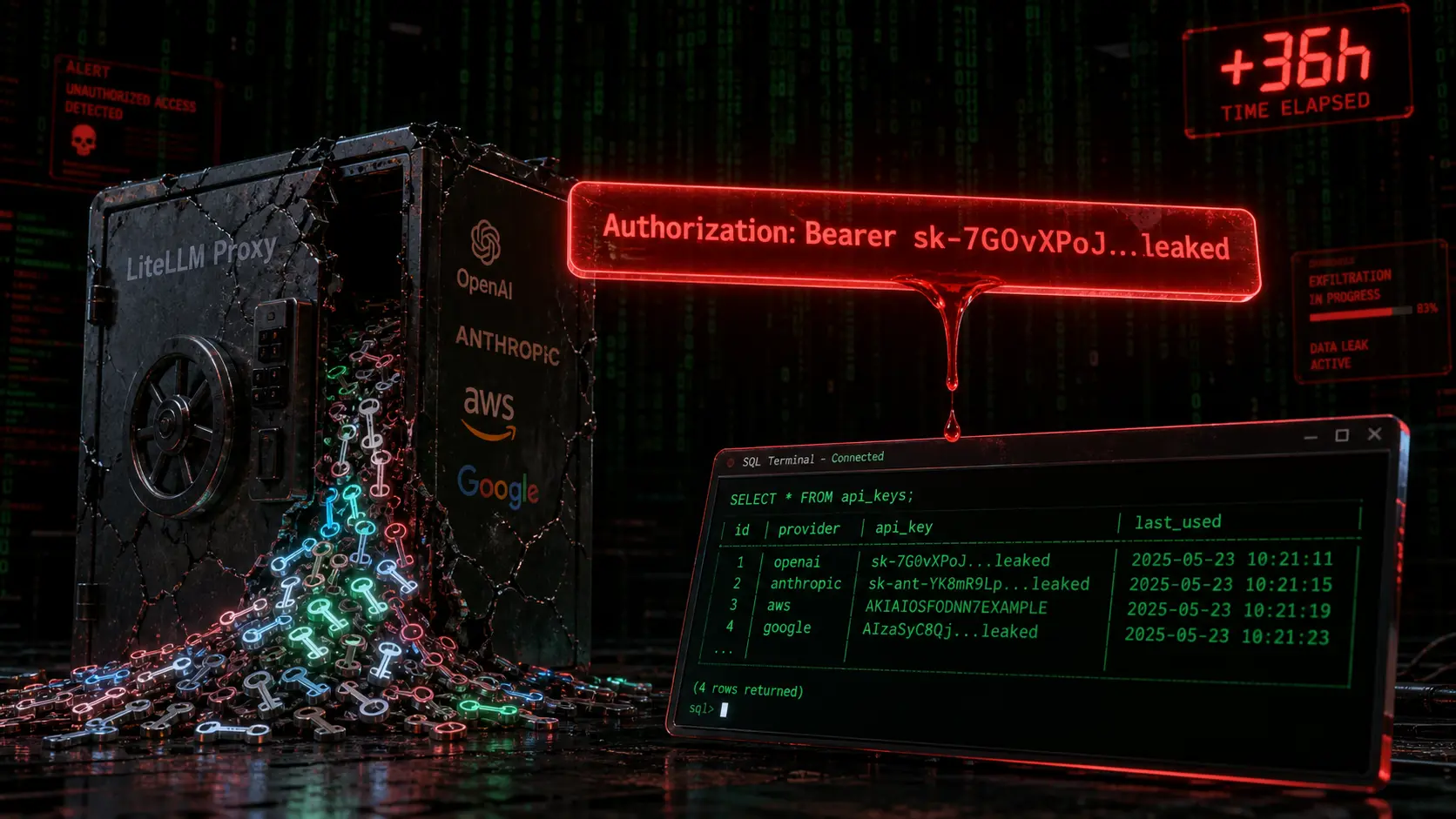
A pre-authentication SQL injection in the LiteLLM proxy's API-key check leaked virtual API keys, stored provider credentials, and the proxy's environment variables. CVSS 9.3. First in-the-wild exploitation: ~36 hours after public disclosure. Every line of the post-mortem hits the four pillars — input validation, authn/authz, third-party packages, and CIA — at the same time.

LiteLLM is the open-source "LLM gateway" that 22,000+ teams sit in front of OpenAI, Anthropic, Google, AWS Bedrock, and friends. It does auth, routing, rate limiting, and cost tracking, and because of that, it holds the most valuable secrets in your entire AI stack: virtual API keys, the upstream provider credentials, and the proxy's env-var configuration. On April 19, 2026, version 1.83.7-stable shipped a fix for CVE-2026-42208. By April 21 at 16:17 UTC — roughly 36 hours after the GitHub Advisory was indexed — researchers at Sysdig captured the first in-the-wild exploitation attempt. It was not a generic sqlmap spray. It was a deliberate, schema-aware enumeration of the three tables that hold those exact secrets.


1. The Bug, in One Sentence


The query that LiteLLM runs to verify a caller's API key concatenated the caller-supplied Authorization header value into the SQL string instead of binding it as a parameter. Reachable pre-auth via any LLM API route, because the error-handling path executed the lookup before any access decision. CVSS 9.3.


2. Four Pillars, One Bug


This single CVE is a perfect classroom example of how the four classic AppSec concerns are not separate disciplines — they all collapse into the same incident the moment one fails.


Input validation & injection defense. The fix is the textbook one: parameterized queries. There is no "sanitize the header" that ever beats binding. Mago's SQL-string lint (see today's PHP story) would have caught this in CI. So would a five-minute static analysis pass with Semgrep or CodeQL.


Authentication & authorization. The lookup ran before the auth decision. That is structurally the same mistake as path traversal in a router: you executed the side-effect on the way to deciding if the caller was allowed to trigger it. Auth checks must happen on the cheapest possible path, with no DB call dependent on raw user input.


Open-source & third-party package security. LiteLLM is your supply chain. Twenty-two thousand stars does not equal "safe" — it equals "extremely high blast radius if wrong." Software Bills of Materials (SBOMs), automated advisory scanning (GitHub Dependabot, Snyk, Renovate with vuln gates), and a rolling exposure dashboard for "which of our services run an LiteLLM version older than 1.83.7?" are no longer optional.


CIA core concepts. Confidentiality lost: every virtual key and upstream credential the proxy held was readable. Integrity lost: the attacker could write to the same DB. Availability lost: by rotating or revoking keys, an attacker could brick the proxy for legitimate users. One bug, three letters.


3. Detection You Should Run Tonight


If you operate any LiteLLM proxy, query your logs for Authorization header values containing single quotes, comment markers (--, #, /*), or boolean tautologies. Hit your DB audit log for any SELECT against the keys/credentials/env tables originating from the API-key-check codepath in the last six weeks. Rotate every virtual key and every upstream provider credential the proxy stored, even if the audit looks clean — the cost of rotation is finite, the cost of a quietly leaked OpenAI billing key is not.


4. Patterns Beyond LiteLLM


The class of bug here — user-controlled input reaching SQL via the credential check itself — exists in roughly every PHP/Node/Python project that someone wrote "real fast in 2023." Audit your own code for: any DB query inside a middleware that runs before authn; any string interpolation reaching a query builder; any "just for logging" debug query that takes raw header values. The 36-hour gap between fix and exploit is now the median, not the worst case.


My Take


What makes CVE-2026-42208 the textbook case of 2026 is not the bug — it is the timeline. Disclosure used to give defenders weeks. We are now measuring exploitation in tens of hours, against repos with five-figure star counts, with attackers who arrive with the schema already memorized. The defensive posture this implies is uncomfortable: assume that for any high-value open-source dependency, the gap between "public CVE" and "your prod is being scanned for it" is one workday. That changes how you do change management. Kill manual CVE triage; auto-merge security patches for vetted dependencies; gate deploys on SBOM age; rotate secrets on a schedule, not on detection. The teams that already work this way shrugged at LiteLLM. Everyone else spent the weekend rotating keys.


Sources