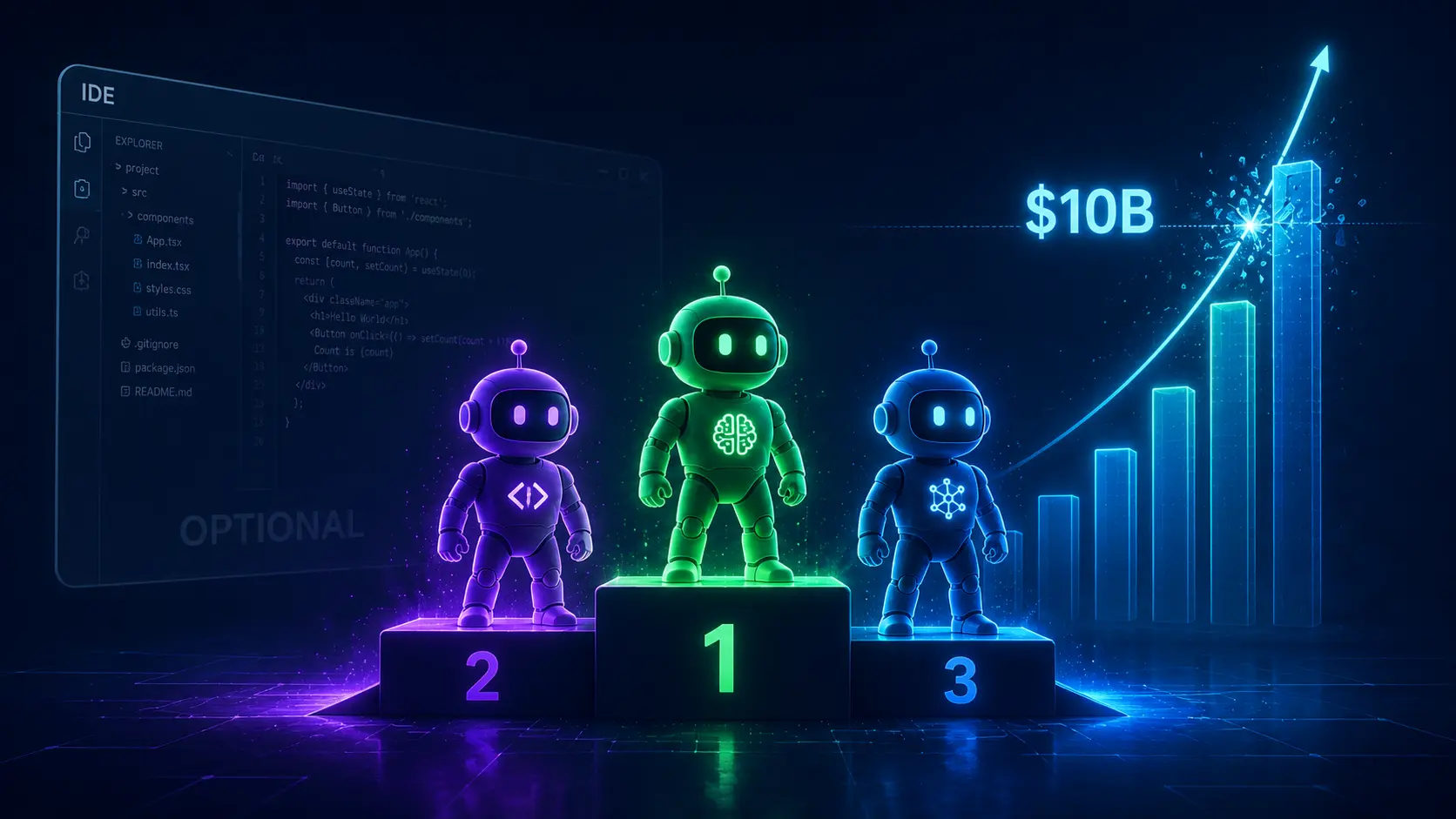
On May 20, 2026, Gartner issued a verdict the whole software industry has been re-sharing: the market for Enterprise AI Coding Agents has entered a new phase of "expansion and competitive realignment." The numbers behind it carry weight — as of April, the market's annualized size sits at roughly $9.8 billion to $11.0 billion, and the momentum comes from four directions at once: frontier model providers moving up the application stack, increasingly agentic workflows, capability spreading across the entire software development life cycle (SDLC), and ever more complex pricing and ROI models.
The most vivid prediction: by 2027, more than 65% of engineering teams using agentic coding will treat the IDE as optional. Control, governance, and validation are migrating away from "the editor where an engineer types by hand" toward "automated platforms."
1. A Three-Way Race Takes Shape
This isn't science fiction — in May alone, Google launched Antigravity 2.0, a standalone desktop app that orchestrates multiple agents in parallel; Anthropic added self-hosted sandboxes and an "MCP tunnels" preview to Claude's managed agents; and xAI formally entered with Grok Build, turning the field into a three-way race between Claude Code, OpenAI's Codex CLI, and Grok Build. On adoption, 55% of respondents now use AI agents regularly, rising to 63.5% among staff+ engineers.
2. Where a Team's Value Migrates
When the IDE becomes optional, the scarce skill is no longer "being able to write code" but "being able to define the problem, design acceptance criteria, and review agent output." An AI agent can produce a Laravel CRUD module, the matching Flutter screens, and even the tests in an afternoon — but it cannot tell the difference between what a client says they want and what they actually need.
My Take
For small-and-midsize dev teams and freelance studios, the signal isn't "go buy the most expensive agent," but "redesign your delivery process." A team's value is migrating to both ends: upward into requirement decomposition and architecture decisions, downward into quality control and security review, while the "pure typing" in the middle gets eaten by agents. The three-way competition is good for clients: prices get pushed down, capability gets pushed up. But don't forget the "complex pricing and ROI" Gartner specifically flagged — heavy agent use produces a hefty token bill, and building cost governance into your process matters as much as building the agents in.
Sources
- Gartner: Enterprise AI Coding Agents Enter a New Phase of Expansion and Competitive Realignment
- Enterprise AI Coding Agents: 2026 Market Guide & Trends — Gartner
- xAI Enters the Coding Agent Race With Grok Build — DevOps.com
- May 8, 2026: AI updates from the past week — SD Times