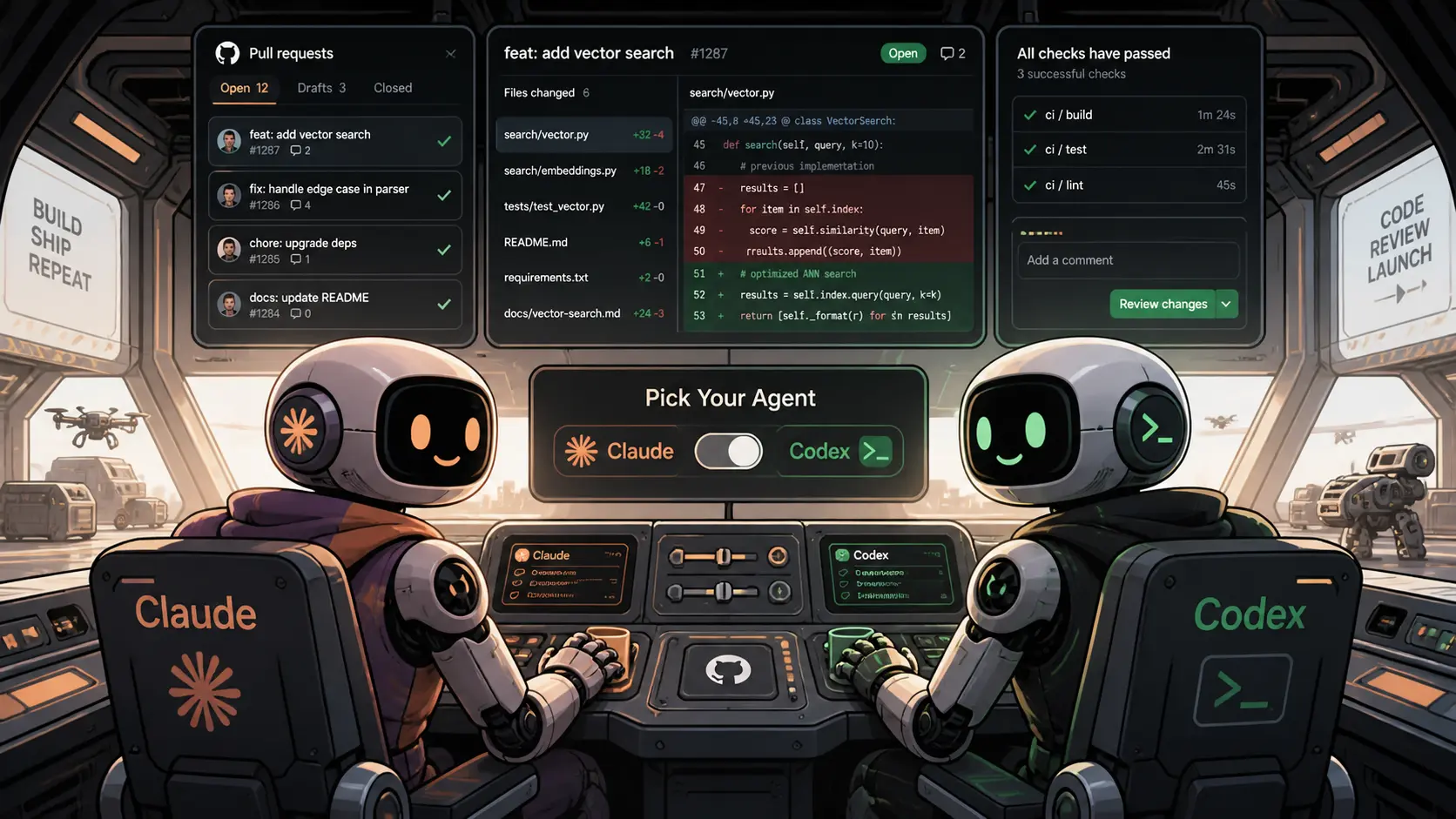
GitHub stacked up enough updates last week that, taken together, they amount to a single message: the "one AI assistant rules them all" era is over. Your repo now hosts both Claude and Codex as cloud agents, and you choose which one handles a given ticket through the new "Agent HQ" surface. Visual Studio gained a Cloud Agent picker so you can dispatch tasks to a remote runner directly from the editor, and cloud-agent startup time was just optimized by another 20% — which matters most to solo devs who can no longer use the warm-up window as a coffee break.
The more practically important change is per-task model selection on github.com. In real life, this lets you assign different models inside the same repo on a per-issue basis: route architecture discussion, long-file reasoning, and refactor reviews to Claude; route greenfield codegen and test scaffolding to Codex; and pull C++ symbol navigation through the now-GA C++ Code Editing Tools. For PHP, Laravel, and full-stack folks, here's the workflow that actually pays off:
Step 1 — Plan with Claude
Write a GitHub Issue in clear natural language (why, what files, what API shape) and tag @claude to return a three-part "Plan + Blast radius + Risks" answer. Claude is still the stronger pick for cross-file reasoning and prescriptive code review.
Step 2 — Land with Codex
Paste Claude's plan into a fresh issue and tag @codex to open the PR. Codex is fast and deterministic on bounded codegen — adding tests, filling types, building scaffolds.
Step 3 — Cross-review
Request a review from @claude on Codex's PR. Claude tends to be pickier than Codex about missed edge cases, security anti-patterns, and performance regressions. McKinsey's early-2026 study of 4,500 developers found AI tools save 46% of routine coding time, but defect rates rise ~1.7× without disciplined review.
Step 4 — Ship the Last Mile Yourself
Anything touching money, privacy, or irreversible state (DB migrations, deletes, payment flows) gets a human-made final call. No exceptions.
My Take
People keep framing "which AI agent should I pick" as a brand fight. In 2026 the better framing is per-task: is this a planning ticket, a building ticket, or a reviewing ticket? Claude versus Codex now reads more like "senior planner" versus "fast hands." Most weeks you need both; pick only one and you tilt the work.
For small teams, Agent HQ's real dividend isn't cost reduction — it's the ability to run two work streams in parallel. You drive Claude through next-sprint planning while a second agent finishes the work-in-flight PR. The first time you watch two PRs progressed by agents in the same hour, you don't go back. Just don't lose sight of that 1.7×: human review is not optional, it is the reason the workflow has positive ROI at all.