AI & Automation

Google Just Removed the AI Overviews Grace Period — Deindexed Sites Now Disappear from AI Answers the Same Day

2026.05.26 · 63 views
Google Just Removed the AI Overviews Grace Period — Deindexed Sites Now Disappear from AI Answers the Same Day

For 18 months, sites hit by a manual action stayed in AI Overviews for a few days after classic Search dropped them. As of the Memorial Day weekend, that gap is gone — and the May 2026 Core Update is happening on top of it.

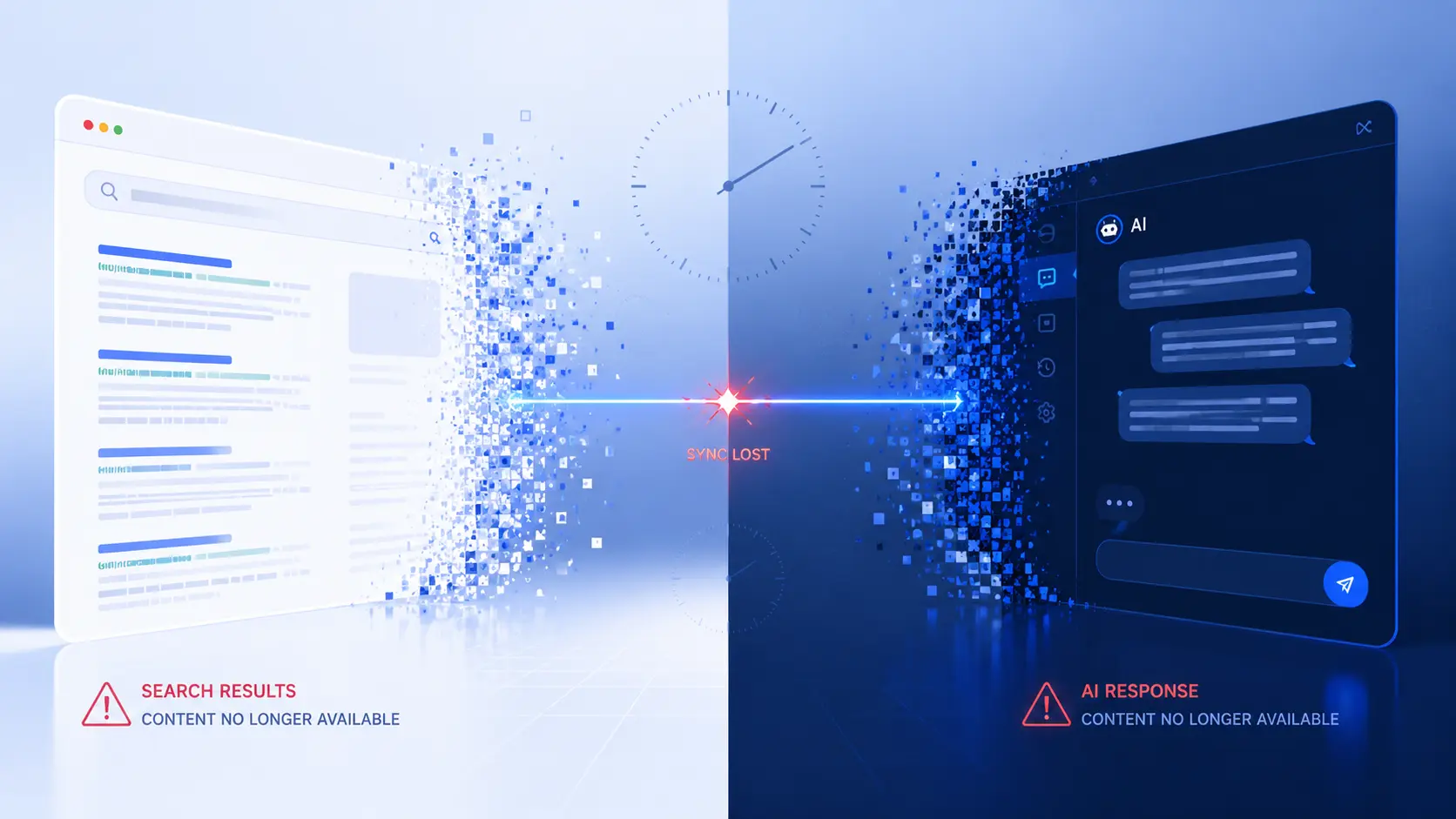
Over the May 23–25 Memorial Day weekend, SEO veteran Glenn Gabe (G-Squared Interactive) ran a test that closed a loophole the SEO community had been quietly relying on since November 2024: he checked whether a freshly deindexed site was still appearing in Google's AI Overviews and AI Mode. For eighteen months the answer had been "yes, for a few days." This time the answer was a clean "no." Search Engine Roundtable picked up the finding on May 25 and made it the lead item of its daily recap. The pipeline between classic Search and Google's AI surfaces is now synchronized.


This sounds small. It is not. It changes how every PHP/Laravel content site, every Nginx-fronted CMS, and every agency-managed brand site needs to think about indexability incidents for the rest of 2026.


1. The Old Behavior, and Why People Quietly Relied On It


For most of 2024 and 2025, AI Overviews and (later) AI Mode were drawing from a slightly stale snapshot of Google's index. If a site got a manual action, lost rankings to a core update, or got deindexed for serving thin auto-generated pages, the immediate hit landed in classic Search — but AI Overviews and AI Mode kept citing the site for two to seven days. That window was a "soft landing." It bought ops teams time to find the cause, fix the page, and request reindexing without watching the AI-surface traffic collapse the same hour.


It also produced a strange asymmetry: the lowest-quality auto-generated content on the web was over-represented in AI answers for a few extra days every time Google cleaned house. That is the asymmetry that just ended.


2. What Glenn Gabe Confirmed


Gabe's test was the kind any agency could replicate. He took a domain that had been freshly deindexed by Google, ran a series of AI Mode and AI Overviews queries for which the site previously appeared, and recorded the responses. Result: zero citations, no link cards, no mention. He cross-checked with Search Console: the site was confirmed deindexed in classic Search at the same point in time. The pipelines are now aligned in near real time.


Search Engine Roundtable's Barry Schwartz published the aggregated finding on May 25 and noted that this matches Google's broader pattern over the last six months — unifying signals across classic Search and AI experiences rather than running parallel pipelines.


3. Why the Timing Stings: The May 2026 Core Update Is Still Rolling


The May 2026 Core Update started on May 21 and is expected to complete around June 4. The update is rewarding original expertise, named authors, and first-party data while demoting AI-shape-fitted content (FAQ-stuffed pages, mechanically expanded "as an AI" boilerplate, recipe-style content with no original photography). Search Engine Roundtable's May 25 recap noted that the update intensified over the weekend.


Stack that on top of the lag removal and you get a new operational reality: a site that loses positions during this core update will lose AI Overviews and AI Mode visibility in the same hour, not in the same week. The cushion that softened the cost of a quality demotion is gone.


4. What Web Developers and Backend Teams Should Do This Week


Four concrete moves that take a single sprint:


One: tighten your indexability monitoring. If you only check Search Console once a week, you are now exposed to multi-day AI-surface drops you cannot explain. Set a daily alert on coverage errors, manual actions, and indexed page counts. For a Laravel stack, this is a Forge cron + a one-page Blade dashboard, not a SaaS purchase.


Two: audit your robots.txt and noindex rules. A misplaced noindex on a CMS template now costs you AI-surface visibility the same day it costs you organic clicks. Re-run a full site crawl after every CMS or Nginx config change.


Three: instrument 5xx alerting on the bot user-agents. A run of 503s from your Nginx layer when Googlebot, GPTBot, or PerplexityBot hits your site no longer just delays indexing — it now suppresses AI citations the same day. Alert if 5xx rate to known crawlers exceeds 1% over a 15-minute window.


Four: separate "thin" auto-generated content into a clearly marked subfolder, or kill it. The May 2026 Core Update is demoting this content category aggressively, and the lag removal means the AI-surface hit lands in real time. If you have an SEO landing-page farm built in 2024 that nobody has touched in a year, it is a liability.


5. The FAQ Schema Side-Effect


Worth a brief note: Google removed FAQ rich results on May 7, 2026, and Gabe has separately noted that FAQ structured data is no longer weighted as a primary signal across AI surfaces. Combine that with the May core update penalizing FAQ-stuffed pages and the lag removal making the penalty land immediately, and the takeaway is unambiguous: do not redesign 2026 content around FAQ schema. Use it only where the page genuinely is an FAQ, and stop force-fitting question-and-answer blocks onto product, service, and landing pages.


6. What This Implies About Google's AI Pipeline


Reading between the lines, this unification suggests Google has finished migrating AI Overviews and AI Mode off whatever staging or cache layer was producing the lag and onto the same retrieval-augmented generation path that touches the live classic index. That is a useful piece of infrastructure intelligence. It means future indexing changes — for better or worse — will propagate to AI surfaces immediately. It also means future AI-Mode-specific quality signals (if Google introduces any) will piggyback on the classic index rather than running in parallel.


My Take


The teams that will struggle with this change are the ones that have been treating AI Overviews and AI Mode as a side experiment. The teams that will thrive are the ones who already operate their indexability monitoring as a tier-1 service: same alerting discipline as application errors, same SLA on remediation. Two years ago, "your AI-surface visibility just dropped" was a niche concern. Today it is a CEO-level metric for any consumer-facing brand, and Google just made the failure mode faster and harsher. The healthy response is boring and disciplined: monitor more, change less without measuring, and stop building content that only exists to be parsed by a machine. The May 25 lag removal is not a punishment for anyone who has been doing the work properly. It is an accelerator that rewards them faster.


Sources


AI & Automation Back to Blog