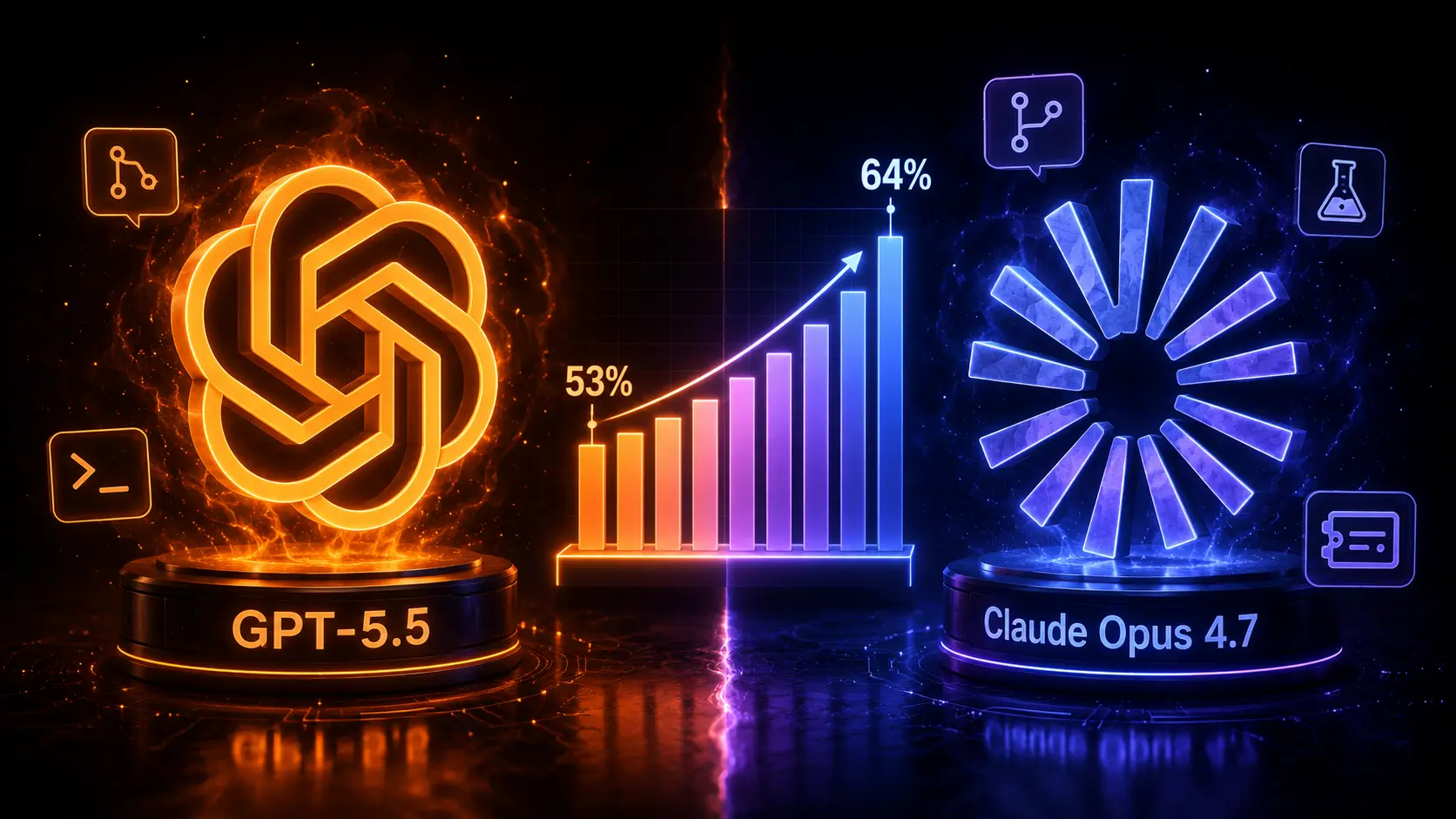
Two big things happened in the AI coding world in the last thirty days. On April 16, Anthropic released Claude Opus 4.7, pushing SWE-bench Pro from 53.4% to 64.3% and reclaiming the coding crown. A week later, on April 23, OpenAI countered with GPT-5.5 — pitched as their "smartest, most intuitive, most agentic" model — beating both GPT-5.4 and Opus 4.7 on autonomous task completion, cross-tool operation, and long-horizon work.
So through May, the conversation in the AI coding world shifted from "which model writes more accurate code?" to "which model can actually finish a Jira ticket on its own?" For agencies, outsourcing shops, and in-house small teams, this line moving directly changes how we should be splitting daily work.
1. What 64.3% on SWE-bench Pro Really Means
SWE-bench Pro is currently the industry's most demanding "real-world GitHub issue solving" benchmark — feed the model a real OSS issue and see if it can read the codebase, write the patch, run the tests, and verify the result, end-to-end. Opus 4.7 hitting 64.3% means:
- Medium-difficulty bug fixes (single file, unit test already exists): >70% success rate fully unattended.
- Cross-file, cross-module refactors: ~50% success — not fire-and-forget, but reviewing is way faster than writing.
- New feature work (new tests, schema changes, migrations): 30–40% success — still firmly in the engineer's lane.
GPT-5.5's SWE-bench score is comparable, but it pulls ahead on "cross-tool operation": opening PRs, kicking off CI, replying to reviewer comments, fixing lint failures. OpenAI's internal demo is "give it a Linear ticket, watch it run all the way to a merged PR."
2. The "Officially Outsourceable to AI" Task List, As of May 2026
Based on a month of production reports from engineering leads running both models, the following tasks can now be safely handed to an AI agent with engineers only in the review seat:
- Unit test generation — give it a class, get 80% coverage including edge cases.
- API client SDKs — feed it an OpenAPI spec, get back PHP / Dart / TypeScript clients.
- Laravel migrations and seeders — describe the schema, get the migration, factory, and seeder fully wired.
- Flutter UI scaffolding — screenshot of the design plus a paragraph of intent, get the widget tree (minus the messy business logic).
- Error message i18n — give it zh-TW source strings, get en / ja / ko / zh-CN translations with the correct keys.
- Deprecated API upgrades — e.g. Laravel 11 → 13, Flutter 3.27 → 3.41 API rewrites.
- PR descriptions and changelogs — synthesize PR descriptions and release notes from commit history.
3. The "Still Not Outsourceable" Task List, As of May 2026
For these, the agent can accelerate you, but it cannot make the call:
- Database schema design — the model writes SQL beautifully but won't ask "does this business case really need 3NF?"
- Authorization modeling — once your RBAC, ABAC, or tenant isolation is wrong, fixing it costs a full-stack rewrite.
- Payment integrations — too many edge cases (partial refunds, subscription downgrades, multi-currency, 3DS fallbacks); any hallucination becomes a customer complaint.
- Performance tuning — it can read your EXPLAIN, but "do we add an index or rearchitect this query?" needs a human.
- Security decisions — CSP, CORS, JWT vs session — the AI's answer is often technically correct but business-wrong.
4. The New Workflow: AI-First, but Human Checkpoints Stay
A consistent pattern from teams that are getting 2–3x productivity gains from agents:
- Engineering lead writes the ticket — more specific than before, with explicit acceptance criteria and a schema-impact note.
- AI agent picks up the ticket — auto-branches, implements, writes tests, opens a PR.
- Human reviewer holds three checkpoints:
- Is the schema/migration sensible (not just runnable)?
- Are any authorization or security boundaries broken?
- Performance regressions (query count, payload size, bundle size)?
Average ticket-to-ready-for-review drops from 4–8 hours to 30–60 minutes. The engineer's job moves from "writing" to "defining and gatekeeping."
My Take
"Will AI replace engineers?" is no longer a useful question in 2026. The new question is: are you willing to spend a month rewriting your ticket templates, PR templates, CI pipelines, and review checklists into formats an AI can actually work with?
Teams that won't will keep shipping at 2024 speed. Teams that will, will take twice as many projects with the same headcount. The gap becomes impossible to ignore in H2 of this year.
GPT-5.5 or Claude Opus 4.7? My practical recommendation: use Opus 4.7 for the actual code, GPT-5.5 for agentic workflows (cross-tool, long-horizon, auto-PR). Run both. The combined monthly cost is less than a junior engineer's daily wage.