Web Development

Laravel Just Closed the Loop: PHP 8.4 + Laravel 12 + Cloud Now One Bill of Materials

2026.05.08 · 56 views
Laravel Just Closed the Loop: PHP 8.4 + Laravel 12 + Cloud Now One Bill of Materials

Why a "boring but coherent" PHP stack is now the most expensive thing your competitors are missing in 2026

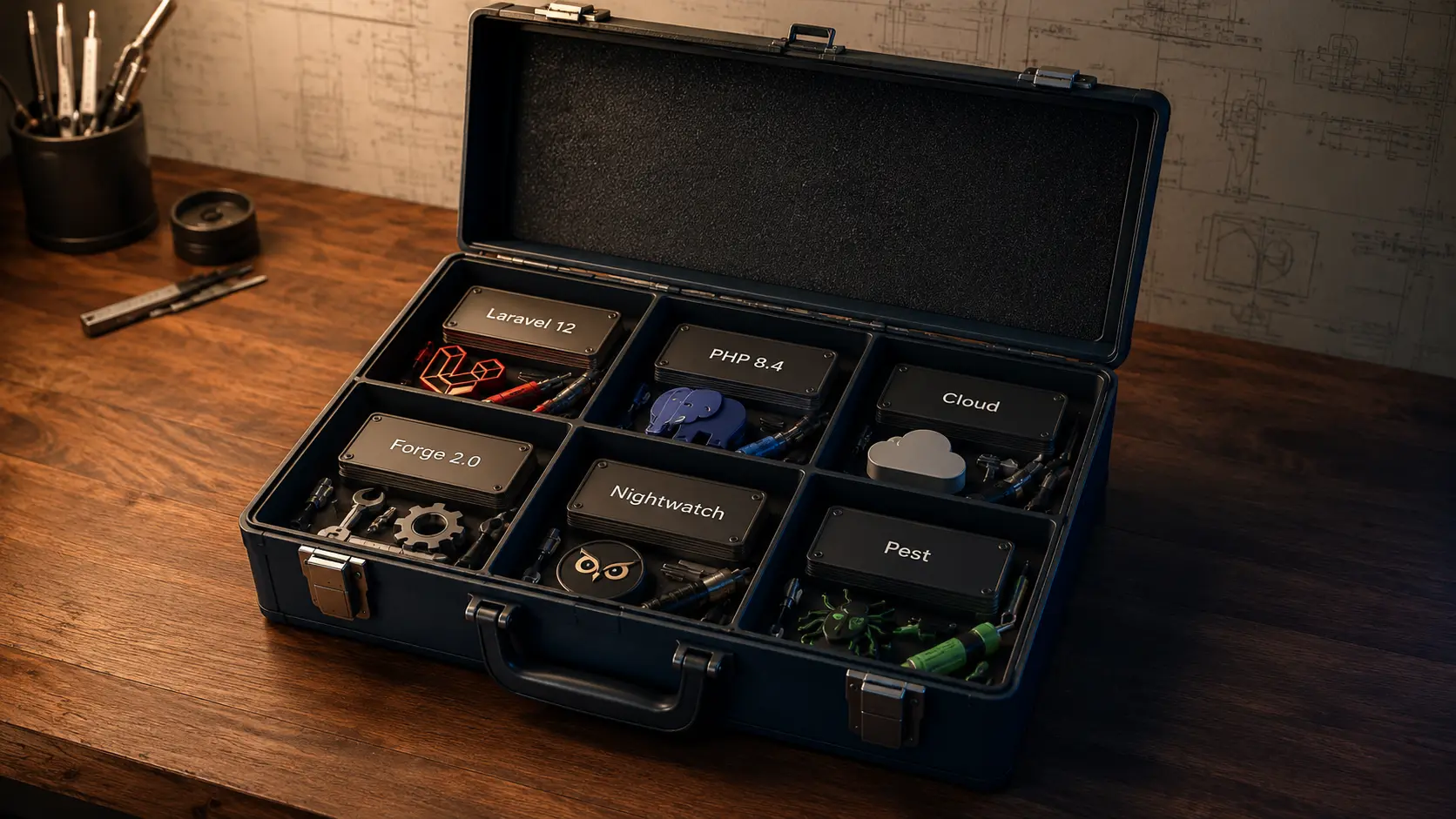
For seven years, the standard joke about hosting a Laravel app was: "first you set up Forge, then you wait." That joke quietly died this quarter. With PHP 8.4 confirmed as the recommended production version through end of 2028, Laravel 12 shipped under a zero-breaking-changes promise, and the Inertia.js Laravel adapter now sitting inside Laravel's official toolbox alongside Cloud, Forge 2.0, Nightwatch and Pest, the entire deploy-build-monitor pipeline for PHP teams sits under one roof for the first time.


Adoption tells the same story. The State of PHP 2026 report puts Laravel at 64%, Symfony at 23%, WordPress at 25% across active PHP shops. PHPStan jumped 9 points to 36%, Pest grew to 17%. PHP didn't reinvent itself; it stopped apologizing.


1. What "vertical integration" actually means


The pieces, all from the same ecosystem: Laravel 12 (framework), Laravel Cloud (managed deployment), Forge 2.0 (server provisioning), Nightwatch (production monitoring), Pest (testing), and Inertia/Livewire (frontend layer). The Inertia adapter is now formally maintained inside the Laravel organisation, removing the last "what if it goes unmaintained?" risk on the SPA frontend.


For an outsourcing studio this translates into something very concrete: you can quote a client a single bill of materials and a single failure surface. There is no longer a moment in the project where you have to explain "the framework is fine, the deployment provider is a third party, the frontend integration is a fourth party, and if any of them moves we have to refactor."


2. Why PHP 8.4 changes the cost model


PHP 8.4 brings property hooks, asymmetric visibility, and a smaller-but-faster JIT. For client work the practical impact is much simpler: same hardware, roughly 15-25% lower request latency on real Laravel apps, plus an official support window that runs longer than Node LTS. For shared-hosting customers and budget-sensitive SMEs, that's the difference between "we need to upgrade the VPS" and "we don't."


3. The GitHub side — what's actually getting stars in May 2026


Laravel itself sits past 80,000 stars. Symfony is at 30.1k. The genuine surprise of the year is the micro-framework rebound: Flight has crossed 2.8k stars and overtaken Fat-Free as the go-to "I just need a single endpoint" framework. Yii 3 has officially replaced Yii 2 for high-throughput shops. None of this would matter if PHP itself were stagnating, but State of PHP 2026 reports healthy growth in security tooling, IoT integrations, and chatbot adoption. The long tail is alive.


4. What an outsourcing team should change this month


Three concrete moves are due before June. First, add Pest as the default test runner for new repos and migrate one PHPUnit suite to validate the workflow. Second, run PHPStan at level 6+ on legacy projects you've inherited; the Laravel 12 upgrade docs assume it. Third, on any project still deployed manually via SSH, evaluate whether Forge 2.0 + Cloud is now cheaper than the maintenance hours you bill the client for "deployment fixes."


My Take


For a long time the conversation around PHP was defensive — "is it dead?", "should we just rewrite in Node?". The 2026 reality is the opposite: PHP has become the boring-but-coherent stack, and coherence is the most expensive thing in software right now. Coherence saves contracts. The teams that shipped a Next.js + Vercel + tRPC + Drizzle + Clerk + Upstash + PostHog stack for a client in 2024 are quietly the same teams migrating to Laravel + Cloud + Inertia in 2026 — not because PHP is fashionable, but because the bill of materials fits on one A4 page and the client understands it. That's the win.


Sources


Web Development Back to Blog