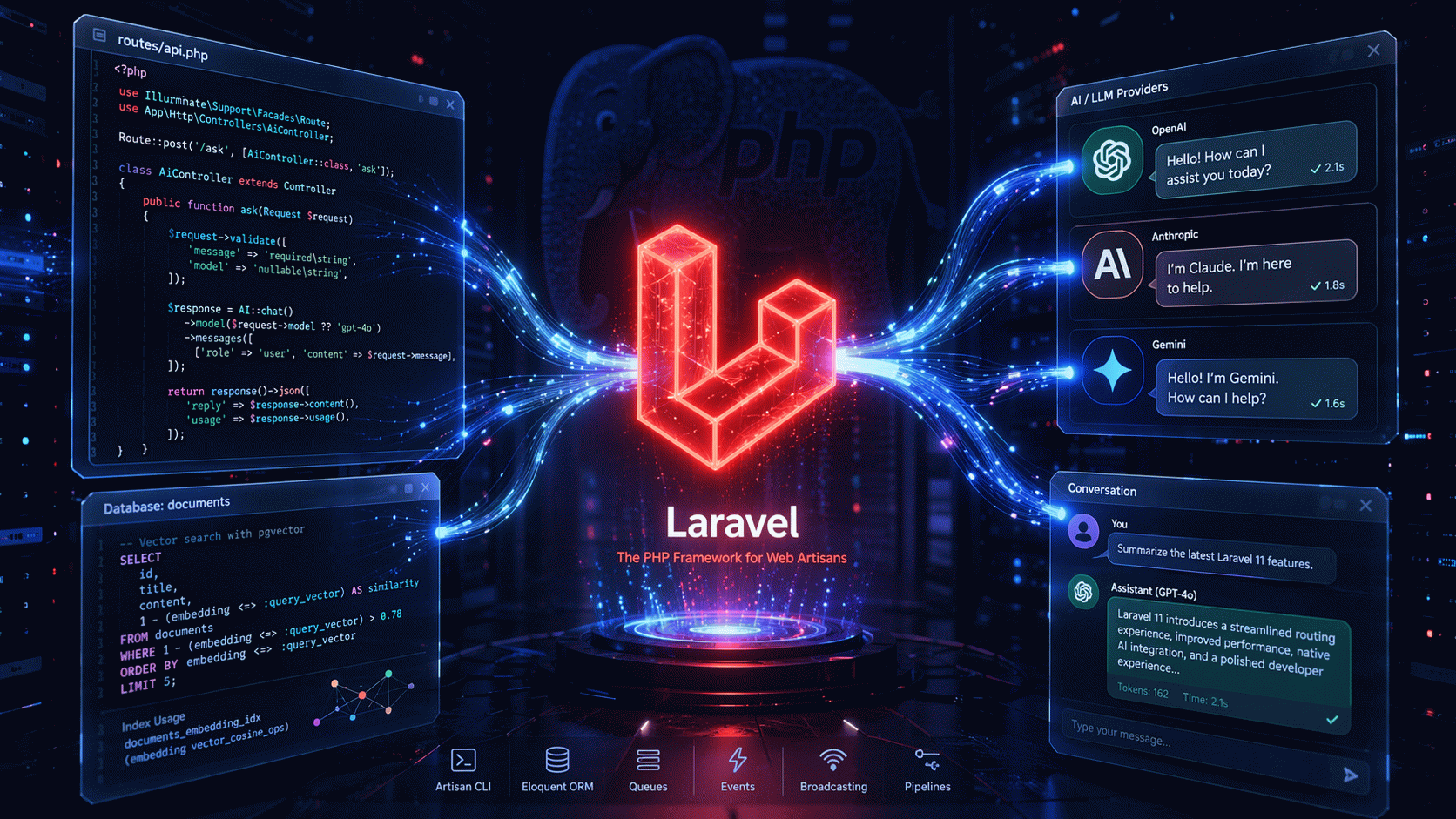
For years, the PHP community has fought the tired narrative that "PHP is dying." In March 2026, Taylor Otwell took the Laracon EU stage and answered that narrative in the only way that actually matters: he shipped product. Laravel 13 dropped with three first-party packages that, taken together, reposition PHP as arguably the most agent-ready web stack in the industry — laravel/ai, Laravel Boost, and Laravel MCP.
A Unified AI SDK for PHP
The headline piece is the AI SDK. Historically, if a PHP developer wanted to integrate OpenAI, Anthropic, and Gemini, the path was a patchwork of community SDKs, each with its own syntax, error model, and retry logic. Swapping a provider meant rewriting half of a feature. Laravel 13 replaces all of that with a single, provider-agnostic interface: text generation, tool-calling agents, embeddings, image generation, audio synthesis, transcription, and vector databases — all exposed through one unified API. More than ten providers are supported at launch, including OpenAI, Anthropic, Gemini, Groq, xAI, DeepSeek, and Ollama. That is not an integration. That is an abstraction layer.
Boost: Turning Your AI Agent Into a Laravel Specialist
The second package, Laravel Boost, solves a subtler but arguably more important problem. Anyone who has pair-programmed with a general-purpose coding assistant inside a Laravel project knows the frustration: the AI hallucinates facade calls, forgets about Eloquent relationships, and writes Blade templates that would make a senior dev cry. Boost is an MCP (Model Context Protocol) server with more than fifteen Laravel-specific tools and an embedded library of 17,000+ curated pieces of Laravel knowledge. When you install Boost, your AI agent stops being a generalist and becomes a Laravel specialist that understands your routes, your migrations, your .env, and your conventions.
The third piece — Laravel MCP — flips the arrow. If Boost helps AI write better Laravel code, MCP lets your Laravel application expose itself to external AI tools as a first-class MCP server. In other words: the same framework now participates on both sides of the agent conversation.
Why This Matters for Databases
Vector search used to be the reason developers left PHP. If you wanted semantic search over documents, you reached for Python, pgvector, or a dedicated vector database. Laravel 13 ships vector search as a built-in primitive of the AI SDK. Embeddings, similarity queries, and RAG pipelines are now native to Eloquent-style thinking. A small team running MySQL or Postgres can now ship a production RAG feature without adopting a new language or new infrastructure.
My Take
I have spent years watching the narrative that PHP is a legacy language that happens to still be popular. Laravel 13 doesn't refute that narrative by arguing — it refutes it by showing up first. Compare this to the current state of Node, Django, and Rails: none of them ship a first-party, provider-agnostic AI SDK combined with a framework-specific MCP server, and none of them bundle vector search into the ORM story. For the first time in a long time, "start a new AI-powered product on Laravel" is not a compromise — it might actually be the fastest path.
The deeper story is about defaults. Taylor Otwell has always understood that frameworks win by shipping opinionated defaults — and the most valuable default of 2026 is not how you structure controllers, but how your app talks to models. By taking a position on AI, vector search, and MCP, Laravel 13 is defining what a "standard" AI-powered web application looks like. PHP developers who were quietly waiting to be told that their stack was obsolete just got told the opposite: you're home. Go build.