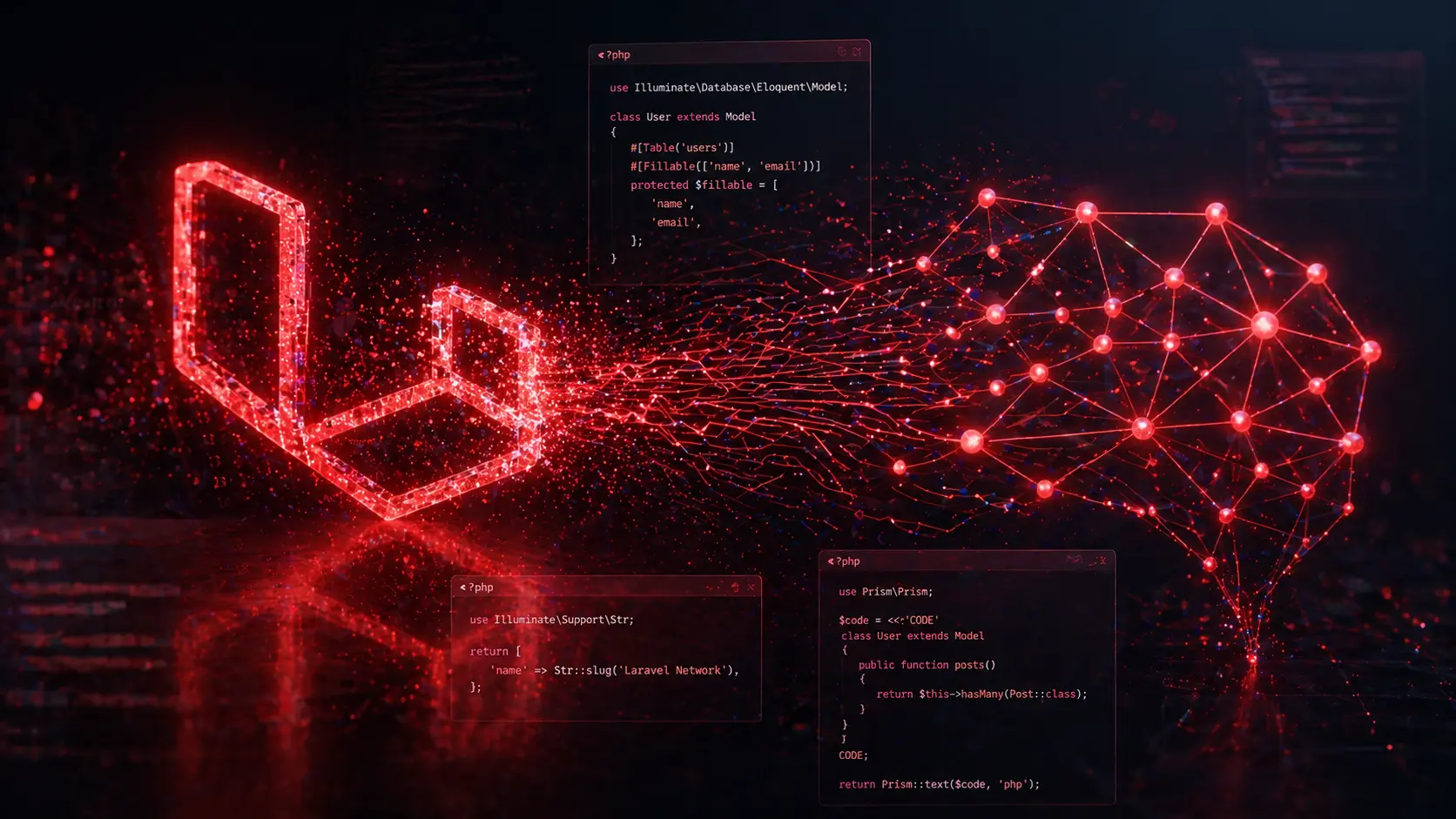
It is rare for a Laravel release to feel like a strategic inflection point rather than a maintenance bump, but Laravel 13 — shipped last month and now being adopted in earnest across production codebases — is the rare exception. Three of its headline features point in the same direction: PHP teams are no longer expected to bolt AI capabilities onto a web app; they are expected to build web apps for an AI-mediated world. If you ship anything serious in PHP, this release deserves a serious look this quarter.
1. The AI SDK Leaves Beta — and Quietly Changes the Default
The biggest shift is the Laravel AI SDK going production-stable on the same day Laravel 13 launched. It is now a first-party package with a single, provider-agnostic interface for text generation, tool-calling agents, image creation, audio synthesis, and embeddings. OpenAI, Anthropic Claude, and Google Gemini ship as first-party providers; Mistral, xAI, and Ollama are community providers with the same surface area. The implication for engineering managers is that "should we use a Python micro-service for the LLM bits?" is no longer the obvious answer. An Eloquent model with ->summarize(), a job that drafts replies via tool-calling, and a queue that routes embedding work to a dedicated connection all live inside the same monolith you already deploy. Less rope, less infra, fewer cross-team handoffs.
2. Native Attributes Everywhere
Laravel 13 lets you replace scattered properties — $table, $fillable, $hidden, $primaryKey, $casts, and a dozen more — with PHP 8 attributes at the top of the class. The win is not aesthetic. The win is that your model's contract is now in metadata that IDEs, static analysers, and AI agents can parse without running your application. PHPStan and Larastan benefit. Cursor and Claude Code benefit. New hires benefit. The cognitive cost of opening an unfamiliar Eloquent model drops measurably.
3. JSON:API Out of the Box
First-party JSON:API resource classes finally make response shapes, relationship inclusion, sparse fieldsets, and link headers spec-compliant by default. If you have ever spent a sprint reverse-engineering why your front-end's relationship endpoint returns slightly different envelopes than your mobile app expects, you will care about this. JSON:API has always been the "right" answer for serious APIs; Laravel 13 makes it the cheap answer.
4. Queue::route() and the Operational Story
A small, easy-to-miss feature: Queue::route() lets you declare in a service provider exactly which queue and connection a given job class uses. It separates infrastructure decisions from business logic so completely that you can move a job from redis to sqs to database without touching the job. For SaaS teams running multi-tenant background work, this is the cleanest queue-routing primitive Laravel has ever had.
5. Security and Passkeys
The PreventRequestForgery middleware is now formal, with origin-aware verification on top of the classic CSRF token. Fortify and the starter kits gain passkey support. Combined with the SDK's ability to delegate "is this request suspicious?" to an LLM-powered checker, the toolbox for PHP teams that want WebAuthn-grade auth without buying a vendor is suddenly a lot fuller.
6. The Non-Trivial Cost: PHP 8.3 Minimum
Laravel 13 drops PHP 8.2 entirely. If your shared hosting story still has 8.2 customers, that is the migration project you actually need to plan first. The good news is PHP 8.5 is already shipping, with the pipe operator (|>), clone with, array_first() / array_last(), the #[NoDiscard] attribute, and OPcache permanently compiled in — the language itself has not been this expressive in years.
What This Means for App and Database Teams
Mobile and desktop teams should care because the AI SDK and JSON:API combo lets a single PHP backend serve a web client, a Flutter app, and a Claude Code-style internal copilot from the same API surface. The historical "PHP is for web, Node or Python is for AI/realtime" division of labour is outdated. Eloquent's attribute-driven schema declaration also makes it easier than ever to keep your migration history, model class, and DBA-facing schema diagrams in sync — paired with PostgreSQL 17's incremental backups and partial vector indexes, you get a stack that scales the boring way.
My Take
Frameworks usually win in two ways: by making the easy thing default, or by making the hard thing tractable. Laravel 13 is doing both at once, in a year when the "hard thing" is integrating AI without taking on a second platform. The teams that ship a Laravel 13 upgrade plus an AI SDK pilot in Q2 will end the year with a measurable lead — not because the SDK is magical, but because their cycle time for adding LLM features will be a fraction of competitors who are still wiring three languages together. If you maintain a Laravel app, the right question this week is not "should we upgrade?" — it is "what is the smallest AI feature we can ship on top of the upgrade by end of quarter?" Pick that, and the rest of the migration will pay for itself.
Sources
- Laravel 13 Release Notes — laravel.com
- What We Know About Laravel 13 — Laravel News
- Laravel 13: Launch Date and New Features (News from Laracon EU) — LaravelDaily
- Laravel 13 (2026) Release: New Features and Upgrade Guide — PHP Everyday
- PHP in 2026 — stitcher.io