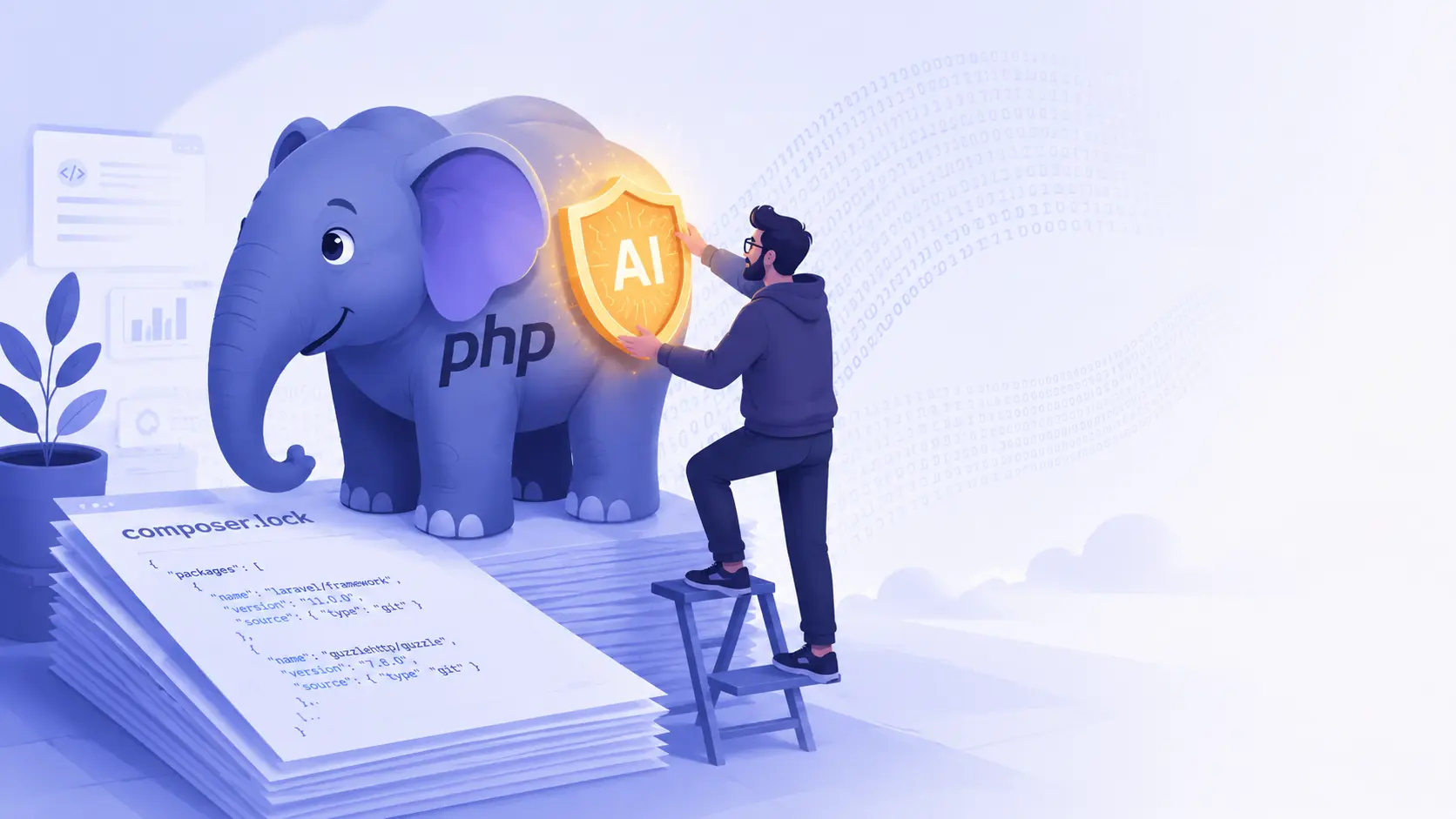
On May 26 2026, the PHP Foundation announced an Ecosystem Security Team funded by an Alpha-Omega grant, and named Volker Dusch as its first "AI Security Engineer in Residence" — a six-month full-time role focused on triaging vulnerability reports, building remediation tooling, and supporting underfunded maintainers. Read past the press-release language and you find two things: an acknowledgement that the PHP ecosystem has reached the same security-throughput crisis the npm and PyPI ecosystems hit in 2024, and an acknowledgement that the volume of AI-generated CVE reports has finally outpaced what unpaid maintainers can absorb. If you ship PHP or Laravel for a living, this is the most important governance news of the quarter.
1. What changed in the last 12 months
Two shifts converged. First, frontier coding models — Claude Opus 4.7, GPT-5.5, Cursor Composer 2.5 — became routinely capable of grepping a PHP codebase for unsafe deserialization, prototype-style class swap-ins, taint flows from request to query builder, and unsafe Blade {!! !!} usage. Security researchers (and a long tail of bug-bounty hunters) are now filing CVE reports written by AI in volumes that small package maintainers cannot triage. Second, attackers have started doing the same thing in the opposite direction: scanning Packagist for low-traffic but widely-installed packages, fuzzing them with model-driven inputs, and posting a CVE just long enough to time a supply-chain exploitation window.
The laravel-lang supply-chain attack on May 22 (three packages tagged with a credential-stealing payload that ran every time vendor/autoload.php loaded) is the textbook case. It was not particularly sophisticated — it was simply faster than the maintainers could respond.
2. What the Ecosystem Security Team actually does
Three concrete workstreams are public:
Vulnerability triage at scale. A single funded engineer reviewing incoming reports across the top 1,000 Packagist packages, ranking by severity and exploitability, and forwarding curated, deduplicated reports to maintainers instead of dumping raw AI output on them.
Tooling. Discovery and remediation tools designed for the modern PHP ecosystem — think automated composer audit hardening, a maintained safe-defaults SAST profile for Laravel, and CI templates that surface unsafe Blade and raw-query patterns before they merge.
Maintainer support. The "long tail" packages — the ones with one or two contributors that 40,000 Laravel apps still depend on — finally have a place to escalate. The Foundation will help with disclosure coordination, patch backporting, and (where appropriate) deprecation paths.
3. What this means for the Laravel teams I work with
Three working assumptions you should adopt this week:
Assume your composer.lock is a liability, not just an artifact. The era of "I'll composer update once a quarter" is over. Move to weekly automated audits with composer audit and Snyk or Dependabot, and budget an hour every Friday for someone — anyone — to read the diff.
Triage your dependency tree by maintainer count, not download count. A package with 10M installs and 12 active maintainers is safer than a package with 800k installs and one maintainer who hasn't pushed in 18 months. Run composer show --tree, mark the leaf nodes, and decide which ones to vendor in or fork. The five oldest unmaintained leaves in your tree are your supply-chain exposure.
Stop using {!! !!} without an explicit allowlist comment. The new SAST profile will flag every instance. If you cannot defend the {!! !!} in code review with a one-line comment naming the sanitizer, replace it with {{ }} or a custom Blade component. This is the cheapest XSS reduction you can ship this month.
4. The AI-generated CVE flood is real
Across all major ecosystems, CVE submissions are up roughly 3x year over year, and the PHP Foundation estimates that a meaningful fraction of recent reports were drafted with the help of an LLM. Most are real; some are hallucinated or duplicates of older issues; a few are speculative theory rather than reproducible exploit. The new team's most important short-term function is the human filter between "AI produced 600 reports this month" and "maintainers' inboxes."
The same pattern is hitting Python (PSF Alpha-Omega security engineer), JavaScript (npm Snyk-backed triage), and Rust (Foundation security WG). PHP is the latest, not the first.
5. The maintenance work nobody wants to fund
If you run Laravel commercially, the honest reading is this: the productivity gains of the last 18 months (Laravel AI SDK, Livewire 4, Octane on FrankenPHP) were earned partly by deferring this exact security maintenance bill. The Foundation is now starting to pay it on behalf of the ecosystem. Your job is to fund the equivalent work inside your own organization — a named owner for dependency hygiene, a quarterly SBOM review, and a written policy for what to do in the 90 minutes after a critical CVE is published. None of these are exciting. All of them will save you a weekend in the next 12 months.
My Take
The PHP Foundation hiring an "AI Security Engineer in Residence" is not branding — it is the most honest signal yet that the asymmetry between offence and defence in open-source PHP has flipped. Attackers can now use AI to find, exploit, and weaponize vulnerabilities faster than volunteer maintainers can patch them. Funded human triage is the bridge until tooling catches up. Every Laravel shop should read this announcement and ask one question: who in our company is the equivalent role? If the answer is "nobody, we hope nothing happens," you have a budget conversation to have this quarter. The teams that came out clean on the laravel-lang week were the ones who had answered that question before May 22 — not after.
Sources
- The PHP Foundation Launches an Ecosystem Security Team — Laravel News
- PHP Foundation Blog
- New "Level" of Laravel Security: laravel-lang Attack Example — Laravel Daily
- Alpha-Omega Project — OpenSSF
- OWASP Top 10 in Laravel: Real Vulnerabilities, Real Code Fixes (2026) — StackShield