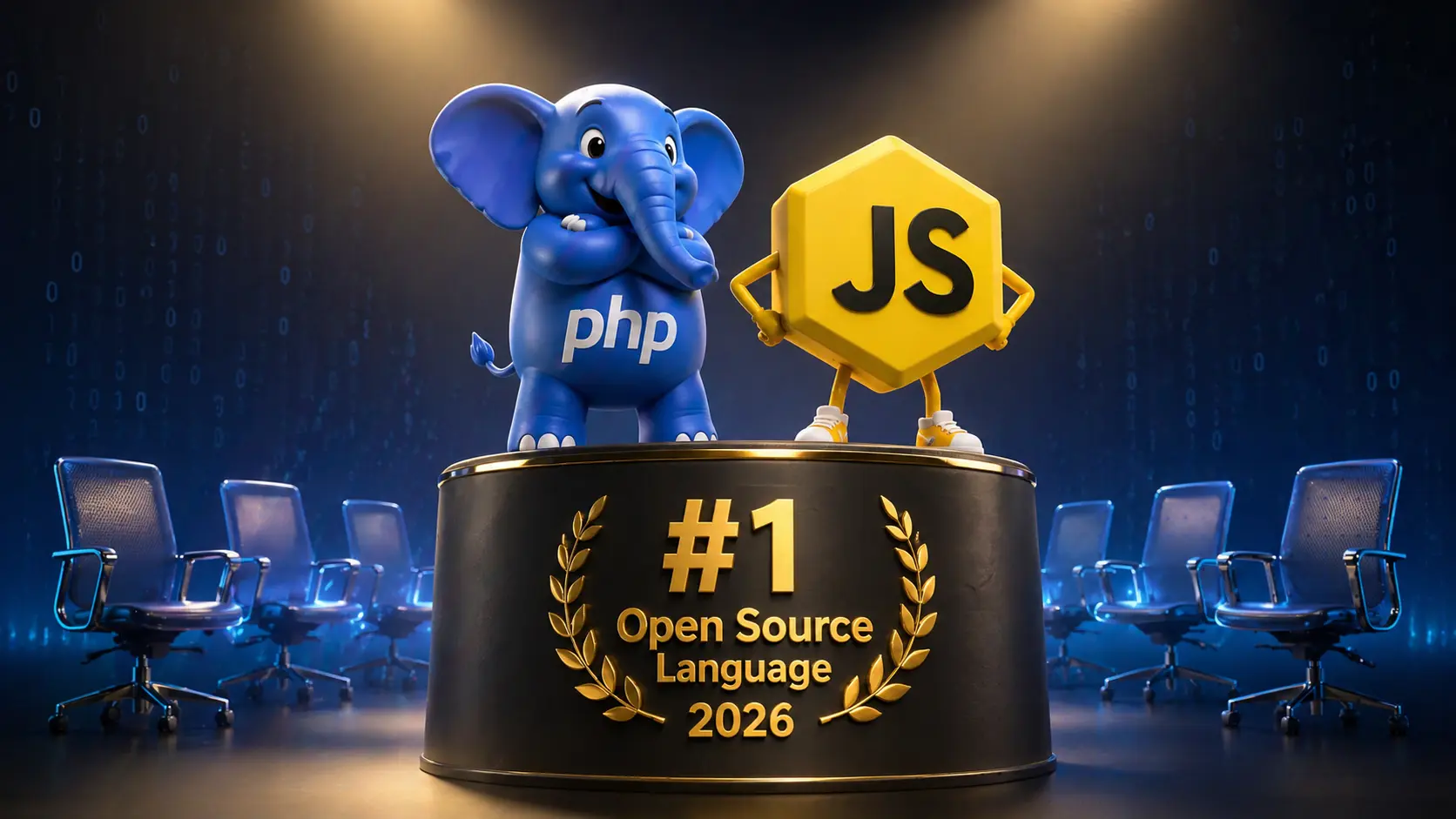
For the past decade the dominant narrative has been "PHP is dying." This week, Perforce's 2026 PHP Landscape Report quietly buried that narrative for good. Surveying more than 2,200 PHP teams worldwide, the report shows PHP tied with JavaScript as the most-used open-source language on the planet, ahead of Python, Node.js and Java. PHP 8.5.5 (released earlier this month) and the rapid uptake of FrankenPHP — which now ships official PHP Foundation backing and benchmarks at roughly 15,000 req/sec versus PHP-FPM's 4,000 in worker mode — have pulled the language back into modern, async, container-native territory. Laravel 13 (released March 17) and the new first-party Laravel AI SDK have done the same on the framework side.
So why isn't anyone celebrating? Because the same report says hiring is now the single biggest pain point in PHP teams. For Managers and Directors, it was ranked the #1 challenge of 2026 — above security, above performance, above tech debt. The runners-up — keeping legacy code alive and patching CVEs — are also downstream of the same problem: there aren't enough mid-level PHP engineers to do the work.
Why the gap exists
A whole generation of universities stopped teaching PHP between 2015 and 2022. The cohort that grew up on Laravel and Symfony is now senior or has moved to platform engineering. Junior developers learn React + Node first, and only meet PHP when they inherit a WordPress install. Meanwhile the demand side never went away: WordPress alone still serves roughly 43% of the public web, and millions of internal CRMs, ERPs and government systems quietly run Laravel, Symfony or CodeIgniter.
What this means for you this week
If you run a PHP shop, three moves will pay back fast in 2026. First, retire PHP-FPM in your dev environments and try FrankenPHP worker mode behind a single Caddy binary. The throughput numbers are real, and the deployment story (one binary, no nginx + php-fpm + opcache dance) cuts onboarding time for new hires roughly in half. Less ceremony means a junior can ship in week one.
Second, mirror your codebase's most-used patterns into a /docs/agents/ folder with concrete code examples, then point Cursor / Claude Code / Codex at it. Junior developers who use a configured AI coding agent on a Laravel codebase are now landing close to mid-level output by month three. This is no longer an experiment; it's the new junior pipeline.
Third, write down your PHP version policy publicly. With PHP 8.1 already past EOL and 8.2 close behind, candidates evaluating your job posting are quietly checking whether they'll be patching 7.4 forever. The shops that publicly committed to "always within one minor of latest" report 30–40% better candidate response rates this quarter.
My Take
The "PHP is dying" meme outlived its truth by a decade, and the price of that meme is the very skill gap teams are now feeling. The language is more modern than at any point in its history, the runtime story is finally good, the framework story (Laravel 13 + AI SDK) is excellent, and the pay is rising because supply is short. If you're a developer reading this, PHP in 2026 is one of the highest leverage skill bets you can make: not because it's trendy, but because trendiness is exactly why nobody else is making it.
Sources
- Perforce 2026 PHP Landscape Report — PRNewswire
- State of PHP 2026 — Dev Newsletter
- What's New in PHP 2026: Modern Features for Production — DEV Community
- Laravel 13 Released: PHP 8.3, Attributes, Laravel AI — Laravel News
- FrankenPHP — official site