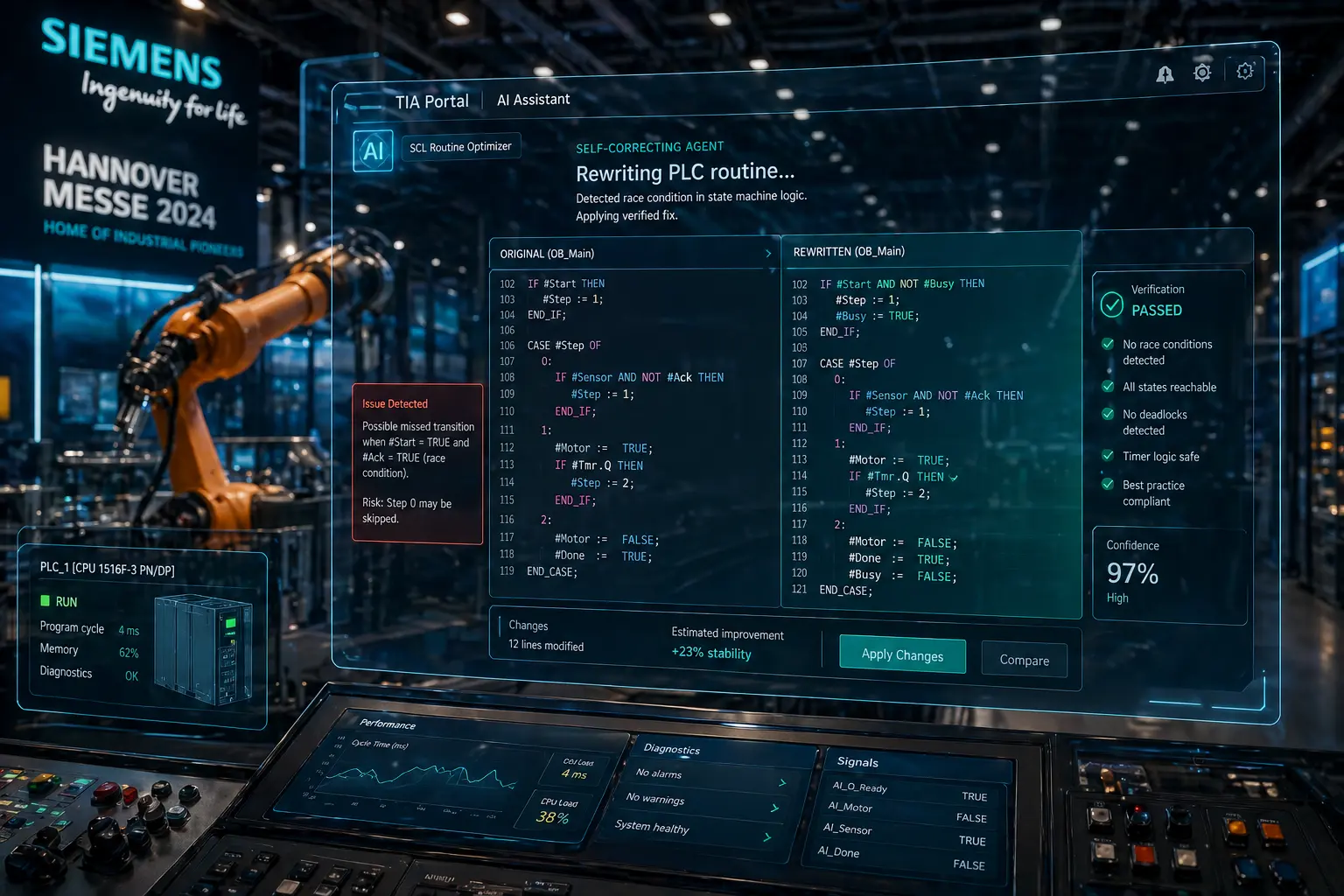
For the last two years, "agentic AI" has lived mostly inside Slack threads and YouTube demos. This week, Siemens dragged it onto the factory floor. The Eigen Engineering Agent — unveiled at Hannover Messe 2026 and now generally available — is one of the first commercially shipping AI agents capable of independently planning and executing industrial automation engineering tasks. The headline numbers are striking: up to 50% higher engineering efficiency, two to five times faster execution, and up to 80% higher solution quality, validated by a pilot with more than 100 companies across 19 countries.
What Industrial Engineering Actually Looks Like
To understand why this matters, it helps to remember what industrial automation engineering actually involves. Someone has to write the PLC logic that controls every conveyor, robotic arm, and safety interlock on a production line. Then someone has to design the HMI screens the operators stare at all day. Then someone has to wire it all up to the SCADA layer above and the field devices below. Each step has historically been done by specialists, often in different vendors' tools, and a single brownfield retrofit can take months.
What Eigen does is take a high-level engineering intent — "configure a new bottling line variant for 0.5L PET" — and walk through the work itself: generating SCL code, modifying existing programs, importing and integrating libraries, drafting HMI visualizations, and self-correcting when its first attempt fails to compile or simulate cleanly. This is no longer "autocomplete for PLC programmers." It is a digital colleague who can take a ticket, plan a multi-step solution, run its own checks, and come back with a finished package.
Early Customers and Real Numbers
The early customer stories are the part that should make every software company nervous. Prism Systems, a U.S. system integrator, used Eigen to create, modify, and import SCL code in seconds — work that previously consumed entire afternoons of senior engineering time. CASMT, a Chinese manufacturer of EV-battery production lines, automated device configuration, code generation, and HMI visualization end-to-end, compressing time-to-market in an industry where time-to-market literally determines market share.
Why It Matters Beyond Manufacturing
Now zoom out. For the first time, a Fortune-50-grade vendor has shown that an AI agent can be trusted to operate inside a regulated, safety-critical, version-controlled engineering environment. Not a chatbot summarizing a meeting — an agent producing artifacts that, if wrong, can break a multi-million-dollar machine or hurt a human. The compliance, observability, and rollback story Siemens had to build to ship Eigen is the same story every enterprise software platform now needs to copy.
Three Implications for the Wider Dev World
First, the bar for what counts as "agentic" just got higher. If a PLC code agent can self-correct against a simulator, your customer-support agent has no excuse for not self-checking against your knowledge base before answering.
Second, vertical domain agents are going to dominate the next 18 months. Generic agents like ChatGPT's Tasks or Anthropic's Claude Agent SDK are general-purpose Lego bricks. Eigen is a finished product for a specific job-to-be-done — and customers pay 10x more for finished products than for Lego.
Third, the line between "engineer" and "engineering reviewer" is now formalized at the industrial level. The most valuable people on a Siemens-using team in 2027 won't be the ones who can write SCL fastest. They'll be the ones who can read what Eigen produced, spot a subtle simulation gap, and decide when to override the machine.
My Take
Watch what Siemens did to PLC engineering closely, because the same pattern is about to land on web development, data engineering, and security operations. The companies that will win 2026 aren't the ones with the smartest model — they're the ones who package an agent so cleanly into a regulated workflow that the buyer feels safer with the AI than without it. Siemens just demonstrated that this is possible. The race is now everyone else's to lose.
Sources
- Siemens introduces AI system for automation engineering — AI News
- Siemens launches the Eigen Engineering Agent — Siemens Press Release
- How Siemens Deployed One of the First Industrial AI Agents — Manufacturing Digital