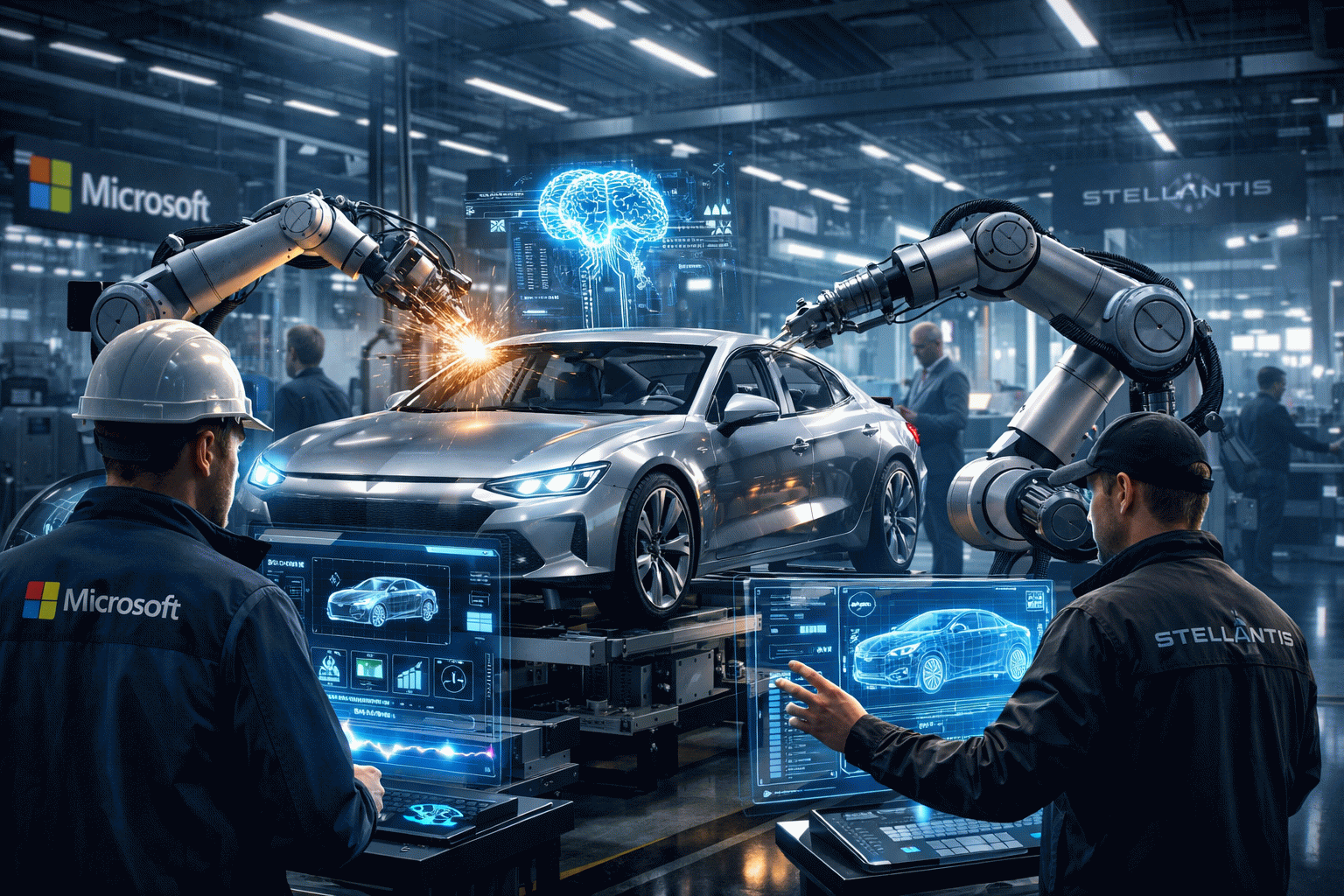
On April 16, 2026, Stellantis — the parent company of Jeep, Ram, Peugeot, Citroën, and over a dozen other automotive brands — announced a five-year strategic collaboration with Microsoft. The scope is staggering: more than 100 AI initiatives across sales, customer care, operations, product development, predictive maintenance, and cybersecurity. This is not a pilot program. It is a comprehensive restructuring of how one of the world's largest automakers operates.
Beyond the Press Release: What's Actually Happening
The partnership covers several concrete domains. First, AI-powered customer experience: Stellantis plans to use AI to personalize interactions across its many brands, from the moment a customer begins researching a vehicle to post-purchase service and support. In an industry where customer loyalty increasingly depends on digital experience rather than just the physical product, this is a strategic bet on software-defined relationships.
Second, engineering and product development. Joint teams will apply AI to accelerate validation, testing, and the rollout of digital features. For an automaker managing multiple platforms across multiple brands and multiple global markets, the ability to use AI to compress development cycles is not a luxury — it is a competitive necessity.
Third, and perhaps most interesting, is the cybersecurity dimension. Stellantis will strengthen its global cyber defense center with AI-driven analytics. As vehicles become increasingly connected — with over-the-air updates, real-time telemetry, and integration with smart infrastructure — the attack surface grows exponentially. An AI-augmented security operations center is not just forward-thinking; it is essential.
The Infrastructure Play
One number stands out in the announcement: a targeted 60% reduction in datacenter footprint by 2029. This signals a massive migration to cloud infrastructure, specifically Microsoft Azure. For a company of Stellantis' scale — operating in over 130 countries with hundreds of thousands of employees — this is an enormous undertaking that will reshape its IT organization from the ground up.
The workforce dimension is equally significant. Stellantis is equipping all employees with access to Copilot Chat, with an initial rollout of 20,000 Microsoft 365 Copilot licenses for select roles. This is not a token gesture. Twenty thousand seats represents a serious commitment to embedding AI into daily workflows across the organization — from engineers to sales teams to administrative staff.
What This Tells Us About Industrial AI Adoption
The Stellantis-Microsoft deal is a case study in how legacy industries are approaching AI transformation in 2026. The pattern is becoming clear: rather than building AI capabilities from scratch, established companies are forming deep partnerships with technology platform providers. The value proposition is speed. Stellantis could spend years building its own AI infrastructure, or it can leverage Microsoft's existing platform and focus its energy on domain-specific applications.
This model has implications beyond automotive. Manufacturing, logistics, energy, and healthcare companies are all facing the same calculus: build versus partner. The Stellantis deal suggests that for most large enterprises, the answer is partner — but partner deeply, with co-development teams and shared roadmaps, not just vendor contracts.
My Perspective: The Real Test Is Execution, Not Announcement
Five-year technology partnerships are announced frequently. Far fewer deliver on their promises. The challenge for Stellantis will not be the technology itself — Microsoft's AI and cloud capabilities are well-proven. The challenge will be organizational transformation.
Can a company with roots in 20th-century manufacturing truly embed AI into its DNA? Can 20,000 Copilot users actually change how work gets done, or will they become another set of unused enterprise licenses? Can AI-driven cybersecurity keep pace with the threats targeting connected vehicles?
The automotive industry is at an inflection point where software capability matters as much as mechanical engineering. Stellantis is making a clear bet that its future competitiveness depends on AI integration at every level. If executed well, this partnership could become a template for how traditional industries transform. If it stumbles, it will join the long list of ambitious digital transformation announcements that never quite materialized.
Either way, the ambition is worth watching. One hundred AI initiatives is not a toe in the water. It is a cannonball.