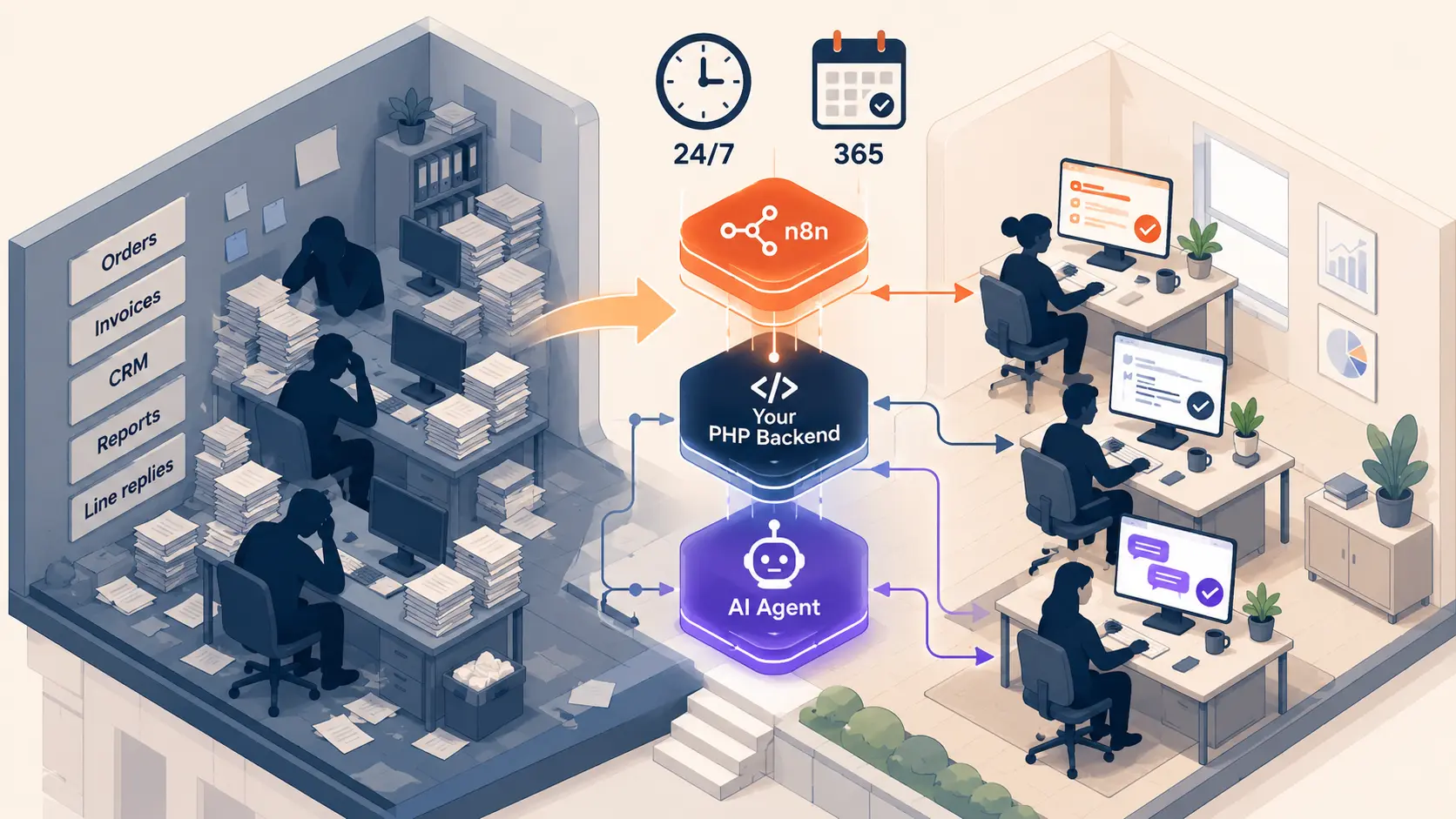
If you've run a company long enough, you know the pattern: it's not the big projects that eat half your time, it's the small, daily, repetitive things — important enough that someone has to do them, annoying enough that whoever does them eventually quits, costly enough when they slip, but never quite big enough to justify a dedicated hire.
Order comes in → ERP entry → Line ping to fulfillment → invoice issued → emailed to customer → month-end reconciliation. Lead form → manual CRM entry. Weekly: pull numbers from GA4, Meta Ads, support tickets, ERP, glue them into a PDF, email three managers. Customer support: "Where's my order?" — staff opens the back office, looks up the tracking number, pastes it into Line.
Each task is too small to be a job. All of them together eat one accountant, half a sales assistant, a quarter of a support agent. And the humans doing them make mistakes — typo'd numbers, missed invoices, an old PDF page, a Line message that fell through the cracks. The traditional answer is "hire someone." In 2026, the true cost of that hire is NT$38,000–45,000 monthly, plus benefits, year-end, training, a desk — call it NT$650,000–800,000 a year. And that person takes vacation, quits, requires handoff, and writes the SOP into a Notion page nobody reads.
We don't offer "another hire." We offer automating the work itself — a digital employee that doesn't take vacation for seven years, doesn't quit for twelve months, and processes the 2 a.m. order on time.
1. How we differ from no-code shops
There are plenty of "I'll wire up your Zapier / Make for you" services. Their problem: workflows hit a complexity ceiling, your data ends up scattered across third-party platforms, and you're billed per-execution forever — the more your business uses it, the deeper the lock-in.
Our automation uses a three-layer architecture: n8n (or open-source equivalent) + your dedicated PHP backend + an AI agent:
- Layer 1 — n8n handles connectors: payment gateways, ERP, invoice issuance, Line Notify, email, Google Sheets, webhooks, cloud APIs. Self-hosted on your server. All data stays inside your network.
- Layer 2 — your dedicated PHP backend holds business rules, the database, version control, and permissions. No "the platform changed the rule and our flow broke" risk. Every business rule and audit log lives in your MySQL or PostgreSQL.
- Layer 3 — the AI agent handles the parts that require judgment: is this email a complaint or a question; is this report metric an anomaly worth escalating; should this auto-reply be handed off to a human.
Wired together, this is a business-process operating system that you fully own. The longer it runs, the more historical data accumulates, the smarter the AI agent becomes — for you, not for someone else's SaaS.
2. Common patterns we've shipped
- E-commerce / order notifications and reconciliation: payment gateway webhook → ERP entry → Line push to fulfillment → auto-generated PDF invoice → month-end reconciliation Excel emailed to accounting. One sales assistant + half an accountant freed up; sales now serves VIPs, accounting only reviews exceptions.
- B2B / customer data sync: lead forms, paid ads leads, trade-show business cards → unified CRM → auto-assigned to sales → follow-up reminders → unanswered leads auto-escalated. No more leads leaking from Google Forms to Excel to a forgotten Notion page.
- Marketing / weekly metrics digest: GA4, Meta Ads, Google Ads, support, ERP sales → auto-compiled bilingual PDF → emailed to leadership Monday 9 a.m. Used to be a 4-hour-a-week job for a marketing analyst.
- Customer support / Line smart auto-reply: customer enters order number → backend looks up tracking → AI agent reads tone → auto-replies, escalates when needed. 85% of "where's my order" questions never reach a human.
- Admin / contracts and invoices: email attachment received → invoice OCR → write into accounting → cloud filing taxonomy. Month-end close stops being an all-nighter.
3. Why work with us
First, the workflow becomes your asset, not our subscription. All n8n flows, PHP code, DB schema, API keys live in your environment. The day you stop working with us, the entire stack — code, docs, SOPs — is handed off cleanly so the next vendor can pick it up.
Second, we don't just wire APIs, we redesign your process. Before automating, we run a process audit — finding the steps that are redundant, the steps that need re-ordering for half the headcount, the steps everyone thought mattered but no one actually reads. Eliminate waste first, then automate what's left. Otherwise you're just running chaos faster.
Third, we integrate AI agents, but we don't worship them. If if/else solves it, no LLM. If a plain webhook solves it, no agent. AI shows up only where genuine semantic judgment is required. The result: stable, cheap, predictable workflows.
Fourth, fixed pricing + monthly ops. A typical SMB automation rollout runs 4–8 weeks at a fixed price of NT$180,000–450,000. Post-launch monthly ops (monitoring, tweaks, up to two new flows per month) runs NT$8,000–18,000 per month. Versus the NT$650,000–800,000 annual cost of a new hire — payback in year one, and from year two onward you save a mid-size sedan every year.
Fifth, we leave documentation and a dashboard. Every flow has a diagram any colleague can read, a monitoring page, and error alerting. Our goal is not to make you depend on us forever; it's to leave a system that keeps running on the day we're not around.
4. For owners about to schedule a call
Bring two things: (1) the three most annoying repetitive daily tasks at your company; (2) who currently does each one, and roughly how many hours per month it takes. In 30 minutes we'll tell you which of the three are worth automating, the implementation cost, and the projected year-one labour-hour savings. If the answer is "not worth it," we'll say so — at no charge.