Industry AI Snapshot
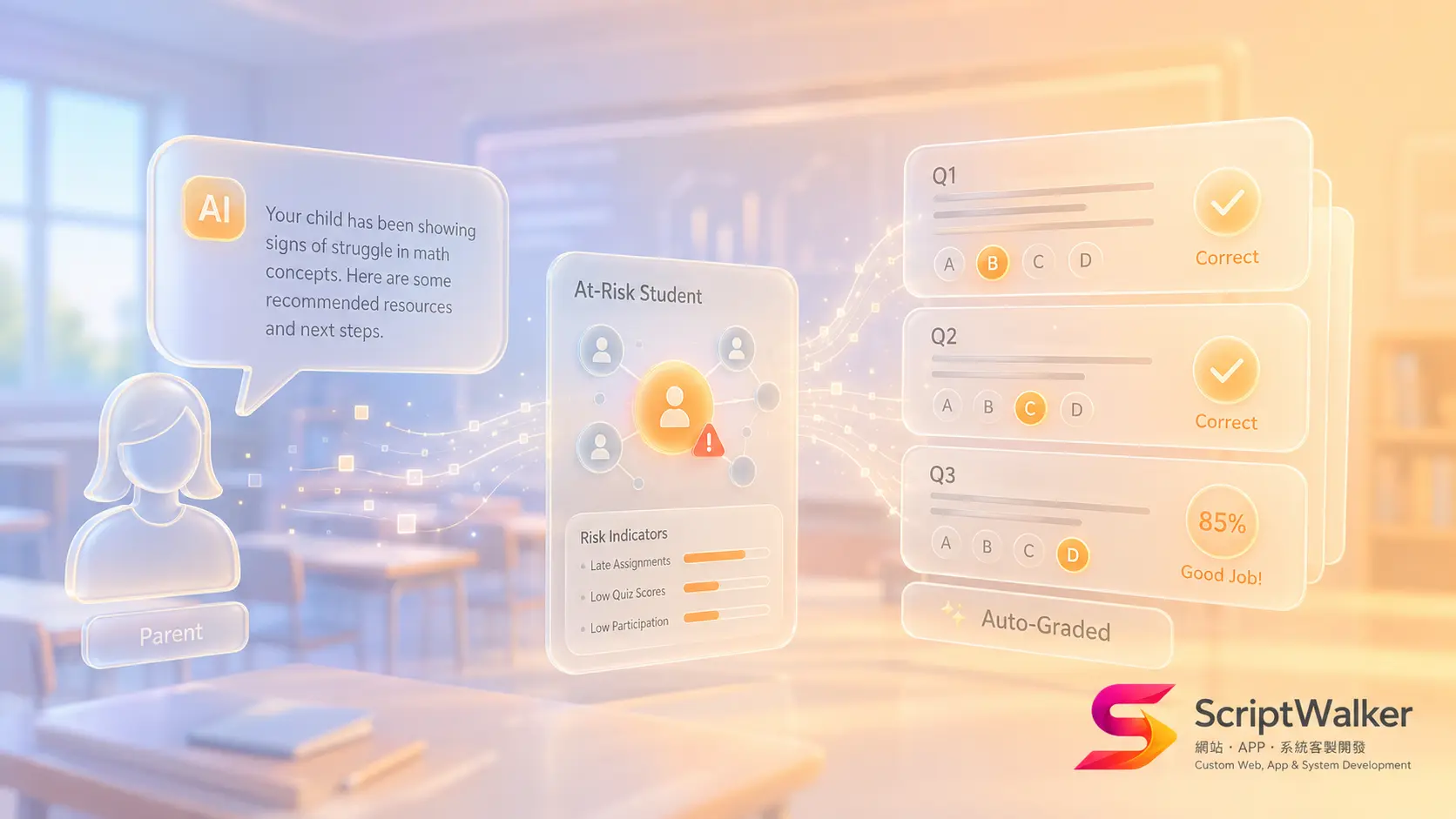
The pain points in cram schools and education are concentrated: the front desk is buried in parent LINE messages (absences, progress, payments, schedules), teachers' time is eaten by question-setting and grading, and — most fatal — silent student churn (a student not re-enrolling today is often something you should have seen a month ago). In 2026, tutoring and test-prep are among the fastest-growing adopters of education AI; the industry broadly observes that a branded chatbot embedded in a parent portal answers 60–80% of routine parent questions, and "administrative communication" use cases are seen as fastest ROI and lowest privacy risk. This isn't about replacing teachers — it's about reclaiming their time from repetitive work.
3–5 Typical AI Use Cases
- Parent LINE auto-reply: routine questions (absences, schedules, progress, payment reminders) answered automatically; complex ones escalate to a human.
- Student churn alerts: use attendance, grade trends, and payment behaviour as signals to flag at-risk students before they say they're leaving.
- Auto question-setting & grading: generate questions by unit and difficulty, grade objective items instantly, freeing teachers for explanation and motivation.
- Personalized after-class practice: AI generates practice on a student's weak spots; human teachers own the relationship and motivation (hybrid model).
- Enrollment content generation: seminar copy, social posts, parent letter drafts — human-reviewed before publishing.
Real Cases (How Two Did It)
Language school A (~300 students): started with the lowest-risk "parent LINE auto-reply." Using the LINE Messaging API + n8n wired to a knowledge base, they turned schedules, leave rules, and payment methods into FAQs. Three months post-launch, routine front-desk message volume dropped ~60%, freeing admin staff for enrollment work. The trap: an unmaintained knowledge base led the AI to give a wrong schedule and spark complaints — it stabilized only after adding "weekly updates + escalate when unsure" rules.
Prep school B: deployed "churn alerts." Attendance, monthly exam scores, and payment records fed a scoring model producing a weekly at-risk list for homeroom teachers to proactively reach out. Result: re-enrollment rose vs the prior year — and the biggest value wasn't model accuracy but the discipline of "forcing the team to look at the list weekly." Research also notes that well-designed AI tutors can produce learning gains of 0.3–0.5 standard deviations on specific skills, but the fastest payback for cram schools remains admin and enrollment.
Recommended Tool Stack
- Conversation layer: LINE Messaging API (the main parent channel) + OpenAI API or Claude for understanding.
- Integration/automation: n8n or Make to wire LINE, Google Sheets, and CRM together without building a heavy backend.
- Knowledge base / RAG: turn schedules, rules, and FAQs into vector retrieval so answers are grounded and updatable.
- Data layer: the existing student-management system (attendance, grades, payments) as the signal source for churn alerts.
Why this stack? Most cram schools have no engineering team; low-code tools like n8n wire existing tools into a pipeline at minimal cost — validate first, customize later.
ROI Model
For a 300-student school's "parent LINE auto-reply":
- Investment: one-off build NT$80k–150k (knowledge base, integration, testing); monthly ops NT$3,000–8,000 (API usage + maintenance).
- Return: saves ~half an admin's routine hours (if an admin earns NT$32,000/month, half is ~NT$16,000/month); plus re-enrollment recovered by churn alerts — retaining 10 extra students a year can be six-figure revenue.
- Payback: most admin-type applications pay back within 6–12 months, and saved time shifts to higher-value enrollment.
Rollout Timeline (Phase 1–4)
- Phase 1 (weeks 1–2): inventory the 30 most-asked parent questions; compile schedules and rules into a knowledge base.
- Phase 2 (weeks 3–5): wire LINE + n8n + knowledge base, internal trial, set "escalate when unsure."
- Phase 3 (weeks 6–8): limited launch to real parents, weekly knowledge-base fixes.
- Phase 4 (weeks 9–12): expand to all parents, then introduce advanced apps like churn alerts.
Common Failure Modes × How to Avoid
- Unmaintained knowledge base: schedule changed, AI still says the old one → assign a "weekly update" owner.
- Doing too much at once: chat, grading, alerts all half-built → do admin-type first, validate, then expand.
- Treating AI as fully automatic: wrong answers on sensitive topics (refunds, disputes) trigger complaints → always escalate sensitive categories to humans.
- Dirty data: attendance and grades not digitized, so churn alerts have no signal → digitize base data first.
- Ignoring privacy: student/parent data compliance missed → clearly state purpose, minimize collection.
Where AI Isn't a Fit
- Sensitive communication like refunds, complaints, conflict resolution — these need humans and warmth.
- Teaching motivation and relationship-building — AI can set questions but can't move a child who wants to quit.
- Single sites with too little data (dozens of students) — ROI can't justify customization; use off-the-shelf tools first.
ScriptWalker's Offering
We build "AI admin automation integration" for education businesses: from parent LINE auto-reply and knowledge-base setup to churn-alert integration. One-off build starts at NT$80,000, including full n8n/LINE/knowledge-base integration and handover docs; a monthly care plan can maintain the knowledge base and model.
FAQ
We have no engineers — can we still adopt this?
Yes. Most education rollouts use low-code tools like n8n/Make to wire LINE, spreadsheets, and CRM — no custom backend needed. We handle integration and handover so your admin staff can maintain the knowledge base.
Won't AI give wrong answers to parents and cause complaints?
It will, if the knowledge base is unmaintained or unguarded. The standard approach: always escalate sensitive topics (refunds, disputes) to humans, set "escalate when unsure" for the rest, and assign a weekly knowledge-base owner. That minimizes risk.
Are churn alerts accurate — worth it?
Model accuracy matters, but the bigger value is the discipline of "reviewing the at-risk list weekly." Most re-enrollment lift comes from teachers' proactive outreach, not model magic. The prerequisite is digitizing attendance, grades, and payments first.
How long until payback?
Admin-type apps (parent auto-reply) usually pay back in 6–12 months, mainly from saved admin hours and re-enrollment recovered by churn alerts. Start with admin-type to validate, then expand to teaching and enrollment.
Decision Checklist + Call to Action
- ☐ How much time does my front desk spend on routine parent messages daily?
- ☐ Are my schedules, rules, and FAQs compiled into documents?
- ☐ Are attendance, grades, and payment data digitized?
- ☐ Can I assign someone to maintain the knowledge base weekly?
- ☐ Do I know which questions must go to a human?
- ☐ Have I calculated what the saved admin hours are worth?
- ☐ Am I willing to do admin-type first, validate, then expand?
- ☐ Does my student count justify customization ROI?
Want to know which AI application your school should adopt first? We offer a free 30-minute consult to calculate ROI and priority based on your actual message volume and student count.
- Email: [email protected]
- Phone: 0916-224-047
- LINE: @ufv9089p
Sources
- HappyFox — AI Chatbot for Education (routine parent question rate)
- The 74 — AI Tutors, With a Little Human Help (learning gains study)