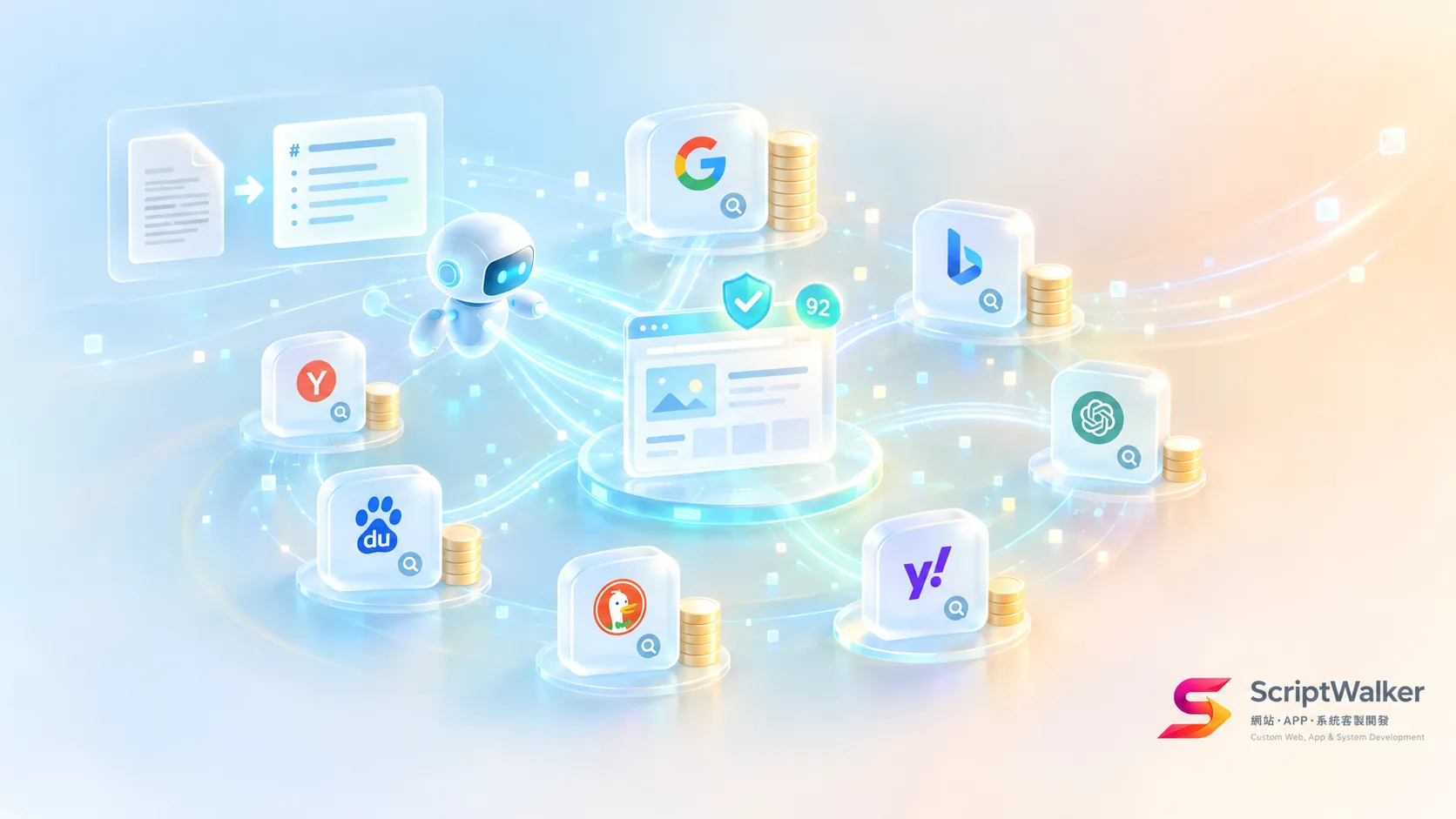
Short answer: Not necessarily Google. DeepSeek opened its in-house search API on Oct. 17 at $0.75 per 1,000 calls, 85% cheaper than Brave, and the Bing Search APIs are already retired. Your website needs to be crawlable and readable by several indexes, not one.
On Saturday, Oct. 17, DeepSeek announced in its API changelog that it is opening its in-house web search engine to outside developers. It launched a Search API, which returns ranked results, and a Fetch API, which turns a web page into Markdown. Both cost $0.75 per 1,000 successful requests. The New Stack reported on Oct. 19 that the price is 15% of Brave's ($5) and about a tenth of Tavily's ($8). DeepSeek says the engine handles hundreds of millions of requests a day and indexes hundreds of billions of pages. In one sentence: the layer AI agents use to look things up online is changing suppliers.
Why now? Over the past 15 months, the two most widely used official search APIs have been pulled back. Microsoft fully retired the Bing Search APIs on Aug. 11, 2025, steering developers to Grounding with Bing inside Azure AI Agents. Google's Custom Search JSON API no longer accepts new customers, and existing users must migrate by Jan. 1, 2027; it charged $5 per 1,000 queries with a cap of 10,000 a day. Meanwhile, agents such as Claude Code and Codex look things up online for almost every task, so demand is rising. DeepSeek made search calls from Claude Code and Codex through its API free until Nov. 1. The intent is clear: become the default choice while the gap is open.
Prices across the category vary widely. According to The New Stack, per 1,000 requests: Ceramic $0.25, Perplexity and Parallel $1, Exa $4, Brave $5 (with an independent index of more than 40 billion pages) and Tavily $8. Cloudflare has also launched a beta search API that routes to other providers. The category is splitting from a Google–Bing duopoly into many players, each building its own index and filtering spam its own way, competing on price, scale and quality judgment. Content farms are growing at the same time: Axios, citing DoubleVerify data, reports that AI slop sites rose more than fivefold in a year.
SMBs won't buy search APIs directly, but the AI assistants and price-comparison agents their customers use may run on these indexes. A website optimized only for Google bets its AI visibility on one supplier. Below we cover the API details, actions for three types of readers, a comparison table, and a sampling method that needs no subscription.
Event details: how DeepSeek's search API scores your pages
Bottom line: every result comes with an "authority" score and a summary written for models, so your page is scored by a machine before it is rewritten.
- Pricing: Search and Fetch each cost $0.75 per 1,000 successful requests; failed calls and empty results are free; each search returns up to 50 results (official pricing).
- Scoring fields: The Search docs list rerank_score (0–3, with 1.5 or above meaning high quality) and authority (0–4, with 3 or above meaning highly authoritative and -1 meaning unknown).
- Queries: 1–128 characters, with support for site:, excluded terms, language and date filters.
- Rate limits: Search allows 100 requests per second and Fetch 25; URLs blocked by a site's policy return 404.
- Filtering: DeepSeek says it filters SEO spam and low-quality AI-generated content.
Winners are sites whose key facts sit in plain HTML, plus developers on small budgets. Losers are higher-priced search APIs and mass-produced content sites.
What three types of readers should do now
Bottom line: owners should make sure their site doesn't block machines, marketers should put key facts at the top, and developers should run a test themselves.
- Brand owners / SMB owners: Ask your web vendor whether the firewall blocks every "unknown bot." Blocking all of them hides you from new AI indexes; rate limiting is the better option.
- Marketers / SEO practitioners: Put services, price ranges and service areas in plain text in the first half of each page. RESONEO's analysis of 76,000 Gemini conversations found that 80% of cited passages start in the first half of the source text.
- Developers / agencies: Use the Fetch API on a client's home page and three service pages, and check whether the Markdown includes prices, phone number and address. If not, the cause is usually client-side rendering or a firewall.
Search API comparison: the index suppliers behind AI agents
Bottom line: prices range 32x, from Ceramic's $0.25 to Tavily's $8, but where the index comes from and where data is stored matter more.
| Service | Price per 1,000 | Index / features | Best for |
|---|---|---|---|
| DeepSeek Search | $0.75 | In-house index with authority scores; data stored in China | Cost-sensitive experimental agents |
| Brave Search API | $5 | Independent index of 40B+ pages | Privacy-focused use, independent index |
| Exa | $4 (Instant) | Semantic search | Research, finding similar content |
| Tavily | $8 (basic, pay-as-you-go) | Results formatted for AI agents | Quick agent-framework integration |
| Google Custom Search | $5 | Closed to new customers, shuts Jan. 1, 2027 | Existing users migrating only |
Prices are from The New Stack's roundup and Google's documentation; check each provider's site. Quality differs, so don't compare on unit price alone.
What they won't tell you
Bottom line: a cheap index is not necessarily a good one, and you may not be allowed to use it.
- Counterpoint 1: Traditional Chinese coverage is a black box. DeepSeek hasn't disclosed how it builds its index or what its crawler is called, and says nothing about robots.txt. There is no way to verify how many Taiwanese sites are indexed or how authority is scored.
- Counterpoint 2: Compliance risk outweighs the price gap. DeepSeek processes data in China, and Reuters reported on Oct. 19 that the US Department of Homeland Security ordered civilian federal agencies to remove DeepSeek products. Government and financial projects mostly can't use it.
- The overlooked long tail: The free period ends on Nov. 1, and developers may move elsewhere. Betting on one new index is as risky as betting only on Google.
A no-subscription alternative for SMBs
Bottom line: for under $1, you can learn whether new AI indexes can see your site and read it.
- Step 1: List questions: Write 10 questions customers ask, in both Chinese and English.
- Step 2: Check indexing: Use the Search API for "site:yourdomain" and the 20 questions, recording whether you appear and your authority score; 100 calls cost under $0.10.
- Step 3: Test readability: Use the Fetch API on your home page and service pages, and check for prices, service area and contact details.
- Step 4: Compare: Ask the same questions on Google and ChatGPT; rewrite pages that appear on none of the three first.
- ☐ The firewall rate-limits unknown bots instead of blocking them
- ☐ Prices and phone number are visible with JavaScript turned off
FAQ
How much does DeepSeek's search API cost?
$0.75 per 1,000 successful requests, billed separately for Search and Fetch.
Do SMBs need to buy a search API?
Most don't. Spending under $1 a quarter to check whether your site can be found is enough.
Should I block AI crawlers in robots.txt?
Rate-limit rather than block everything. A full block hides you from new AI search indexes.
Is Google SEO alone still enough?
No. The Bing Search APIs are retired, and AI agents now draw on several indexes.
My take
The mainstream view is that GEO means getting ChatGPT and Gemini to recommend you. I disagree. Over the next 12 months, a growing share of AI traffic to SMB websites will come from "brandless agents": price-comparison tools, procurement agents and customers' own automations, running on third-party indexes that cost fractions of a dollar per 1,000 calls. They only check whether the Markdown that Fetch returns contains prices, specs and contact details. GEO services that write "recommendation copy" will cool off first; machine readability is the long-term work.
ScriptWalker (a Taiwan-based Laravel/Flutter custom development studio) sees a service opportunity for agencies here: an "AI agent readability check" that samples indexing across three or four search APIs, then fixes server-side rendering, plain-text price blocks and structured data. Based on ScriptWalker's experience, we estimate it at about NT$20,000–60,000. To start with a sample test, contact us:
- Email: [email protected]
- Phone: 0916-224-047
- LINE: @ufv9089p
Sources
- DeepSeek API changelog (2026-10-17) (primary)
- DeepSeek: Search and Fetch guide (primary)
- DeepSeek: Models and pricing (primary)
- Microsoft: Bing Search APIs retirement (primary)
- Google: Custom Search JSON API overview (primary)
- The New Stack: DeepSeek search API (2026-10-19)
- DigitalToday (2026-10-19)
- Reuters: US bans DeepSeek from government systems (2026-10-19)
- Axios: AI slop sites rise fivefold (2026-10-17)
- RESONEO: Gemini citation study