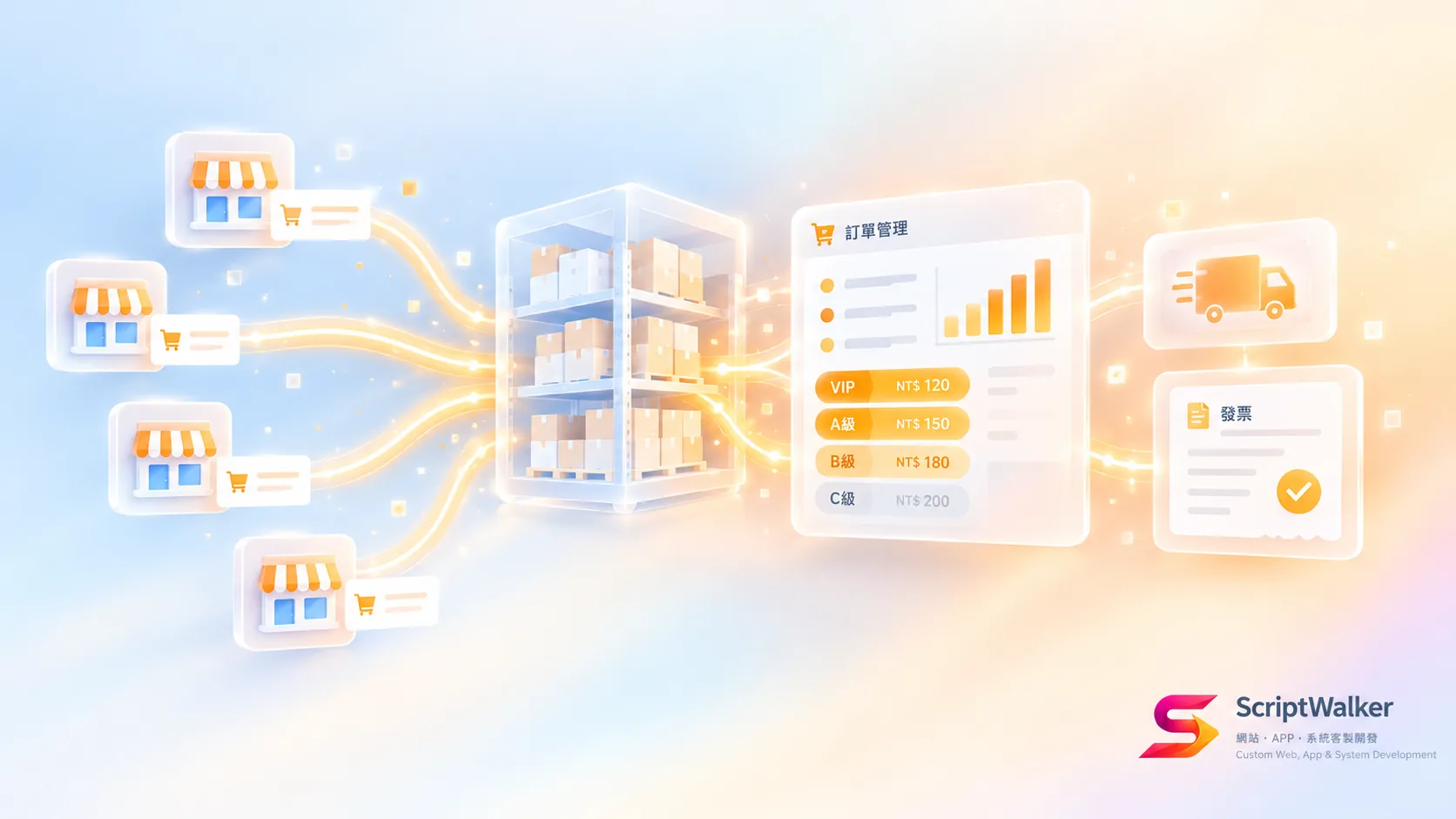
Short answer: A dealer ordering system rests on three things: tiered pricing, credit limits and orders flowing into the ERP automatically. For wholesalers with 50+ retail accounts and 30+ orders a day, a standard build costs NT$180k–500k, goes live in 10–14 weeks, and typically cuts manual order entry by more than 70%.
The pain: 80 orders a day, two assistants doing nothing else
Bottom line: the problem is not too many ordering channels; it is that every order is typed in twice. A food wholesaler serves 120 restaurants and supermarkets that order by LINE photos, phone calls and even fax, about 80 orders a day. Two assistants spend the whole day keying them into the ERP. Product names vary, prices live in people's heads, and the error rate sits around 3%, adding NT$20k–30k a month in re-deliveries and returns.
When it fits and when it does not
Bottom line: best for wholesalers with many accounts, tiered pricing and monthly billing; unnecessary if you sell to a handful of large clients.
| Fits | Does not fit |
|---|---|
| 50+ accounts and 30+ orders a day | 5–10 fixed key accounts that can confirm by email |
| Different prices and discounts per tier | One price list, cash on delivery |
| Credit limits and monthly statements | Fewer than 30 products that rarely change |
Alternatives matrix
Bottom line: store builders are cheapest but rigid; a custom build costs most but keeps up with the business.
| Option | Upfront cost | Pros | Cons |
|---|---|---|---|
| LINE plus Google Forms | Near zero | Usable today | No tiered pricing; still re-keyed into ERP |
| Store builder with member tiers | NT$2,000–8,000/month | Fast launch | Credit limits, monthly billing and ERP sync mostly impossible |
| ERP vendor B2B module | NT$150k–400k plus annual fees | Consistent data | Clunky interface dealers avoid |
| Custom ordering portal | NT$180k–500k | Rules fit exactly; LINE integration | Needs an internal contact for 10–14 weeks |
Process breakdown
Bottom line: four phases over about 14 weeks; the slowest part is pinning down pricing rules.
- Weeks 1–2, discovery: dealer tiers, pricing rules, credit limits, delivery routes, ERP field mapping. Deliverable: requirements spec.
- Weeks 3–4, design: Figma screens for dealer ordering and back-office review, tested with three dealers. Deliverable: clickable prototype.
- Weeks 5–11, build: catalogue, tiered pricing, cart, credit checks and export on Laravel, with shipping alerts via LINE Messaging API. Deliverable: staging site.
- Weeks 12–14, pilot: 10–20 dealers, two weeks of parallel channels, then full switch. Deliverable: live site and manual.
Real cost breakdown
Bottom line: beyond the build, budget 15–20% of it each year for hosting, maintenance and changes.
- Build: NT$180k–300k standard; NT$350k–500k with two-way ERP sync and an app.
- Hosting and domain: about NT$12k–30k a year.
- Online payment, if used: card fees per ECPay's official rates.
- Hidden costs: cleaning product data (often 40–80 hours), dealer training, and fees your ERP vendor may charge to open an API.
Reality vs expectation
Bottom line: the hardest part is not code but turning the owner's pricing logic into a table.
- Expectation: dealers will self-serve at launch. Reality: about 30% still phone in for two months and need sales follow-up.
- Expectation: pricing is simple. Reality: discovery usually reveals 6–10 exceptions, such as special prices for one dealer on one item.
- Expectation: the ERP will connect. Reality: many local ERPs have no API and only accept file imports.
Five pitfalls and how to avoid them
Bottom line: all five can be handled during requirements.
- Building before cleaning product data → standardise names, units and barcodes first.
- Pricing rules only in the owner's head → build a price matrix in week one and have sales confirm it.
- No credit check → route over-limit orders to a manager for approval.
- Forcing dealers to create passwords → use LINE login or personal links.
- Switching everyone at once → pilot with 10–20 dealers and run both channels for two weeks.
Success metrics and 90-day roadmap
Bottom line: by day 90, aim for 70%+ of orders online and errors under 1%.
- Day 30: 20 pilot dealers, 30% of orders online.
- Day 60: open to all, 55% online, manual entry time halved.
- Day 90: 70%+ online, error rate under 1%, orders reach the ERP the same day.
Decision checklist
Bottom line: six or more yes answers out of 11 means an ordering system is worth planning.
- ☐ More than 50 retail accounts?
- ☐ More than 30 orders a day?
- ☐ Two or more price tiers?
- ☐ Credit limits or monthly billing?
- ☐ Order errors above 2% a month?
- ☐ Assistants spend 3+ hours a day keying orders?
- ☐ Frequent stock-outs needing substitutes?
- ☐ ERP accepts Excel imports or has an API?
- ☐ An internal contact can give 4 hours a week?
- ☐ Most dealers already use LINE?
- ☐ Budget can cover NT$180k or more?
FAQ
How much does a dealer ordering system cost?
Usually NT$180k–500k; the spread comes from pricing-rule complexity and whether you need two-way ERP sync.
How long does it take?
About 10–14 weeks for a standard build; add 4–6 weeks for two-way ERP sync or a mobile app.
What if dealers do not want to learn a new system?
Let them order from a LINE link without passwords and offer a reorder-last-order button; that keeps the barrier lowest.
Can we use Shopify or a store builder?
For a simple version, yes, but tiered prices, credit limits and monthly billing usually need plugins or are impossible; it tends to break past 50 accounts.
Must it connect to the ERP?
Not at first. Phase one can export to Excel for ERP import; automate the sync once volume is steady.
Next step
The B2B Dealer Ordering System package from ScriptWalker (a Taiwan-based Laravel/Flutter custom development studio) starts at NT$180k and includes tiered pricing, credit limits, LINE notifications and order export. Send us your pricing rules and daily order volume and we will reply with a free scope and timeline estimate:
- Email: [email protected]
- Phone: 0916-224-047
- LINE: @ufv9089p