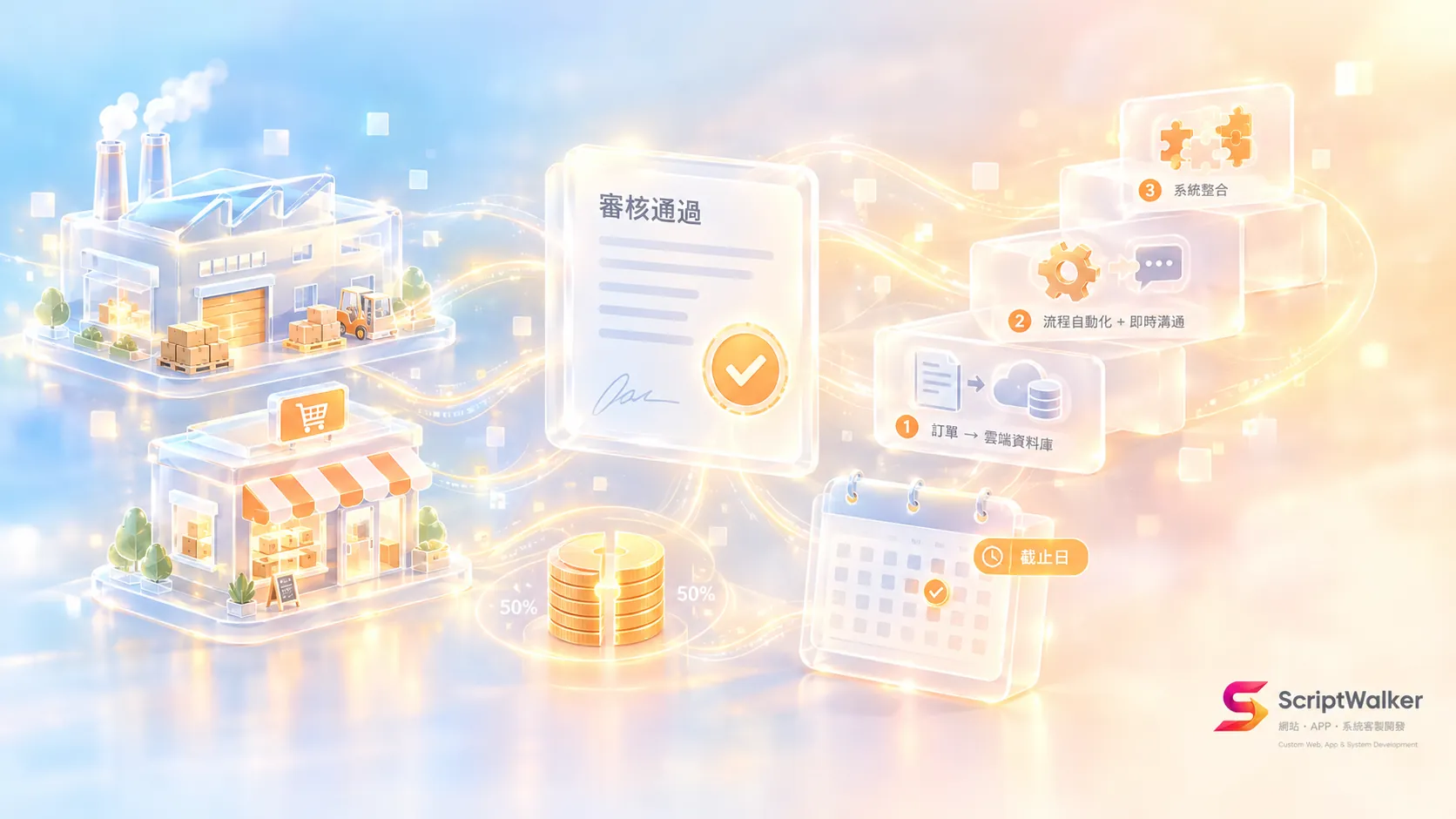
Short answer: In 2026, Taiwan SMEs have four main digital transformation subsidy routes: the AI Tool Library point subsidy for manufacturers, the service-sector AI upgrade (up to NT$100,000 per store), SBIR R&D grants (up to NT$12 million), and city/county Local SBIR programs. Most require you to cover at least 50% yourself, and you must get approval before you buy.
The owner of a hardware parts factory heard from a peer that "the government subsidizes digital transformation." He spent NT$120,000 on a cloud inventory system first, then asked about the subsidy, only to learn that most programs require approval before purchase; what he had already bought did not count. A brunch shop owner saw "subsidies up to NT$20 million" online and assumed a single store could get that much. That figure is the cap for multi-site integration projects; a single store can get at most NT$100,000. Digital transformation subsidies are not hard to get. The hard part is the rules and the short windows: get the order wrong and the effort is wasted.
Direct answer: the first 3 steps of a digital transformation subsidy application
Bottom line: confirm your eligibility and the timeline, then choose a solution, and pay last. Never reverse the order.
- Step 1: Know which category you are in. SME manufacturers with a factory registration, commercial service businesses, and companies developing new products qualify for completely different programs.
- Step 2: Check the application window and remaining budget. Point-based subsidies usually stop accepting applications once points run out, so apply as soon as a call is announced.
- Step 3: Sign only after approval. Points can only be redeemed against solutions already listed on the program platform. A custom system built by your own vendor usually has to go through a proposal-based program such as SBIR.
The full roadmap: digitize data, automate workflows, integrate systems
Bottom line: subsidies fit stages 1 and 2; for stage 3, system integration, you will usually fund most of the budget yourself.
| Stage | What you do | Cost range | Benefit | Matching subsidy |
|---|---|---|---|---|
| 1. Digitize data | Move paper orders, customers and stock into cloud inventory software | NT$30,000–150,000 | Order lookup and reconciliation time cut in half | Point subsidies |
| 2. Automate workflows | Automate quotes, job dispatch and LINE notifications | NT$80,000–300,000 | 20–60 staff hours saved per month | Service-sector AI upgrade, point subsidies |
| 3. Integrate systems | Connect website inquiries, ERP, warehouse and app into one system | NT$300,000–1.5 million | Data entered once; the owner sees live reports | SBIR, Local SBIR |
Costs and benefits in the table are ranges estimated from ScriptWalker's project experience. Point subsidies usually cover at most half, so for a NT$100,000 solution you still need at least NT$50,000 of your own.
2026 government digital transformation subsidy programs at a glance
Bottom line: manufacturers should look at AI Tool Library points, service businesses at the single-store AI upgrade, and anyone building a new system or product at SBIR.
| Program | Who it fits | Subsidy | 2026 status |
|---|---|---|---|
| AI Tool Library point subsidy (MOEA Administration of Industrial Development) | SME manufacturers with a factory registration | Points redeemable against listed AI tools; cap per the official application guide | Open until 2026/10/30 17:30, closes early if points run out |
| Cloud Marketplace Industrial Pavilion cloud solution point subsidy | SME manufacturers | Up to 50,000 points, covering at most half the service fee | Closed 2026/9/29; next round per official announcement |
| Service-sector AI upgrade: single-store adoption (MOEA Department of Commerce) | Commercial service businesses | 50% of the solution cost, up to NT$100,000 | 2026/4/20 to 2027/10/20, or until funds run out |
| SBIR (Small Business Innovation Research) (MOEA SME and Startup Administration) | SMEs developing new products or services | Phase 1 up to NT$1.5 million; Phase 2 up to NT$12 million | Timeline per the official SBIR site |
| Local SBIR (city and county governments) | Local SMEs | Taichung in 2025, for example, capped single companies at about NT$1 million | Per each local government's official announcement |
In 2025 SBIR approved 634 projects with more than NT$450 million in government funding, 35% of them AI-related. The Ministry of Digital Affairs' TCloud marketplace site now carries a notice that the program is ending and policies are being adjusted, so do not plan purchases around it.
Common mistakes: buying a system nobody uses just to get the subsidy
Bottom line: a subsidy only lowers the cost; choosing the wrong system costs far more than the subsidy is worth.
- Buying before applying: payments made before approval are not recognized by most programs, so you pay the full price.
- Choosing a solution for the points: buying whatever is on the platform, staff never use it, the monthly fee keeps running and the data stays in Excel.
- Double-dipping: if the same item already received another government subsidy, you cannot apply again; violators may have to repay funds and be barred from applying for 5 years.
- Looking only at the headline cap: "up to NT$20 million" is for multi-site integration; size your budget to your own scale.
FAQ
Can I buy a system first and apply for a digital transformation subsidy later?
Usually no. Most programs require approval before purchase, and earlier spending is not recognized.
How much digital transformation subsidy can one company get?
It depends on the program: up to NT$100,000 per service-sector store, up to NT$12 million for SBIR Phase 2, and most require a 50% co-pay.
Can a subsidy pay for a custom system built by an outside vendor?
Point subsidies only cover listed platform solutions; custom systems fit SBIR better, which requires an innovation R&D proposal.
How long does a digital transformation subsidy application take?
It varies. Point subsidies need an eligibility review, SBIR adds written and presentation reviews; follow official timelines.
Next step: a free assessment of where you should start
Bottom line: find the one workflow most worth digitizing first, then decide which subsidy to apply for.
ScriptWalker (a Taiwan-based custom Laravel/Flutter development studio) helps traditional businesses and SMEs build order, quoting, inventory and website systems. For subsidy eligibility, rely on the official announcements; we help you work out which parts fit a listed platform solution you can pay for with points and which parts are worth building custom, and we provide the system plan and quote an SBIR proposal needs. Websites start at NT$15,000 and systems at NT$80,000. Tell us how your workflow runs today for a free assessment:
- Email: [email protected]
- Phone: 0916-224-047
- LINE: @ufv9089p