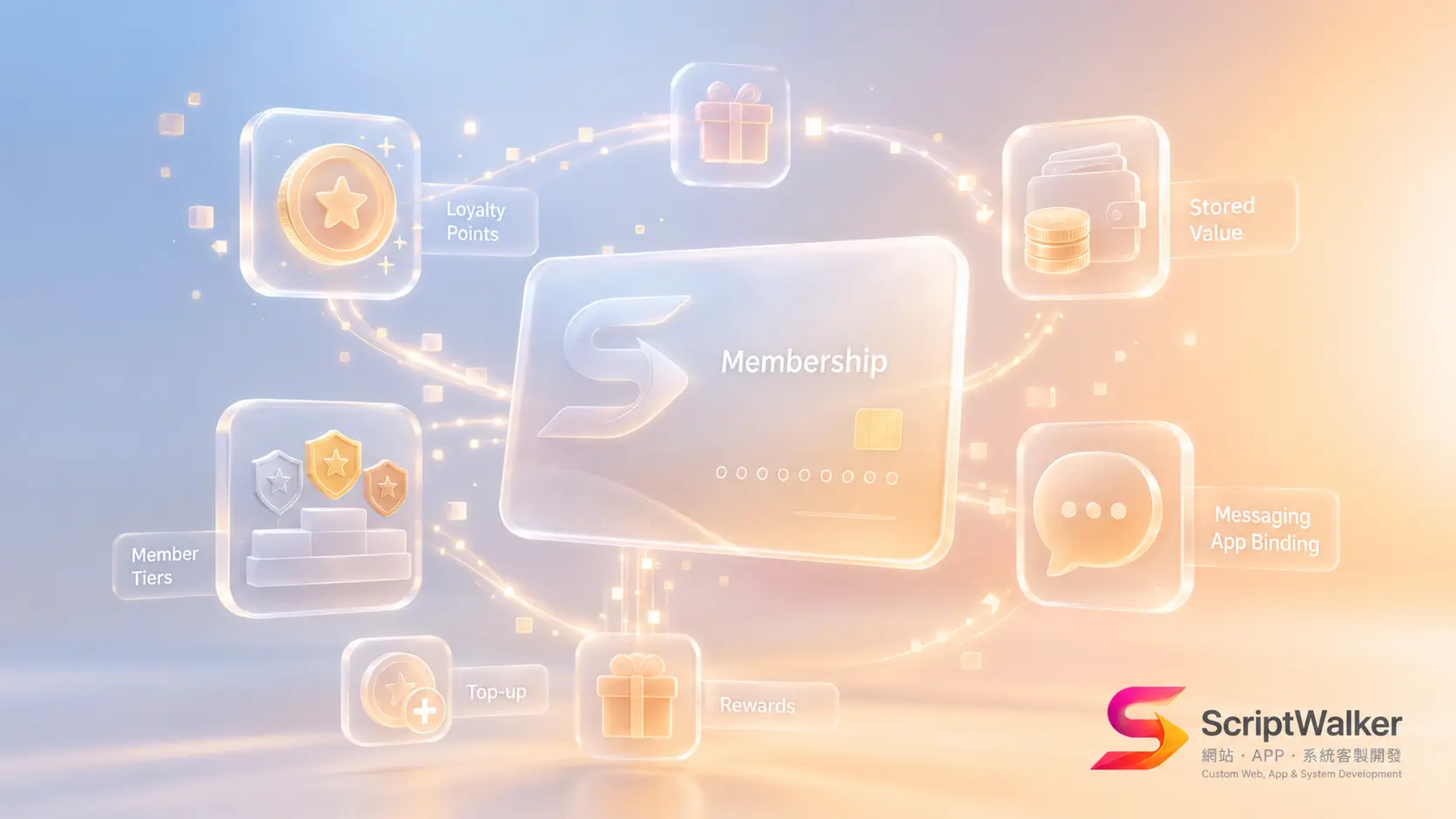
A hair salon owner told us: "We push a LINE points card, a stored-value top-up, and a members-only price — but they live in three tools that do not talk to each other, and reconciling them every month takes a full day." That is the real problem behind a "membership system." It is not a login page; it is points, stored value, member tiers, and a LINE binding that must all agree on the same balance. Get the money and the data model wrong and you are hand-fixing balances forever.
Where It Fits — and Where It Does Not
A good fit if you:
- Have repeat customers (salons, cafes, clinics, retail) where a points or top-up card lifts return visits.
- Already run a LINE Official Account and want the member card bound to it.
- Need member-tier pricing, prepaid balances, or a referral/points loop tied to real transactions.
Not a fit if you:
- Are pre-launch with no repeat-customer base yet — a spreadsheet or an off-the-shelf loyalty app is enough.
- Only need a simple digital stamp card — a SaaS loyalty tool is cheaper and faster.
- Cannot commit to the legal/trust requirements that stored value (prepaid) triggers.
Alternatives Matrix
| Option | Pros | Cons | Cost tier |
|---|---|---|---|
| SaaS loyalty app (stamp/points) | Live in days, low upfront | No tier logic, no true stored value, monthly fee forever, data locked in | NT$1,000-4,000/mo |
| POS built-in membership | Ties to checkout, no extra login | Weak online/LINE binding, hard to customize tiers/points rules | Bundled with POS |
| Custom (Laravel + LINE LIFF + payment) | Owns data, any tier/points/top-up rule, LINE-bound, integrates POS/online | Higher upfront, needs maintenance | NT$180,000-450,000 build |
The Full Build Process
- Phase 1 — Member rules & data model (1-2 wks): tiers, points earn/burn rates, top-up bonuses, expiry rules. Deliverable: a rules doc + data schema in Notion. This phase decides whether reconciliation is easy or a nightmare.
- Phase 2 — System & LINE binding (2-3 wks): member backend + LINE LIFF front end so the card lives inside LINE. Deliverable: working binding + member profile.
- Phase 3 — Points/top-up & payment (2-3 wks): integrate ECPay or Stripe for top-ups; build the ledger that keeps points and balance atomic. Deliverable: end-to-end top-up + spend.
- Phase 4 — Testing & soft launch (1-2 wks): reconcile a week of real transactions with staff before go-live. Deliverable: a signed-off reconciliation report.
- Phase 5 — Launch & 90-day optimization: monitor top-up rate, redemption rate, and reconciliation gaps.
The Real Cost
- Build: NT$180,000-450,000 depending on tier/points complexity and POS integration.
- Payment fees: credit card via ECPay ~2.8%, or Stripe 3.4% + NT$10 per transaction — every top-up pays this.
- LINE Official Account messaging beyond the free quota (push-message fees add up with a big member base).
- Hidden — stored-value trust: prepaid balances can fall under Taiwan gift-voucher/stored-value contract rules requiring third-party performance guarantee or trust; budget legal review before selling top-ups.
- Ongoing: hosting, SSL, and a maintenance retainer for rule changes and reconciliation support.
Reality vs What Clients Imagine
- Imagined: "Points and stored value are basically the same feature." Reality: stored value is real money with legal/trust obligations; points are marketing liability. They need different ledgers and rules.
- Imagined: "LINE binding is one button." Reality: LIFF, login, and matching an existing walk-in customer to their LINE ID is where most of the edge cases live.
- Imagined: "Once it launches, reconciliation is automatic." Reality: automatic only if the ledger was designed atomically in Phase 1; retrofitting it later is expensive.
Common Traps & How to Avoid Them
- Non-atomic ledger: points and balance updated in separate steps → drift. Fix: single transactional ledger, every change is one atomic entry.
- Selling top-ups with no trust arrangement: legal exposure. Fix: confirm gift-voucher/stored-value obligations before launch.
- No expiry policy: unlimited points become an unbounded liability. Fix: define expiry and disclose it.
- Duplicate members: same person, walk-in record and LINE record unmerged. Fix: phone-number-based identity + merge flow.
- Refund/chargeback on a spent balance: a top-up refunded after points were burned. Fix: model refunds in the ledger, not as ad-hoc edits.
Success Metrics & 90-Day Roadmap
- Day 30: member sign-up rate at checkout, top-up conversion, zero reconciliation gaps.
- Day 60: repeat-visit rate of members vs non-members; tune points earn/burn.
- Day 90: stored-value balance outstanding, redemption rate, and referral loop performance.
Decision Checklist
- ☐ Do we have enough repeat customers to justify a members system?
- ☐ Do we need tiers, or just a simple points card?
- ☐ Are we selling stored value (top-ups)? If yes, have we checked trust/guarantee rules?
- ☐ Do we already run a LINE Official Account to bind to?
- ☐ Do points/balance need to sync with our POS or online store?
- ☐ Have we defined points expiry and top-up bonus rules?
- ☐ Do we have a plan to merge walk-in and LINE customer records?
- ☐ Can we run a one-week soft launch before going live?
- ☐ Have we budgeted payment fees on every top-up?
- ☐ Do we have a maintenance plan for rule changes?
FAQ
Points vs stored value — what is the difference?
Points are a marketing reward you issue for free; stored value is prepaid real money the customer paid you. Stored value carries legal and trust obligations and must be tracked in a separate, auditable ledger. Never treat them as the same field.
Do I need legal review before selling top-ups?
Yes. Prepaid balances can fall under Taiwan gift-voucher/stored-value contract rules that may require a third-party performance guarantee or trust arrangement. Confirm this before you take a single top-up, not after.
How long does a custom build take?
Typically 6-11 weeks across five phases, depending on tier complexity and POS integration. Rushing Phase 1 (the rules and ledger design) is the fastest way to create months of reconciliation pain.
Can it bind to my existing LINE Official Account?
Yes — via LINE LIFF and the Messaging API the member card lives inside your existing LINE OA. The tricky part is matching existing walk-in customers to their LINE identity, which we handle with a phone-number-based merge flow.
Get Started
ScriptWalker builds custom membership, points, stored-value, and LINE-bound systems on Laravel + LINE LIFF, starting around NT$180,000. Book a free 30-minute consultation and we will map your member rules and flag the stored-value obligations before you build.
- Email: [email protected]
- Phone: 0916-224-047
- LINE: @ufv9089p