What actually shipped: six changes and one hard prerequisite
The Microsoft Clarity announcement lists six changes landing together:
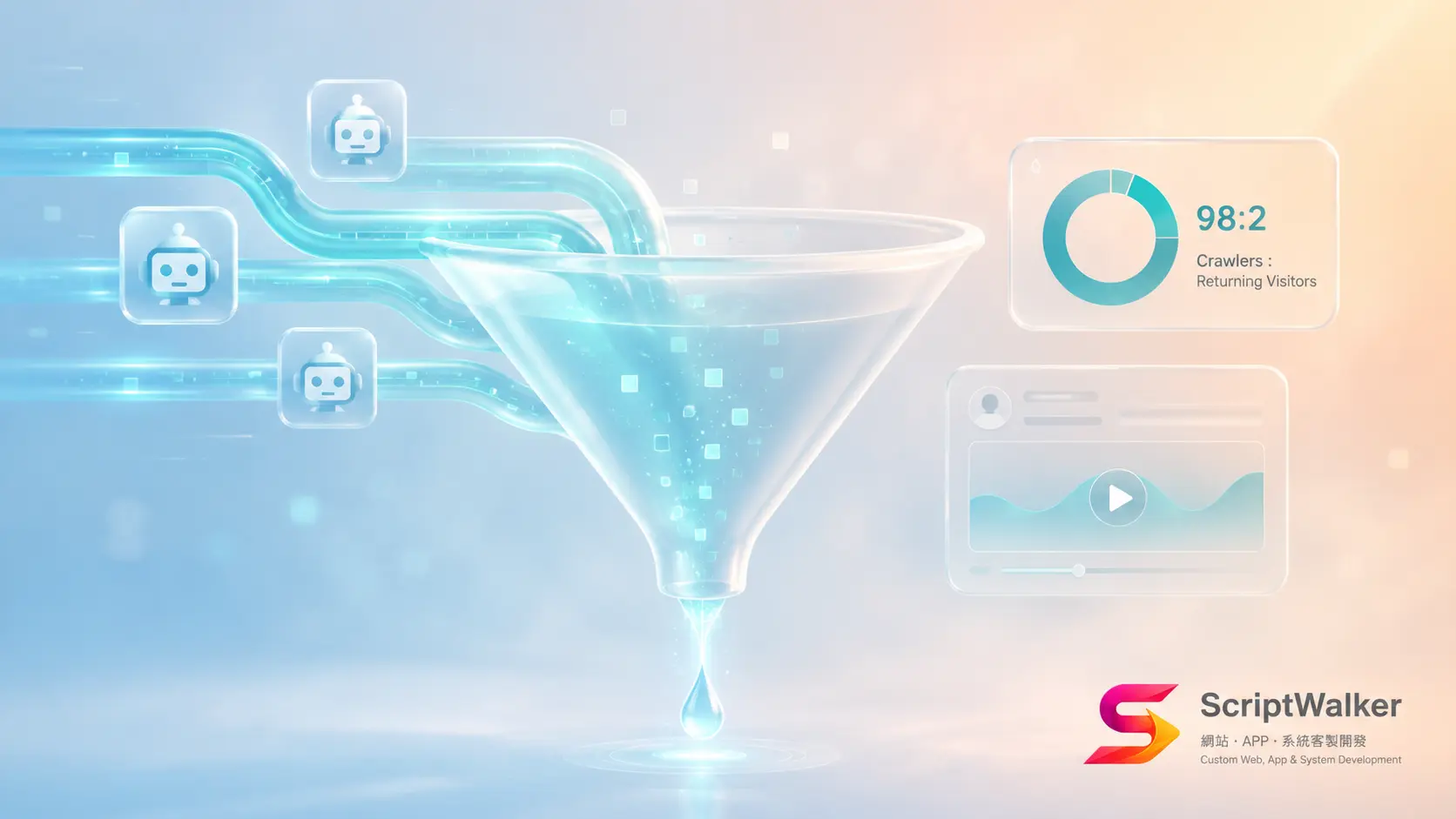
- AI Scrape-to-Referral Ratio card: crawl activity divided by referral traffic, expressed as one number. The illustration reads 6,000:1 against 41 referrals; Microsoft does not present it as a cross-site benchmark.
- Operator-level breakdown: a ranked list showing which AI sources send visitors back and which crawl heavily with little return. Far more useful than the site-wide average.
- Mapped-domain coverage safeguards: ratios computed only across correctly mapped domains. The reason is structural — the numerator comes from CDN server logs, the denominator from Clarity's JavaScript tag. When the two layers cover different domains, the quotient is arithmetic without meaning.
- Explicit coverage-gap context: the interface flags when bot data and referral data disagree on domain scope.
- One-click into session recordings: jump from a referral source straight into filtered replays and watch whether those visitors scroll, engage, convert, or bounce in three seconds.
- Traffic quality analysis: moving past referral counts into behavioural signals.
The prerequisite sits in the fine print: the numerator requires a connected CDN. When Clarity added robots.txt violation detection on 23 June 2026, Microsoft specified that project administrators must connect a supported provider through AI Visibility settings, naming Fastly, Amazon CloudFront and Cloudflare, with WordPress sites covered automatically by the current plugin. For the many small-business sites on self-hosted infrastructure or a non-listed CDN, the left half of this card is simply empty.
What to do now, by role
Business owners
- Do not treat the ratio as a blocking trigger. It measures a supply-side cost, not your revenue, and crawling usually costs you bandwidth and nothing else.
- Ask a more useful question first: in the last 90 days, did a single deal close where the customer said an AI assistant recommended you? If not, an ugly ratio is not your most urgent problem.
- If your site runs on Cloudflare and carries advertising, put 15 September 2026 in the calendar and confirm the default block rules will not wall off pages you want cited.
Marketing and SEO practitioners
- Fix the denominator before you read the ratio. GA4 only added a native AI Assistant channel on 13 May 2026 and a Source Group field in June. Anything earlier buried AI referrals inside direct traffic.
- Use Clarity's operator ranking as a prioritisation tool, not a verdict. Optimise content for the one or two operators that actually return visitors instead of writing a single rule for every crawler.
- Close the Google-side gap with the Search Console generative AI performance reports, launched in June and visible globally since August, covering impressions inside AI Overviews and AI Mode.
Developers and agencies
- For clients without a supported CDN, build the numerator from Nginx or Apache access logs by counting requests from
GPTBot,ClaudeBot,PerplexityBot,Google-ExtendedandBingbot. One cron job and one table. - Build the denominator from a proxy signal — no referrer, deep-page landing, dwell time above a threshold — rather than waiting for platforms to fix referrer passing.
- Ship CDN connection, Clarity project setup and GA4 channel calibration as a single configuration document, so the client is not staring at three mutually contradictory dashboards in three months.
Same ratio, four different ways of computing it
| Tool | Numerator | Denominator | Access |
|---|---|---|---|
| Microsoft Clarity Bot Analytics | CDN server logs | Sessions from the Clarity JS tag | Free, no traffic cap, but requires Fastly / CloudFront / Cloudflare or the WordPress plugin |
| Cloudflare Attribution Business Insights | Inline interception in the request path | Referrals tracked via UTM parameters | Bot Management customers; documentation specifies enterprise tier |
| Profound | No server-layer crawl data; citation monitoring instead | Proprietary citation dataset | Paid subscription; company raised a $96M Series C at a $1B valuation |
| Semrush / Ahrefs AI visibility modules | No server-layer crawl data | Sampled prompt citation results | Add-on modules to existing suites, priced by plan |
| Self-hosted log parsing | Your own access logs | GA4 AI Assistant channel | No licence fee; one-off engineering |
Note: the four approaches take different inputs, so the numbers are not comparable. Check vendor sites for current pricing.
What nobody is telling you
- The denominator is systematically undercounted, which biases the ratio toward "AI is freeloading." Google confirmed on 23 May 2025 that noreferrer attributes in AI Mode links stripped referrer values, registering those clicks as direct traffic. OpenAI only added UTM parameters to ChatGPT links in June 2025. Gemini's iOS app was found in October 2025 using an undocumented user agent. An undercounted denominator makes the exchange look more lopsided than it is.
- Blocking on the strength of this ratio backfires. Research from Rutgers Business School and The Wharton School, published 31 December 2025, found news publishers who blocked AI crawlers via robots.txt lost 23.1% of monthly visits and 13.9% of human-only browsing, without a proportional drop in citation rates. The same authors later re-measured on a weekly basis and the figure fell to roughly 7% — the evidence base here is softer than the people quoting it suggest.
- Ratios cannot be compared across sites, so no industry benchmark is coming. The IAB measurement framework of 4 August 2026 reported that only 16% of brands systematically track AI visibility, partly because there is no shared definition of what counts as a citation. A Similarweb framework found citation datasets shifting roughly 50% month over month with only 11% overlap across platforms.
- AI traffic is still small but unusually valuable per visit. Clarity's own study of more than 1,200 publisher sites, published 18 December 2025, found AI-referred traffic up 155% over eight months while remaining under 1% of total visitors — converting to sign-ups at 1.66% against 0.15% for search, 0.13% for direct and 0.46% for social.
The no-subscription version for small businesses
- ☐ Verify your GA4 AI Assistant channel and Source Group configuration first. Stabilise the denominator before arguing about the ratio.
- ☐ On WordPress, install the official Clarity plugin — bot data is covered automatically without a separate CDN contract.
- ☐ On self-hosted infrastructure, count daily requests per AI user agent from access logs with a single
grepand push the trend into a spreadsheet. - ☐ Enable the Search Console generative AI performance reports to fill in the Google-side impression data.
- ☐ Add a "how did you find us" question to enquiry forms with AI assistants as an explicit option, and use first-party answers to calibrate third-party attribution.
- ☐ Do not treat llms.txt as a fix: Ahrefs' study across 137,000 domains found 97% of llms.txt files received zero requests in May 2026.
FAQ
What scrape-to-referral ratio counts as healthy?
There is no usable threshold. Published figures span 118:1 to 286,930:1, and every vendor sources the numerator and denominator differently. The only meaningful comparison is operator A against operator B on your own site, tracked over time.
My ratio looks terrible. Should I block AI crawlers?
For most small businesses, no. Crawling typically costs you bandwidth and little else, while blocking also switches off your chance of being cited. Academic work shows blocking publishers lost meaningful traffic without a proportional reduction in citations. Blocking makes sense when bandwidth is genuinely under strain or the content is itself the paid product.
My site has no CDN. Can I see this card?
Not the left half. Clarity's bot data depends on CDN server logs, with Fastly, Amazon CloudFront and Cloudflare named as supported providers and WordPress sites covered by the current plugin. Otherwise you either connect a CDN or parse your own access logs.
If Clarity is free, is there still a case for Profound or Semrush?
Yes, for a different problem. Clarity is strong on your own server and behavioural data. Paid AEO platforms are strong on cross-platform, cross-competitor prompt sampling. Use the latter to learn who is being recommended, the former to learn whether the visitors are worth anything.
Which part of this release is actually valuable?
Not the ratio — the one-click path into filtered session recordings. Industry averages move 50% a month with 11% cross-platform overlap, but ten replays from your own site answer whether those visitors filled in a form. That question has a local answer.
My take
The consensus reading will be that we can finally quantify AI freeloading, so it is time to charge or block. I think the opposite: within 12 months the scrape-to-referral ratio will be understood as a supply-side political metric with no buyer-side decision value, and its most concrete harm today is nudging small businesses with zero bargaining power into blocking the one exposure channel still growing for them. Cloudflare has tens of millions of domains as leverage, so the ratio is a negotiating instrument for it. You have one website. Blocking does not buy you a licensing deal; it buys you not being cited.
The expensive mistake this quarter is seeing a four-digit ratio and adding a row of Disallow directives to robots.txt. The correct sequence is inverted: fix the denominator, read the operator ranking, then optimise content for the one or two operators that demonstrably send people back.
For an agency like ScriptWalker there is a concrete service package here: AI visibility measurement infrastructure — CDN and Clarity wiring, GA4 AI Assistant channel and Source Group calibration, Search Console generative AI report onboarding, an access-log parsing script, and a monthly operator-level crawl-versus-return report. One-off build plus monthly reporting retainer. Most small-business analytics setups in Taiwan are still running 2023-era channel groupings. The technical barrier is low, almost nobody is selling it, and clients do not yet know what they are missing.
To discuss how to start measuring your own site:
- Email: [email protected]
- Phone: 0916-224-047
- LINE: @ufv9089p
Sources
- Primary: Microsoft Clarity blog — AI Scrape-to-Referral Insights (13 Aug 2026)
- Primary: Microsoft Clarity AI Visibility product page
- Primary: Microsoft Clarity documentation
- Primary: Google Search Central — generative AI performance reports
- Primary: Cloudflare Radar AI Insights (crawl and referral data)
- Third-party: PPC Land — the ratio card and its history (13 Aug 2026)
- Third-party: Search Engine Land — Microsoft Clarity AI Scrape-to-Referral insights report
- Third-party: Ahrefs — llms.txt study across 137,000 domains
- Third-party: PPC Land — coverage of the Rutgers and Wharton crawler-blocking study