1. Where primary care clinics actually stand
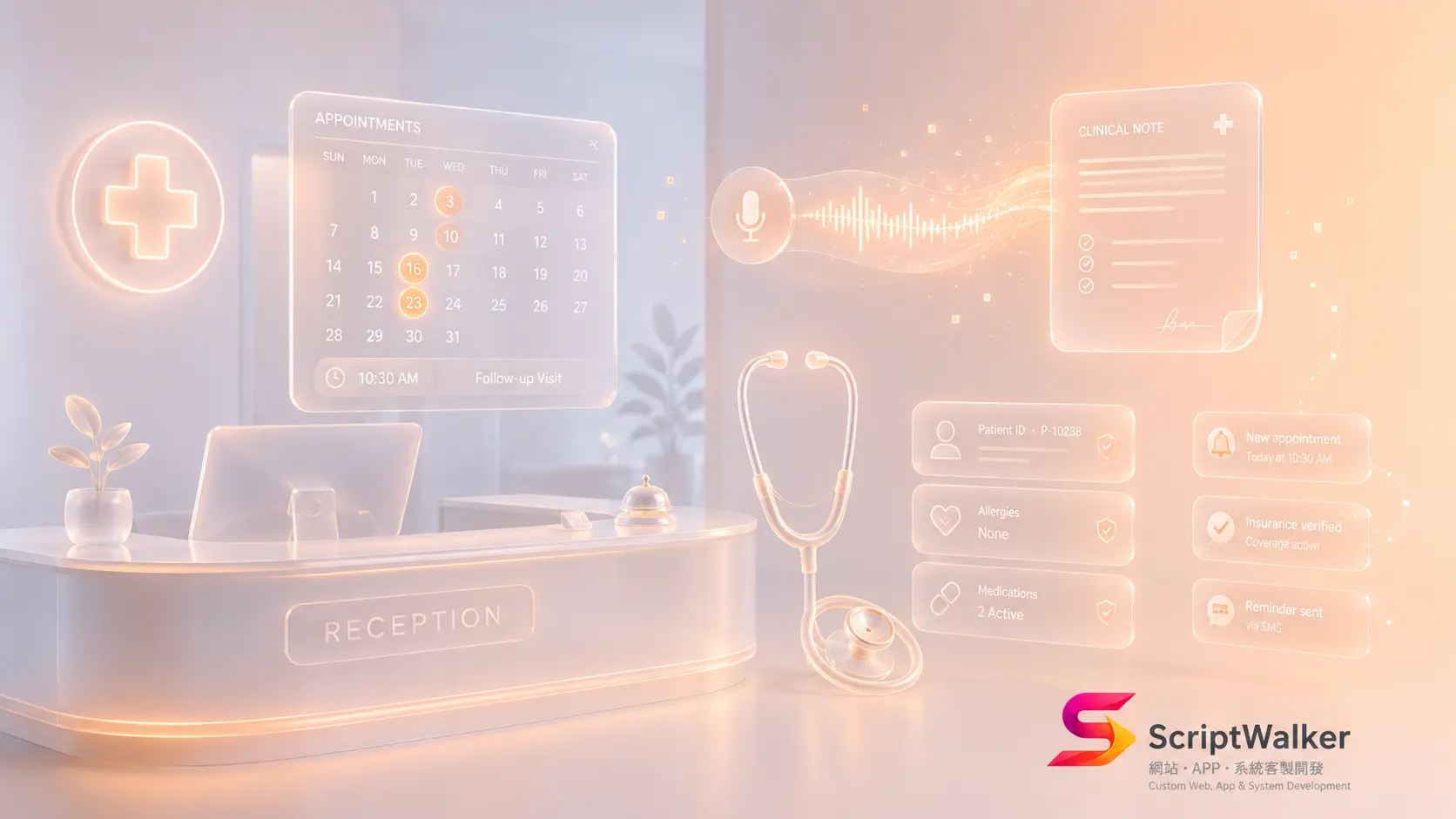
Taiwan's medical AI conversation orbits academic medical centers, but the volume sits in primary care. Clinics in the Ministry of Health and Welfare's clinic specialty dataset are overwhelmingly one-to-five-physician practices with no IT department. Adoption is climbing fast: the Doximity 2026 State of AI in Medicine report found 81% of physicians used AI professionally in 2026, up from 38% in 2023, with 29% using ambient documentation. The pain points are consistent: phone and LINE overload, first-visit no-shows, charting at night, and missing fields caught only at claim submission. None require AI to diagnose anything, which is why they are the safest entry points.
2. Four use cases worth building
- LINE first-response deflection: opening hours, self-pay pricing and similar repeats are roughly 60–70% of traffic. A retrieval-augmented bot answers and hands off to staff when it cannot.
- Ambient note drafts: consultation audio becomes a SOAP draft the physician reviews and edits; signature and clinical responsibility stay human.
- No-show prediction and tiered reminders: score risk from visit type, booking lead time, prior no-show history and time slot, then push an extra confirmation plus a reschedule link 24 hours ahead for high-risk bookings.
- Pre-submission claim checks: rules engine plus LLM flags note-versus-order inconsistencies, missing fields and known rejection patterns, producing a review queue rather than auto-submitting.
3. Two verifiable case studies
Case A: Kaiser Permanente, 7,260 physicians. From October 2023 to December 2024 its physicians used ambient documentation across roughly 2.5 million encounters, reported in NEJM Catalyst: nearly 16,000 documentation hours saved, and 84% of surveyed physicians reporting a positive effect on the visit. The critical design choice: the system makes no clinical recommendations, it only handles the record.
Case B: a five-centre controlled study. Published in JAMA Network Open, it tracked 8,581 ambulatory clinicians (1,809 adopters, 6,772 non-adopters): total EHR time fell 13.4 minutes per clinician per day, documentation time 16.0 minutes, with 0.49 additional visits per week. Far more conservative than the "two hours a day" vendors quote, and the number to budget against. Taiwan has local deployments too, such as the case documented by PwC Taiwan — but that is an IT-supported environment, so small clinics should still model on the JAMA figure.
4. Recommended tool stack
A clinic does not need to train models, only a controllable assembly:
- n8n, self-hosted, connecting the LINE Official Account, the existing HIS or booking system and an SMS gateway. Self-hosting matters because Taiwan's amended electronic medical record regulations require domestic storage.
- Claude API or OpenAI API for comprehension, summarisation and patient-education drafts, under enterprise terms with training feedback off, and with names and chart numbers tokenised before anything leaves the building.
- pgvector on PostgreSQL to store the clinic's own FAQ, price list and treatment descriptions, keeping the model from improvising.
- Laravel and Flutter for the review console — draft approval, no-show lists, claim exception queues — and the staff app. The console is the safety valve.
5. ROI model: three rooms, 120 patients a day
| Line item | Amount |
|---|---|
| One-off build (Phase 1–3) | NT$220,000 |
| Monthly run cost (API, hosting, 3 ambient licences) | NT$12,000 |
| Front desk: 90 enquiries/day, 55% deflected, 45 hrs × NT$230 | +NT$10,350 |
| No-shows: 380 bookings/mo, 16% → 10%, 23 slots × NT$800 margin | +NT$18,400 |
| Physician charting: 3 × 20 min × 22 days ≈ 22 hours (valued at half) | +NT$15,000 |
Ignoring physician time value, net benefit is about NT$16,750 per month and payback lands near 13 months. Counting it, about NT$31,750 per month, or roughly 7 months. Off-the-shelf ambient scribes run US$39–500 per clinician per month (2026 pricing surveys) but pay back slowest on their own, because they return physician time rather than cash.
6. Rollout timeline, Phase 1–4
- Phase 1 (2 weeks): inventory and compliance boundaries. Catalogue the top 30 front-desk questions and booking fields, confirm HIS export or API capability, and draw the red lines for what data AI may touch plus an approved-language whitelist.
- Phase 2 (3–5 weeks): front-desk MVP. Launch the LINE FAQ and booking bot on the lowest-risk question types, define the handoff threshold, run two weeks in shadow mode.
- Phase 3 (4–8 weeks): clinical and operations. Pilot ambient note drafts with one physician, ship the no-show model and tiered reminders, wire the claim exception queue into the console.
- Phase 4 (ongoing): governance. Sample 5% of AI output monthly, track the human edit rate, refresh the knowledge base, retrain the no-show model quarterly.
7. Four failure modes and how to avoid them
- Describing administrative AI as diagnostic AI. Claim "AI interpretation" or "AI diagnosis" and the software falls under medical device regulation requiring TFDA registration (see the AI/ML Medical Device Platform). Fix: position everything as administrative support.
- AI copy breaching medical advertising rules. Articles 84 onward of Taiwan's Medical Care Act restrict advertising content; efficacy guarantees, before-and-after comparisons and limited-time promotions are high risk. Fix: encode a banned-term list in the prompt, require human release.
- Sending records straight to public cloud tools. Records are sensitive personal data; outsourced storage must stay domestic with security certification. Fix: de-identify, deploy in-country, sign a written processing agreement.
- An unmaintained knowledge base. A bot quoting last year's prices is worse than no bot. Fix: attach updates to the existing notice workflow and name an owner.
8. Where AI does not belong
- Symptom triage and severity grading: clinical judgement, disproportionate liability.
- Dosing and drug interaction advice: approved databases and a pharmacist only.
- Mental health intake and crisis signals: a human must respond first.
- Complaints and malpractice-adjacent communication: human only; AI at most assembles a timeline.
9. ScriptWalker's offer and pricing
We build on Laravel, Flutter and self-hosted n8n, in three modules: LINE smart reception and booking (from NT$120,000), no-show prediction and reminders (from NT$80,000), and ambient note drafting with a review console (from NT$150,000, subject to HIS integration). The bundle starts at NT$220,000 and includes the Phase 1 compliance inventory plus a one-year maintenance playbook, defaulting to Taiwan-based hosting.
10. FAQ
Does auto-replying to patients with AI breach Taiwan's Medical Care Act?
Not if replies stay factual: clinic name, address, phone, specialties and hours, physician credentials, self-pay pricing. Efficacy claims, symptom responses and promotional language must be handled by a human.
Is it legal to summarise medical records with ChatGPT?
Records are sensitive personal data; outsourced storage must remain domestic with security certification. In practice you de-identify before sending, or use a model service deployable in Taiwan, with a written processing agreement.
Do we have to replace our current HIS or booking system?
No. Most projects add an automation and review layer alongside the existing system, syncing by API or export. Only fully closed legacy systems push you toward RPA or a manual bridge.
Can AI read X-rays or suggest a diagnosis?
Out of scope. Software offering diagnostic or treatment recommendations is a medical device requiring formal registration, beyond a general information systems project.
11. Decision checklist and next step
- ☐ Can you list your front desk's 30 most common questions?
- ☐ Are more than 60% pure factual lookups?
- ☐ Can your booking or HIS system export or expose an API?
- ☐ Do you know your first-visit no-show rate?
- ☐ Is someone willing to own the knowledge base?
- ☐ Will physicians accept an AI-drafts, human-reviews workflow?
- ☐ Does anyone check copy against advertising rules?
- ☐ Have you confirmed the data flow stays inside Taiwan?
- ☐ Is there agreement on a ~NT$250,000 first-year budget?
- ☐ Have you explicitly ruled out any "AI diagnosis" claims?
Seven or more checked means you are ready for Phase 1. For an ROI estimate specific to your specialty, get in touch:
- Email: [email protected]
- Phone: 0916-224-047
- LINE: @ufv9089p