Short answer: RAG makes AI look up your company documents before answering; an embedding turns text into comparable numeric coordinates; a vector database stores those coordinates and quickly finds similar content. A document Q&A system for an SMB costs about NT$150K–500K, with model fees often just hundreds to a few thousand NT$ a month.
A 60-person machine parts factory has sales staff constantly asking about a model's tolerances or which document covers warranty terms, with answers scattered across 400 PDFs and shared folders. A vendor proposes: "We'll use RAG, embed your documents into a vector database and connect a large language model." The owner nods but understands none of the three terms. They belong together because they're three parts of one system.
RAG: AI that checks the documents before answering
RAG (retrieval-augmented generation) means the AI first finds relevant passages in your documents, so answers are grounded.
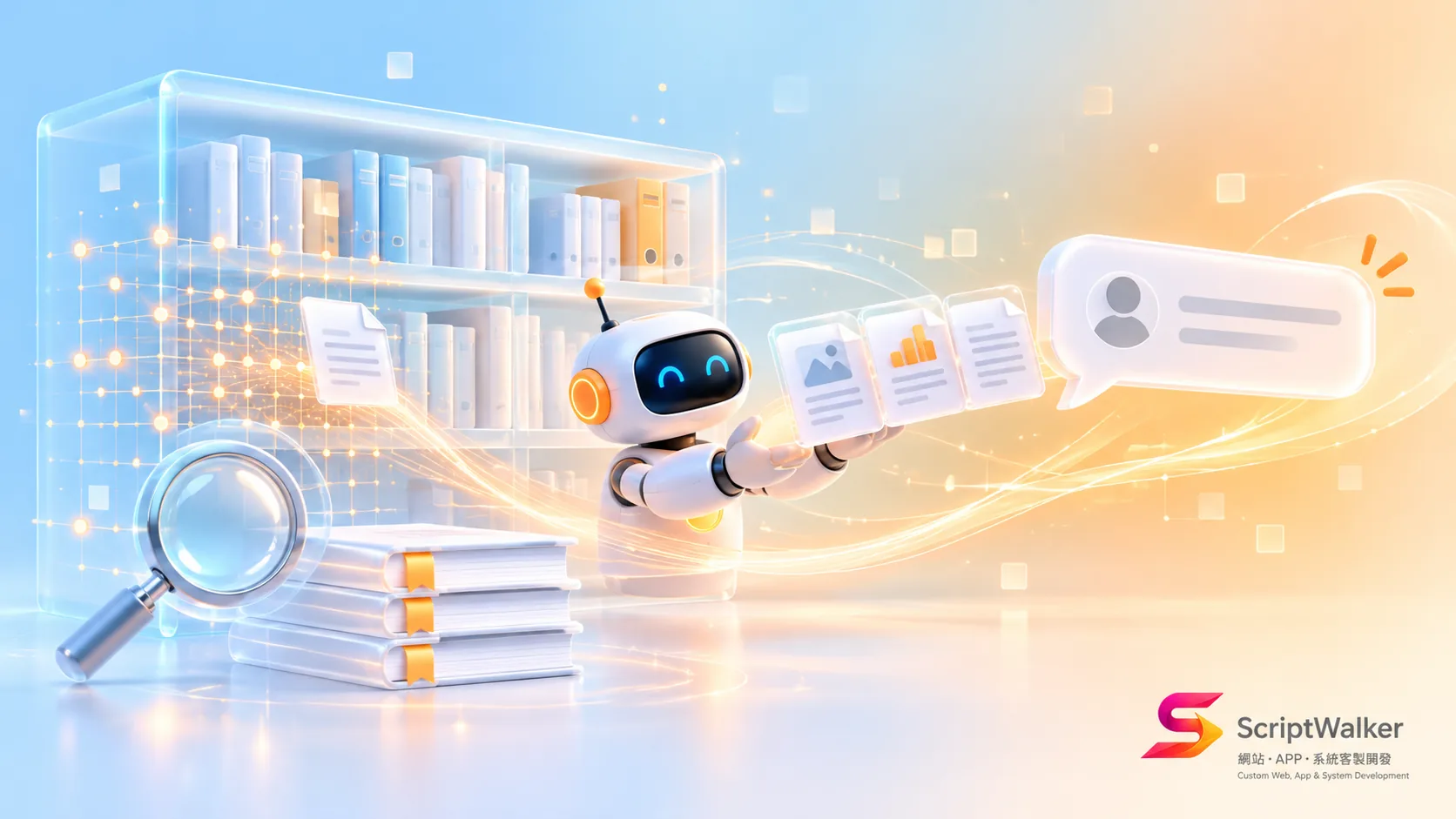
Analogy: a plain AI is like a new hire answering from memory who may make things up; RAG is like a librarian who pulls three relevant books, opens to the right page and answers from it.
Example: a cram school front desk keeps hearing "Is there room in the Wednesday 11th-grade math class, and how do refunds work?" A RAG system finds the timetable and refund policy passages, writes the answer and cites them so parents can check.
Embeddings: turning text into coordinates
An embedding converts a piece of text into a list of numbers, and text with similar meaning gets similar numbers.
Analogy: like giving every book map coordinates. "Warranty period" and "how long is repair coverage" are worded differently but land close together, so different phrasings still find the answer.
Example: a sales rep types "how hot can this bearing get" and the system finds the spec sheet line "operating temperature -20 to 120°C" even though the two share no words. Conversion is cheap: with OpenAI's embedding models, embedding 400 documents once usually costs under NT$100; check the official pricing page for current rates.
Vector databases: store coordinates, find the nearest
A vector database stores embeddings and finds the closest passages in milliseconds.
Analogy: a normal database is a shelf sorted by title that only finds exact titles; a vector database is a shelf arranged by topic, so "warranty" sits right next to "repairs" and "returns."
Example: SMBs with fewer than tens of thousands of passages don't need a dedicated service; adding the open-source pgvector extension to an existing PostgreSQL database works and saves thousands of NT$ a month in cloud fees.
How the three fit together
They form one pipeline: embeddings translate, the vector database finds, and RAG hands what was found to the AI to answer.
Picture it this way: on the left, company documents are split into passages and embedded into coordinates stored in the vector database in the middle. On the right, a user's question is also turned into coordinates, the database returns the 3–5 closest passages, and those go to the language model with the question, producing an answer with sources.
| Term | In one line | Everyday analogy | Main cost |
|---|---|---|---|
| RAG | Look it up, then answer | A librarian | Model fee per question |
| Embedding | Text to coordinates | Map coordinates on books | One-off conversion, very cheap |
| Vector database | Store coordinates, find nearest | A shelf sorted by topic | Server or cloud fees |
What it means for your decisions
Most of the budget goes to document cleanup and access control, not AI.
- Budget: basic (one department, a few hundred documents) about NT$150K–250K; with permission levels, a LINE interface and admin about NT$300K–500K.
- Monthly fees: at 200 questions a day, model fees are typically hundreds to a few thousand NT$ a month, plus hosting.
- Timeline: 6–10 weeks, 2–3 of them spent sorting and cleaning documents.
- Risk: outdated or conflicting documents get quoted; without permissions, any employee may reach confidential files.
Five questions to ask vendors
Use these as-is; be wary of vendors who can't answer.
- Will answers cite the source document and passage?
- How soon do document updates show up in answers, and does that cost extra?
- Can different departments see different documents, and how are permissions set?
- When no answer exists, does the system say "I don't know" or make something up?
- How are monthly model and hosting fees estimated, and is there a cap if usage spikes?
FAQ
Can a RAG system still make things up?
Less often, but not never. Requiring sources and an "I don't know" fallback greatly reduces the risk.
Do we need a vector database?
Not always. Up to tens of thousands of passages, PostgreSQL with pgvector is enough.
Will our documents be used to train AI?
With business APIs, most providers don't train on your data by default. Still check the contract and retention policy.
How is this different from uploading files to ChatGPT?
Permissions, scale and integration. A custom system can restrict by department, connect to LINE and internal systems, and update documents automatically.
Next step
ScriptWalker (a Taiwan-based Laravel/Flutter custom development studio) can assess your document volume, permission needs and budget, with custom development from NT$80,000. To see whether your company documents suit an AI Q&A system, book a 30-minute technical consultation:
- Email: [email protected]
- Phone: 0916-224-047
- LINE: @ufv9089p