A 45-person medical device distributor budgets NT$1,600,000 for an inventory and approval system. The vendor asks for a requirements spec; the client's PM locks himself in a meeting room for three weeks and produces 22 pages of Word. Week 9 blows up: one order can ship in two batches but must be invoiced once — the warehouse lead has worked that way for 11 years and never wrote it down. Rework: 6 working days, NT$96,000, launch pushed back three weeks. Not a communication failure; spec ownership was never negotiated.
Four Myths Worth Breaking First
Myth 1: the spec is the vendor's job and belongs in the quote. The quote covers turning a spec into a system, not extracting eleven years of tacit rules from your head. In a free spec phase the vendor guesses, and the client still pays for the rework.
Myth 2: thicker specs are safer. Twenty-two pages with no acceptance criteria is worse than six where every line is testable. ISO/IEC/IEEE 29148:2018 decomposes a requirement into condition, subject, action, object and constraint — the point is verifiability.
Myth 3: it's faster to change as you go. Agile does not mean no spec. The GOV.UK Service Manual explicitly says you do not build during discovery — you understand the problem.
Myth 4: once signed, the spec is frozen. A spec is a baseline, not a seal; what the contract should fix is how changes are priced.
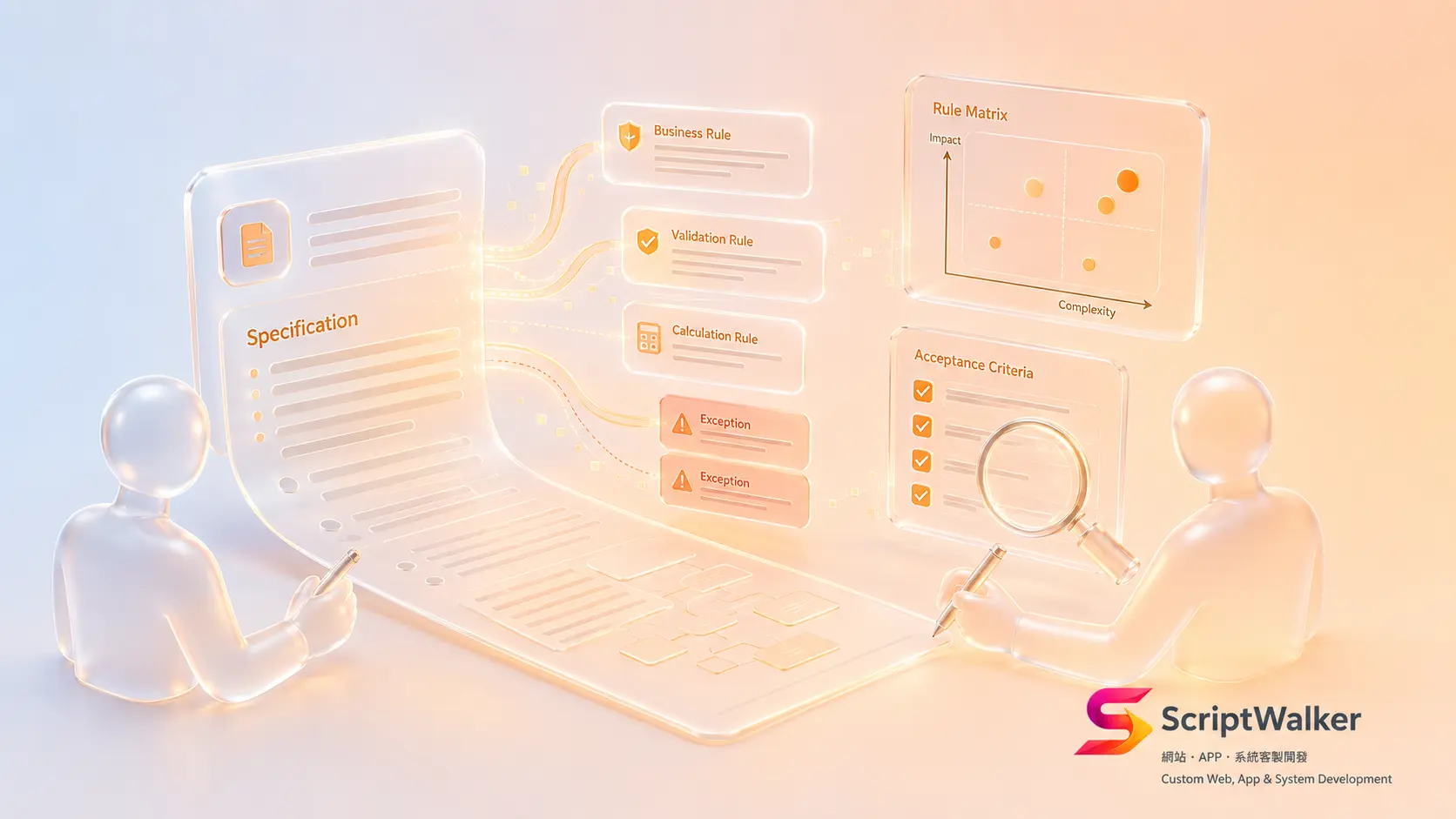
The Framework: Domain Rule Density × Documentation Muscle
DRD = the number of business rules that exist only inside your company and cannot be looked up externally. Every sentence like “unless…” or “only department X can…” counts as one.
Documentation muscle: in the past 12 months, did anyone produce a 3+ page process document that is still in use? Written once and never read counts as weak.
| DRD < 15 rules | DRD ≥ 15 rules | |
|---|---|---|
| Strong documentation muscle | Client writes the outline, vendor converts it | Co-authored: client writes rules, vendor writes behaviour |
| Weak documentation muscle | Vendor-written (paid) | Paid spec sprint (highest sticker price, lowest total cost) |
TSC = client hours × NT$450 + vendor spec hours × NT$2,000 + rework from missed rules + cost of blocked days
Rework coefficients use medians: a rule found mid-development costs about 9 hours to retrofit, about 32 hours after launch.
The Same Project, Three Ways, Priced Out
Using the distributor above (DRD 24, weak muscle):
| Approach | Client hours | Vendor spec hours | Rules missed | Rework cost | TSC | Launch delay |
|---|---|---|---|---|---|---|
| Client writes alone | 120 | 16 | 9 (2 post-launch) | NT$254,000 | ~NT$340,000 | 15 working days |
| Vendor writes | 28 | 70 | 5 (1 post-launch) | NT$136,000 | ~NT$289,000 | 6 working days |
| Co-authored sprint | 55 | 90 | 2 | NT$36,000 | ~NT$241,000 | 0 days |
The option that looks free is the most expensive: the sprint costs NT$180,000 up front and still lands lowest, saving NT$99,000 and 15 working days.
Three Companies, Three Different Answers
- 12-person e-commerce brand (DRD ~6, weak muscle): rules are industry-standard; vendor-written at NT$45,000–70,000 is enough.
- 45-person medical device distributor (DRD 24, weak muscle): exceptions live inside long-tenured staff; a paid sprint at NT$150,000–220,000 is a premium.
- 200-person restaurant chain (DRD 30+, strong muscle, PMO): co-author — client writes 40% (rules), vendor 60% (behaviour), NT$120,000–180,000; full outsourcing here is waste.
Hidden Costs of the Client Writing the Spec
- PM opportunity cost: 120 hours = three weeks with the day job stalled; at NT$60,000/month plus employer costs the loaded rate is about NT$450 (MOL wage survey).
- Cross-department interviews: warehouse, accounting, sales, support at 2–4 hours each — 10–20 hours total.
- Spec review meetings: 3 × 6 people × 2 hours = 36 person-hours, about NT$16,200.
- Vocabulary translation loss: the client writes “automatic,” the vendor reads “scheduled batch job”; each misread burns 4–9 hours.
- Missing acceptance criteria and version chaos: the Word file reaches version 7 while development builds from version 4; disputes drag 5–12 working days.
- Rules that surface after launch: a 3.5× rework coefficient plus the trust cost with your customers.
A 10-Dimension Scorecard for the Spec Phase
Score each 1–5, 50 total, before a line of code exists.
| Dimension | What a 5 looks like |
|---|---|
| Asks to be paid for the spec | Says plainly a free spec means guessing, and quotes |
| Spec copyright | Owned by the client, usable for competing quotes |
| Acceptance criteria | Every requirement is testable |
| Interview depth | Talked to frontline operators |
| Out of scope | Volunteers a “not building this” list |
| Assumptions flagged | Open questions and risks marked |
| Quantified description | States data volumes, concurrency, peaks |
| Non-functional requirements | Performance, permissions, audit trails |
| Change pricing | Delivers a CR rate card with the spec |
| Willingness to refuse | Says “this rule doubles the cost, change the process” |
Below 30, do not develop. 31–40, close gaps before signing. 41+, proceed to contract.
How ScriptWalker Fits — and the Honest Caveats
Standalone paid spec sprints (Advisory model, 2–3 weeks, NT$120,000–220,000), copyright with the client, usable for competing quotes and not tied to us building it; if we build, 50% of the fee is credited against development.
Three things that do not favour us. Vendor-written specs carry structural bias toward the stack we know, so every line must be read back by your frontline staff. A sprint is guaranteed revenue for the agency, so you are entitled to a deliverables list before the second instalment. And we routinely recommend cutting features you asked for.
Do not hire us if: you only want leverage over your incumbent vendor; you will not let frontline staff be interviewed; all the rules live in one departing, uncooperative employee's head; or the core is machine, PLC or production-line integration.
Playbook: 14 Days Before Kick-off Through Day 30
- Day −14 to −8 | Exception inventory: department heads submit their “unless” lists, target 20+; the one task a client cannot outsource.
- Day −7 to −1 | Materials: three months of real data, the five most complex documents, current Excel and its formulas.
- Week 1 | Field observation: sit with the warehouse lead and the accountant half a day each; watch, do not listen.
- Week 2 | Draft plus reverse read-aloud: the vendor writes, frontline staff read each line back as “customer returns half — what do I click?” What they cannot narrate is not written.
- Week 3 | Freeze: acceptance criteria, out-of-scope list and CR rate card delivered together.
- Day 30 | Review: more than 5 new rules in the first month means the sprint was incomplete.
Decision Checklist
- Can list 15+ rules unique to how your company operates
- A process document from the past 12 months is still in use
- Willing to give frontline operators 2+ hours of interview time
- Can supply three months of data and the five most complex documents
- Every requirement has a testable acceptance condition
- Have an explicit “not building this” list
- Know who owns the spec copyright
- Hold a change-request rate card
- Someone can sign off and freeze the spec
- Accept that the spec phase is billed separately
- Understand a rule retrofitted after launch costs 3× or more
Eight or more: go into development. Five or fewer: run a sprint before quoting.
FAQ
Do I always have to pay someone to write the spec?
No — not if DRD is under 15 or usable documentation exists. When DRD is high and muscle is weak, the rework on a “free” spec runs 1.5–2× the spec fee.
Can I take a paid spec to other vendors for quotes?
Yes, and asking is a good way to judge a vendor. Put copyright and unrestricted use in writing.
How detailed does a spec need to be?
The bar: a frontline employee can read it aloud as operating steps. Every “unless” must map to a defined system behaviour.
A rule was missed mid-build — whose cost is it?
Check the client's “unless” list. In the list and not implemented is a bug; not in the list is a change request priced by the CR rate card.
Will a spec sprint delay launch?
No. The 2–3 weeks come back multiplied during development — a net saving of 15 working days in the case above.
Next Step
Start with an exception inventory. Send us your “unless” list for a free 30 minutes: we calculate your DRD on the spot, map it against the matrix, and tell you who should write this spec and roughly what it costs. Nothing to sign.
- Email: [email protected]
- Phone: 0916-224-047
- LINE: @ufv9089p