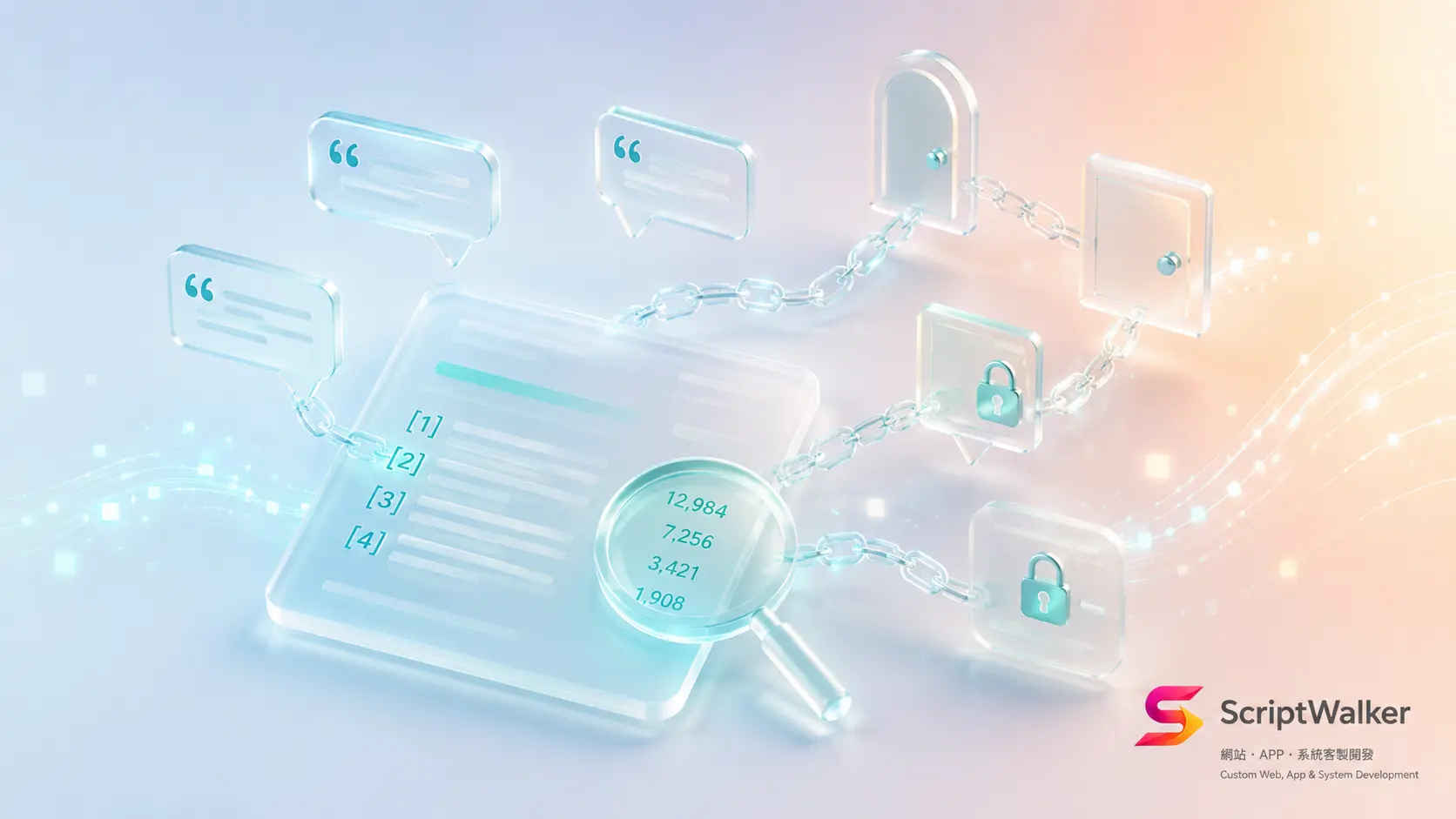
1,826 citations, and 34.7% won't open or don't carry the number
On 2 September, Haus Research published audit HR-2026-09: 310 factual questions about 210 technology companies, every citation Perplexity's two search models returned pulled down, fetched, and checked against the sentence it was attached to. The result — of the 1,826 citations attached to a sentence stating a figure, 34.7% pointed at a page that would not open to an ordinary reader, or opened and contained none of that sentence's numbers (full report and CC BY 4.0 dataset). This is not the familiar "AI hallucinates" story. It measures something else: whether the evidence the AI hands you can function as evidence.
The timing is not accidental. For the past 12 to 18 months the entire GEO/AEO industry has rested on an unexamined premise: cited equals visible equals valuable. Monitoring subscriptions are priced against that premise — Profound from around $399/month at the growth tier, Scrunch from $250 annually, Peec AI at roughly €89–199/month, Otterly.AI at $29/$189/$489 per month for 15/100/400 prompts. Every one counts how often you are mentioned. None counts whether the URL that cited you opens, or whether the number is on the page. Haus's method is deliberately crude: fetch each URL, grep for the figures, normalise so $185 million, $185M and 185000000 all match, and pass the pair if a single figure hits. A third still fails.
The control is telling. sonar averages 9.8 sources per answer and sonar-pro 9.7, passing 65.9% versus 64.7% with overlapping confidence intervals — the premium model is no better at grounding. GPT-4.1 with a web plugin cites just 2.0 sources per answer, 36.4% of them the company's own domain against Perplexity's 23.4%. The category's trajectory is not toward more accurate citation. It is toward more citation, functioning more like decoration.
For SMBs and agencies, this report converts GEO from a marketing problem back into an engineering one. Below: where exactly the 34.7% breaks, which bucket your own site falls into, and a self-audit that costs no subscription.
Breaking the number down: dead links are not the problem
Intuition says 404s. It isn't. Across sonar's 2,915 unique cited URLs:
| Class | Share |
|---|---|
| Live and readable | 78.7% |
| Behind a login, paywall, 403 or bot wall | 16.1% |
| Client-rendered shell, unreadable | 2.5% |
| Dead (404, 410, DNS failure, soft 404) | 1.3% |
| Still unreachable after three passes | 1.4% |
In other words, one citation in six is a door the reader cannot open. Aggregated to the answer level, 84.2% of sonar's 310 answers cited at least one URL an ordinary reader could not open. And among pairs whose page did open and was readable, 16.1% still contained none of the claim's own figures.
By question type the spread is wide: current CEO passes only 44.3%, headquarters address 53.0%, entry price 62.6% — against headcount at 82.0% and founding year at 75.0%. The pattern is clear: whether a fact lives in a canonical structured field determines whether the model can cite it correctly. A CEO's start date and a street number are the kind of thing everyone repeats and nobody formally publishes, so the model reproduces consensus and attaches the marker to a page that never carried it.
The sharpest number comes last: of 1,500 randomly sampled cited URLs looked up in the Wayback Machine, 1,432 resolved and 25.1% had never been captured at all. For directory and lead-list pages the figure is 39.3%. These pages were built to be found, not kept.
Immediate actions for three kinds of reader
Brand owners and SMB leadership
- Split the "how often does AI mention us" KPI in two: mentioned, and whether the cited page is on your own domain. 23.4% of Perplexity's citations point at the company's own domain — the only portion you fully control.
- Stop using "the AI says we're great" as a slide. The report is explicit: a claim being true and a citation being valid are different things, and it measures the second.
Marketing and SEO practitioners
- Put your key facts in plain text on one fixed page of your own site: founding year, address, current leadership and start date, entry pricing, SLA figures. These are precisely the lowest-passing question types.
- Write figures as literal text — not inside images, PDFs, or elements computed by JavaScript. Haus's check is plain string matching, and crawler behaviour is not far off.
Developers and agencies
- Check whether the sites you ship land in that 2.5% client-rendered bucket. A Next.js, Nuxt or Vue SPA without SSR or prerendering hands crawlers an empty
<div id="app">. - Check whether Cloudflare or your WAF is blocking legitimate AI fetchers into that 16.1%. That is a configuration problem, not a content problem.
- Put key values in both JSON-LD structured data and visible text. JSON-LD alone is not enough — the audit reads visible page text.
Tool comparison
| Tool | Published entry price | What it measures | Blind spot this report exposes |
|---|---|---|---|
| Profound | ~US$399/mo (Growth); enterprise on request | Brand mentions, cited sources, sentiment | Does not verify whether cited pages open or carry the figure |
| Peec AI | ~€89–199/mo | Mention rate, source distribution | Same, plus no way to re-verify citations that vanish |
| Scrunch AI | From US$250 (annual) | AI visibility tracking | Same |
| Otterly.AI | US$29/189/489 per month (15/100/400 prompts) | Prompt-level ranking and citation | Priced by prompt volume, unrelated to citation validity |
| Self-built grep audit | NT$0 + ~4 hours | Citation open-rate, literal figure hit-rate | No competitor tracking, no historical charts |
What the coverage does not tell you
- Haus lists seven limitations itself, and most push the number toward optimism. They fetch as an identified bot from datacentre addresses, so the 16.1% gated share exceeds what a person with a browser meets. But their pass bar is a single matching figure — a bare year counts — so 34.7% is a floor, not a ceiling. Their secondary model-judged run looks far worse: on readable pages only 50.8% of claims judged supported, 40.0% end to end.
- This tests API models, not the consumer product. Answers came from
perplexity/sonarandsonar-provia OpenRouter; the Perplexity app retrieves and cites under its own settings. Reading this as an indictment of the consumer product is a misread — though for anyone doing GEO, the API versions are what a large share of downstream applications actually run. - Being cited can be a liability. Half the dead links come from one family of pages:
komo.ai/directory/<company>-offices,apollo.io/where-is/<company>,temperstack.com/plans/<company>— minted per company per question type to catch specific queries, and taken down as cheaply as they went up. If AI answers about your company lean on those, your "AI visibility" sits on ground somebody else can remove at will.
The no-subscription DIY alternative
Haus's core check uses no model at all, so you can reproduce it. A weekend version:
- Step 1: write 20 questions your prospects actually ask — where you are, what your plans cost, whether you do X.
- Step 2: run them once and capture citations. Use any API that returns citations (Perplexity Sonar, OpenAI with retrieval, Gemini) and save each answer's URL list to CSV.
- Step 3: fetch every URL with curl and record status. Give failures two retries (longer timeout, different egress). Compute the open rate.
- Step 4: grep the figures. Extract amounts, percentages, years and any run of three or more digits from the answer sentence, normalise, and search the page's plain text. One hit passes.
- Step 5: fix only the rows on your own domain. Those are the ones you can fix, and there are exactly two fixes: write the number as visible plain text, and confirm the page is readable with no JavaScript and no cookies.
Haus's full method and scripts are published under CC BY 4.0, so you are not designing from scratch.
FAQ
Does 34.7% mean a third of Perplexity's answers are wrong?
No. The report's closing section is explicit: it measures whether the thing offered as proof functions as proof, not whether the answer is right. In most failures the answer is correct — Vercel's $20/month entry tier is probably accurate; that string simply is not on the cited page.
My site is a Next.js SPA. Does it fall into that 2.5%?
Very likely, if there is no SSR or static prerendering. Test it: curl -s your-url | grep "some key number". If nothing comes back, no non-JavaScript fetcher sees it either. The fix is server-side rendering or build-time prerendering of key content.
Is putting figures in JSON-LD enough?
No. Structured data helps with search-result features, but this audit reads visible page text. Put figures in both, and keep them consistent — mismatched is worse than absent.
Should I still buy an AI visibility monitoring tool?
Depends on the job. For competitor trends and historical charts, they earn their keep. But if the goal is to find what is broken and fix it, nine times in ten the breakage is on your own domain and a free script finds it — no $399 a month required.
My take
The GEO industry currently sells "how to get cited." My judgment: over the next 12 months the deciding variable will not be citation count but whether the cited page opens and can be grepped. The reasoning is direct — when 34.7% of citations fail the most generous possible string check, platforms have one path available: raise the evidentiary bar on sources. The moment citation requires verification (page reachable, figure matchable), the 16.1% behind login walls and the 2.5% client-rendered shells fall out of the citation pool wholesale. On that day, everyone optimising "mention rate" today discovers they optimised a metric about to be redefined.
For a studio like ScriptWalker this is an immediately productisable service, and it is engineering work rather than marketing work: an AI citation-readability audit — verify server-side rendering, check the WAF is not blocking legitimate fetchers, confirm key values exist as visible plain text, and reconcile JSON-LD against visible content, delivered as an open-rate and literal-hit-rate report plus a remediation list. Marketing agencies cannot run it; we can finish it in a day. The counter-argument deserves stating: if platforms never tighten their citation standards, this service caps out at "site health check" pricing and cannot sustain an annual contract — so it belongs as an add-on to existing maintenance agreements, not as a standalone line.
Sources
- Primary: Haus Research HR-2026-09: A third of Perplexity's citations don't contain the number they're cited for (2026-09-02)
- Primary: Haus Research full method (CC BY 4.0)
- Primary: Every cited URL and how it resolved (raw data)
- Primary: Google Search Central: Intro to structured data
- Third-party: Search Engine Roundtable: September 2026 Google Webmaster Report
- Third-party: AI Visibility Tool Pricing Compared 2026
Want a citation-readability audit on your site?
In a day we can check server-side rendering, crawler reachability and the literal visibility of your key figures, and hand back a remediation list.
- Email: [email protected]
- Phone: 0916-224-047
- LINE: @ufv9089p