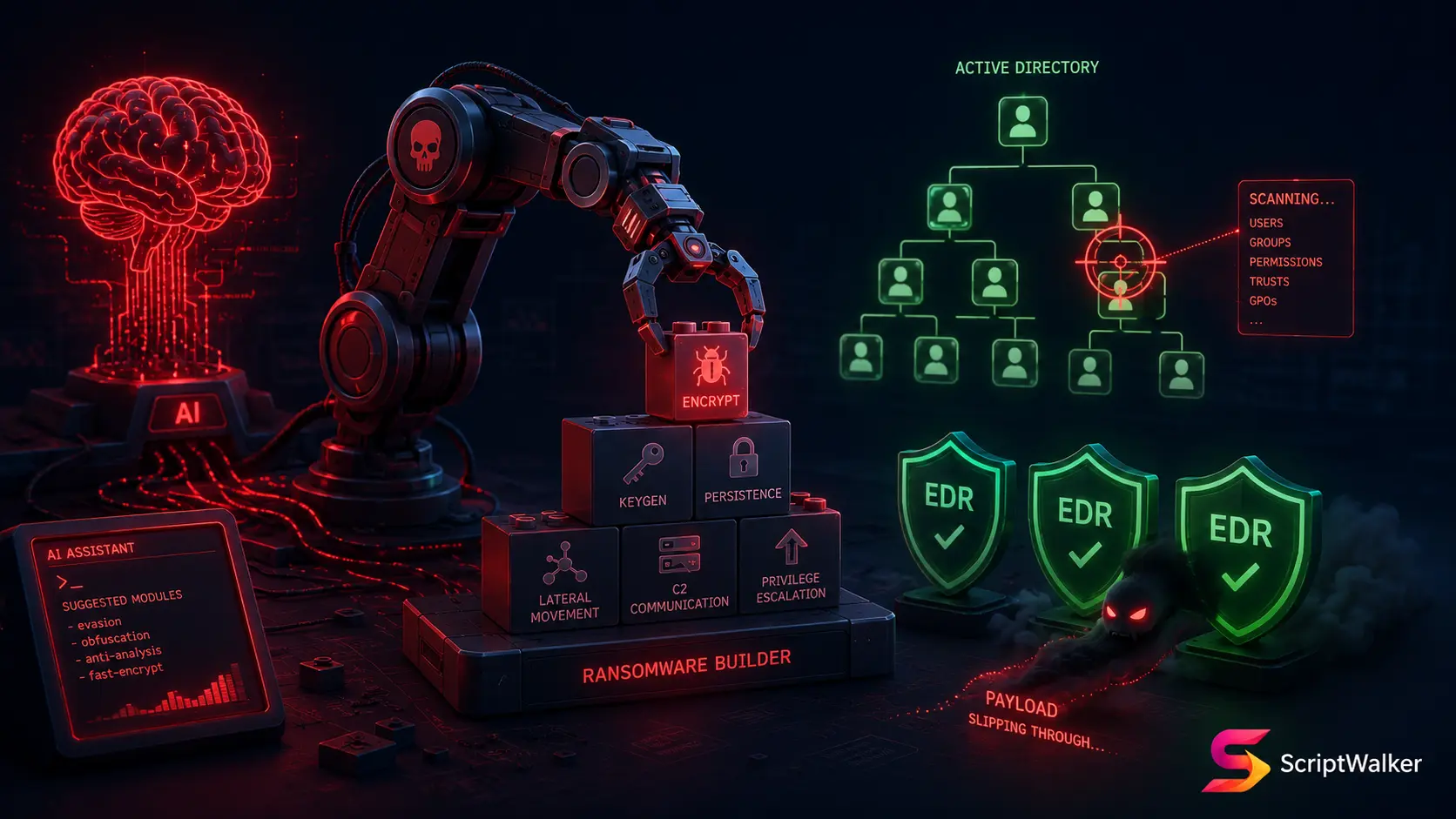
We've debated "could AI be used for evil" for a long time; now there's a concrete case. Security vendor Sophos exposed a threat actor using a ransomware attack toolkit built with the help of AI to automate Active Directory (AD) discovery and evade endpoint detection and response (EDR) products from Sophos, CrowdStrike and Microsoft. Notably, the toolkit was developed with the aid of AI agents like Cursor and Claude Opus — but the overall workflow remains human-driven, with AI acting as an accelerator, not an autonomous crime machine.
What Was Found
Researchers found a Git repository containing an automated Active Directory discovery panel and a "lab" that uses an iterative approach to develop and test malware specifically against the Sophos, CrowdStrike and Windows Defender EDR agents. The kit is fairly complete: Cobalt Strike profiles to disguise beacon traffic, a Telegram bot API for command and control, Python scripts that inject shellcode into legitimate Windows executables, and a Cloudflare Worker to obscure the C2 server. Sophos assesses it is likely intended for real-world intrusions — ransomware deployment and data theft.
The Wider Context
In the same window, critical flaws are under mass exploitation — the CitrixBleed-like Citrix NetScaler out-of-bounds read (CVE-2026-3055, CVSS 9.3) confirmed by Fortinet as exploited at scale, high-severity Oracle WebLogic and Windows Netlogon bugs being tracked, and a WordPress Kirki plugin privilege-escalation flaw used to take over admin accounts. The vulnerabilities were always there; what's changed is attackers can use AI to speed up the whole "find the flaw, write the exploit, iterate past the defenses" loop.
My Take
The sentence to hear: attackers have turned AI into a productivity tool, and defenders can't stay in the manual era. But don't panic-buy products over a headline — Sophos itself says the workflow remains human-driven; AI mainly accelerates development and testing. The shape of the attack hasn't changed; the speed has. For SMBs and agencies my advice is deliberately boring. First, AD discovery succeeds mostly because internal permissions are too loose and lateral movement isn't contained — least privilege, network segmentation and privileged-account management beat any new tool. Second, EDR isn't fire-and-forget: keep it updated, enable behavioral detection, centralize logs. Third, your patch cadence on internet-facing services (VPNs, gateways, WordPress plugins) is your survival line. AI made attacks faster; the only answer is to make patching, permissions and monitoring faster and more automated too.
Note: This article discusses malicious tooling and attack techniques for defensive and research purposes only. Do not use for unlawful activity.
Sources
- AI-built ransomware toolkit automates EDR evasion, AD discovery — BleepingComputer
- AI accelerates development of ransomware toolkit with EDR evasion capabilities — SC Media
- Hackers Leverage AI-Powered Tools to Streamline Active Directory Compromise — GBHackers
- Citrix NetScaler SAML IDP Vulnerability (CVE-2026-3055): Large-Scale Exploitation Confirmed — Threat-Modeling.com