This is the number from Anthropic's just-released 2026 Agentic Coding Trends Report that I cannot stop turning over: roughly 27% of AI-assisted developer work in 2026 is work that would not have been attempted at all without agents. Not "would have taken longer." Not "would have been done by someone else." Wouldn't have shipped. Wouldn't have existed.
If you only read one paragraph from the report, that should be it, because it changes the entire economics conversation about AI in software.
The productivity story isn't "faster." It's "more."
For three years the dominant pitch for AI coding tools has been time savings: pair Copilot or Claude or Cursor next to a developer, recover three hours per week, multiply by team size. That story is true but small. Anthropic's report flips it. Engineers do report a net decrease in time per task — but the much larger movement is in volume of output. Output grows faster than time-per-task shrinks, because AI lowers the activation energy for the work that used to fall off the bottom of every backlog.
The unwritten internal tool. The polish on the admin page nobody loved enough to file a ticket for. The migration script that was always somebody else's problem. That 27% lives there. It is, in plain terms, the long tail of engineering work that was previously priced too high to do.
Eight trends — but three that matter to a small team
The report names eight trends. Three of them have direct, immediate implications for any web or app shop with under a hundred engineers.
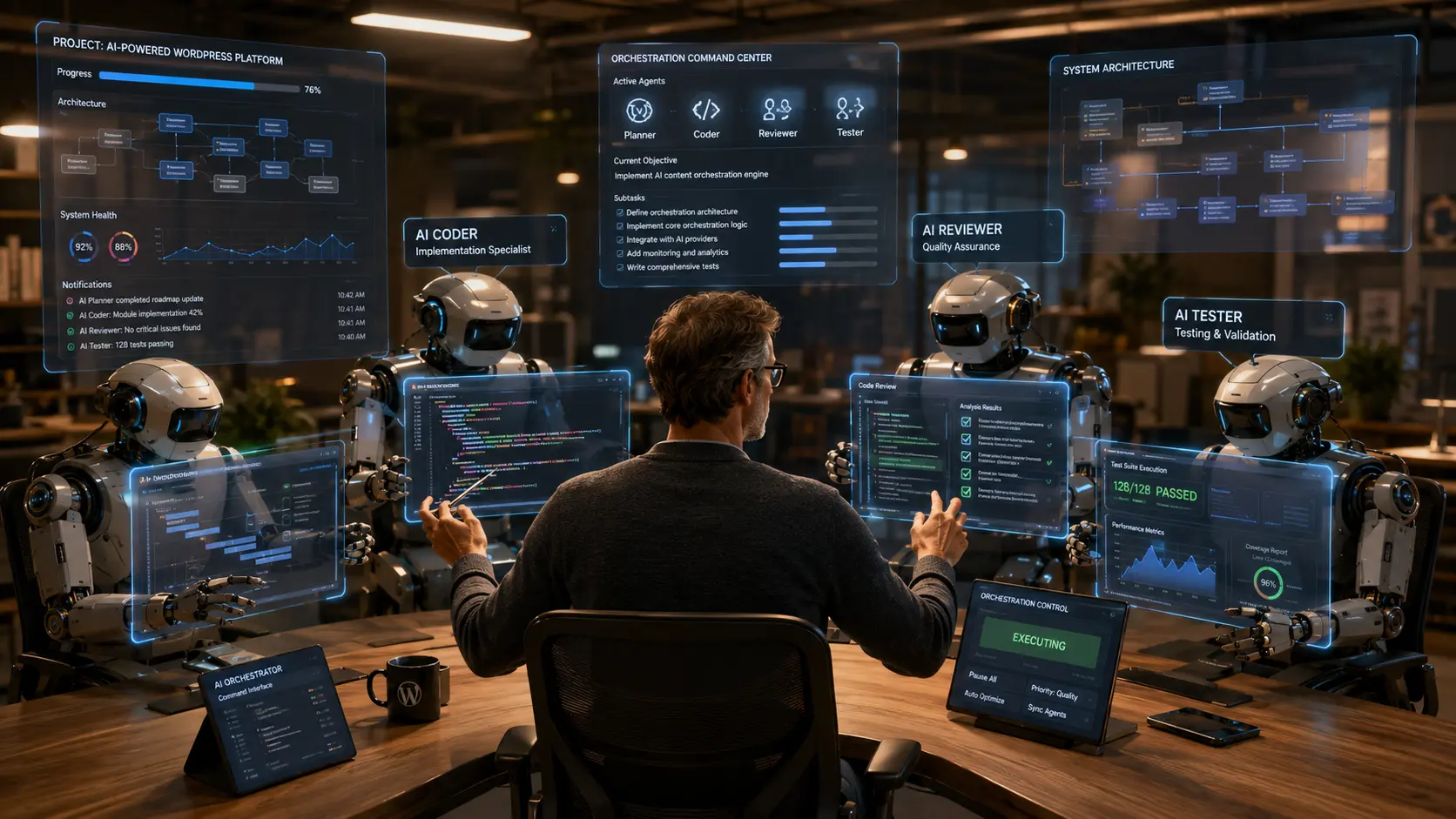
First, single agents are becoming coordinated multi-agent teams. The pattern of one human plus one assistant is being replaced by one human orchestrating a small swarm — a planner agent, a coder, a reviewer, a tester. That changes onboarding (you're now teaching new hires to manage agents) and changes interview screens (you're now testing for "can this candidate decompose a problem cleanly enough for a fleet to execute it?").
Second, long-running agents are now building complete subsystems over multiple days. The interesting unit of work is no longer "the next pull request." It is "leave this agent running over the weekend and ship a feature on Monday morning." If your CI pipeline can't survive an agent committing on its own at 3am Saturday, your CI pipeline is now the bottleneck, not the model.
Third, human oversight is shifting from reviewing everything to reviewing what matters. Agents are getting better at recognizing situations that need human judgment and elevating them. Senior engineers in 2026 spend less time approving boilerplate and more time arbitrating decisions with business consequence. That maps to compensation: judgment is becoming the scarce resource, not output.
What the report doesn't say loudly enough
There is one finding the report partly obscures: bug density in projects with unreviewed AI-generated code is roughly 23% higher (corroborated by 2026 surveys outside Anthropic). The headline productivity number assumes review discipline. If your team has been quietly skipping the second pair of eyes because "the AI already did it," your defect rate is silently climbing — and you'll find out at the worst possible time.
A second underplayed finding: engineers say they can "fully delegate" only a small fraction of their tasks despite using AI in roughly 60% of their work. Translation: the "agents will replace us" narrative is wrong, but the "we'll still write the same code with help" narrative is also wrong. The real shape is "we'll define problems and adjudicate solutions, while the agents write the code."
My Take
The most underrated chart in the report shows that AI's biggest contribution is the work it makes economically viable for the first time. Internal tooling. Test coverage on legacy code. Documentation of tribal knowledge. None of these gets prioritized in normal sprints because they don't ship value to a customer this quarter. With agents, they cost approximately nothing to attempt, so they happen.
For a small studio or contractor, this means the competitive moat is no longer raw output speed — most teams are converging on similar throughput numbers. The moat is now (a) judgment about which problems to point the agents at, and (b) the discipline to actually review the output. The first is taste. The second is hygiene. Both compound. Both take years. And both are exactly what an experienced PHP/database/app team has been quietly accumulating while everyone else was running benchmark wars.
Sources
- 2026 Agentic Coding Trends Report — Anthropic
- How AI Is Transforming Work at Anthropic
- We Read Anthropic's 2026 Agentic Coding Trends Report — Hivetrail
- Anthropic's 2026 Agentic Coding Trends Report: From Assistants to Agent Teams — NYU Shanghai RITS
- AI Coding Assistant Statistics & Trends 2026 — Second Talent