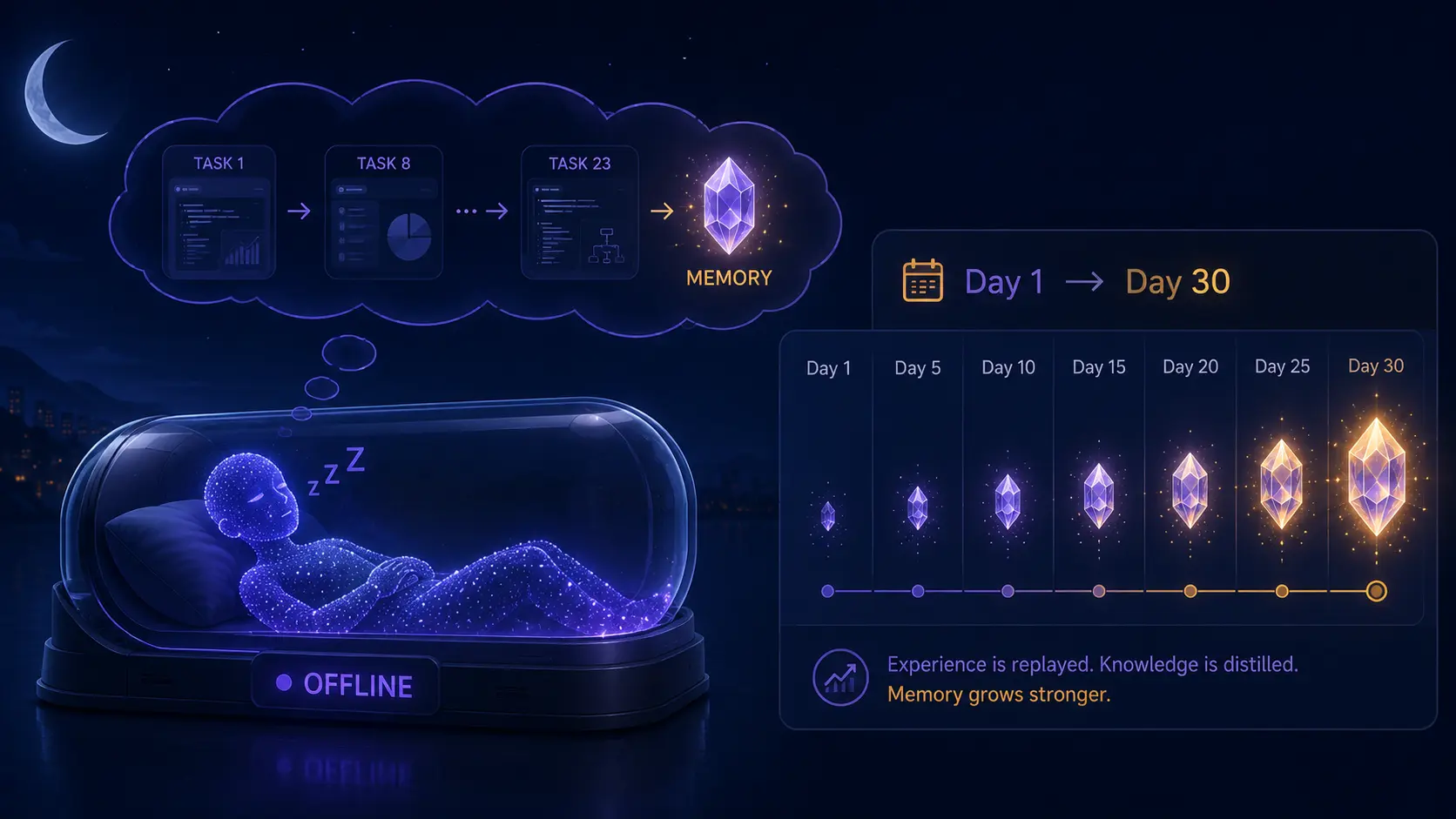
On May 6, Anthropic ran its Code with Claude developer conference in San Francisco. Two of the three headline updates were expected — the Claude Opus 4.7 model release, and a doubling of Claude Code usage limits. The middle one, called Dreaming, is the one we'll look back on at year-end as the inflection point.
1. What dreaming actually is
Dreaming is a scheduled offline process that runs between agent sessions. It re-reads the agent's past conversation transcripts, finds recurring patterns, and curates the agent's memory stores — the long-running context files that let an agent remember user preferences, recipe-style tool usages, and previously stepped-on rakes. The patterns it surfaces include recurring mistakes, workflows the agents converged on, and preferences shared across a team.
That sounds like an automated retrospective, but there are two crucial differences. First, dreaming does not retrain model weights — it edits the agent's memory files and the context that hangs alongside the system prompt. So any company, any studio, can adopt it the day it ships, no waiting for the next pretraining cycle. Second, it runs offline. The agent does this while you sleep; when you arrive in the morning, the playbook is one page longer.
2. The keynote demo and the Harvey number
The keynote demo triggered a dreaming session live from the Claude Developer Console. Overnight, the agent reviewed past simulation runs and emitted a "descent playbook" — a structured set of heuristics extracted from patterns across many sessions. Anthropic's flagship case study was Harvey, the legal AI company: after enabling dreaming, task completion rates rose roughly 6x.
3. Why this matters for studios and consultants
For PHP studios, SEO/AEO consultants, and process automation contractors, the meaning of this feature isn't "AI got smarter." It's that memory now compounds. In the old world, you wrote a system prompt and hoped the agent retained it; you compensated by stuffing more context. Dreaming flips it — every night, the agent compresses its own memory, noise drops, reusable heuristics rise. For a studio running one agent across ten customers, dreaming means you don't need to hand-craft a per-customer fork; you let dreaming distill each customer's preferences and domain knowledge automatically.
4. The honest caveats
Dreaming is not a free lunch. It costs tokens. And on workflows full of conflicting goals or noisy human feedback, dreaming may calcify chaos into the playbook — the agent then becomes more stubborn about doing the wrong thing. That's why Anthropic launched it as a research preview, request-only. Expect a wave of "I turned on dreaming and now my agent is harder to correct" reports in the first month.
Worth flagging alongside Dreaming: Anthropic's compute deal with SpaceX, using the Colossus 1 facility in Memphis (220,000 NVIDIA processors, 300 MW of new capacity). That capacity is the physical precondition for Opus 4.7 and Dreaming launching together.
My Take
For 18 months, the AI tools fight has been over two things: models (whose SWE-bench score wins) and IDE seats (whose autocomplete is pinned to the developer's editor). This week we got a third front: agent memory.
Training data belongs to model labs. Prompt engineering belongs to tool vendors. But "what memory has this agent accumulated by working with you for three months" — for the first time, that has a productizable, reproducible, billable shape. Dreaming turns memory from free text into a scheduled, audit-able, version-controllable asset. Within six months, expect this offer in the market: "We train you a Claude agent dedicated to your company, dreaming for you every night, and in 90 days it understands your back office better than your new hires." That is the next product line for Taiwan's outsourcing studios.
Short-term tactical advice: request access to dreaming in the Claude Developer Console today. Run it for one month against your own studio's internal agent — the one that handles customer onboarding, contract drafts, and quotation generation. Take the playbook dreaming produces and turn it into your studio's SOP. That SOP is the most valuable IP you'll own when you start selling AI agent services to clients.
Sources
- Anthropic introduces "dreaming," a system that lets AI agents learn from their own mistakes — VentureBeat
- Anthropic Unveils 'Dreaming' Feature to Help Its AI Agents Self-Improve — U.S. News
- Anthropic is letting Claude agents 'dream' so they don't sleep on the job — SiliconANGLE
- Anthropic will let its managed agents dream — The New Stack
- Inside Anthropic's 2026 Developer Conference — Every
- SpaceX backs Anthropic with data centre deal — Al Jazeera