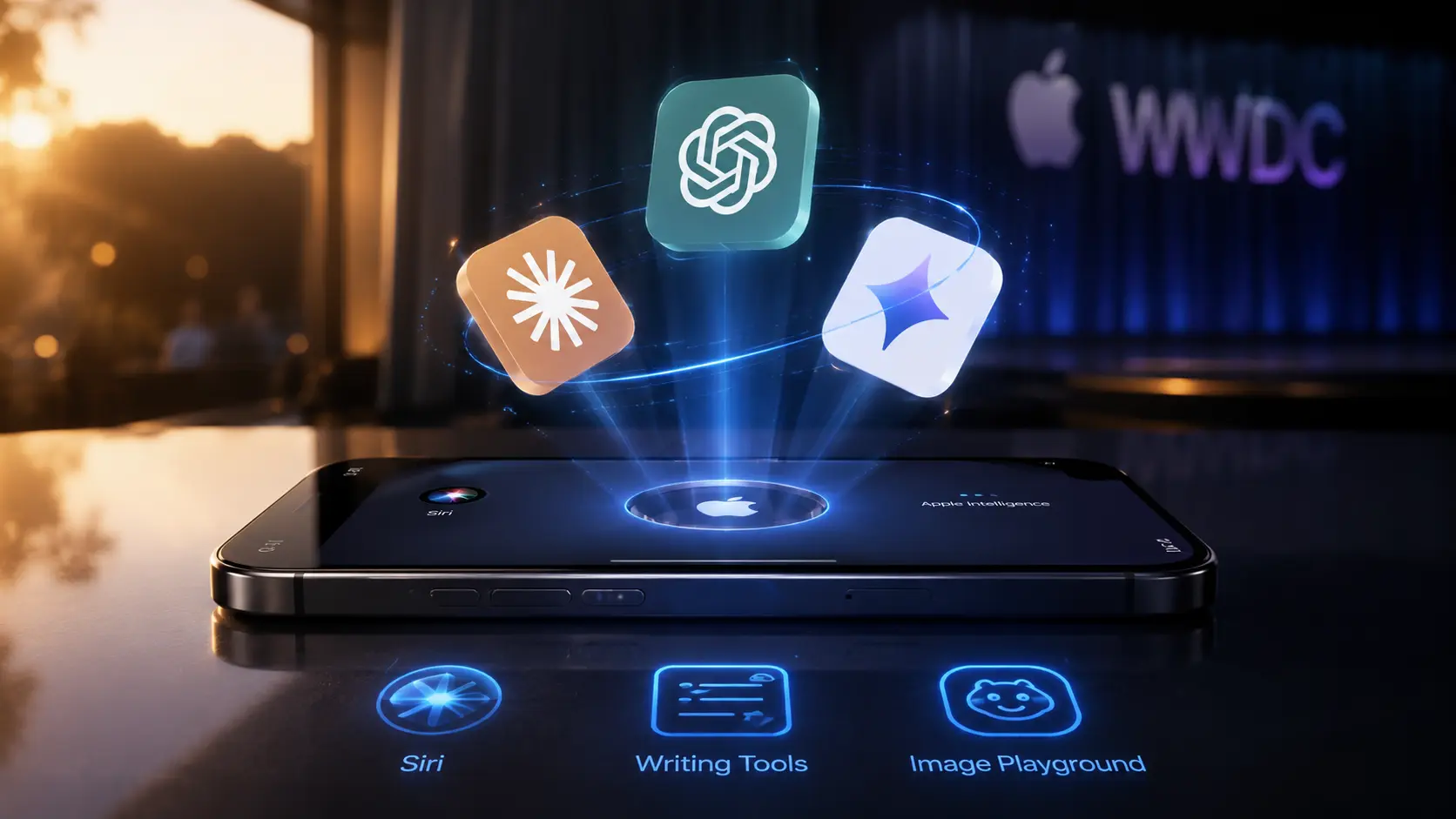
The 9to5Mac and MacRumors reports that landed between May 5 and May 9 are the kind of news that sounds like a small product update and is actually a platform shift. iOS 27, iPadOS 27, and macOS 27 will introduce an "AI Extensions" system that lets users replace ChatGPT — currently the exclusive AI behind Apple Intelligence — with Gemini, Claude, Perplexity, Mistral, or any third-party model whose app supports the new extension hooks. Apple is widely expected to formally announce this at WWDC in June; the Bloomberg-sourced reporting describes the architecture as already implemented in seed builds.
This is bigger than the headline reads.
1. What "Extensions" actually means
Apple Intelligence today is a closed loop: Writing Tools sends to Apple's on-device or private-cloud models, with a fallback handoff to ChatGPT for anything outside the local model's competency. The Extensions system makes that handoff selectable. Crucially, Apple is reportedly extending the system beyond Writing Tools and Image Playground into Siri herself — third-party AIs will be able to respond to Siri queries, with Apple differentiating the voice so users can hear which assistant is replying.
For developers this is the App Store moment of 2026. To plug into Extensions, your app needs to expose the right intents, ship a clean response surface, and respect the Apple Intelligence privacy contract. Whoever does this work first — for ChatGPT, Claude, Gemini, Perplexity, or a vertical AI like a tax assistant or a recipe coach — gets a year of distribution that doesn't cost a cent in Meta or Google ad spend.
2. Why this matters for Flutter and PHP devs
For mobile app developers, the Extensions API is your new moat. Any consumer app that handles structured user requests (calendar, finance, travel, fitness, language learning) can ship an extension that lets Siri call directly into your app's logic. If you build a Flutter app today, the right move is to design your business logic so that an Extensions integration is a thin shim, not a rewrite. That means: keep your service layer pure Dart, expose typed intents via a single dispatcher, and avoid coupling to UI state.
For PHP / Laravel backend developers, the implication is subtler. Extensions live on the device, but the queries they answer almost always need to fan out to your backend — order history, account state, support transcripts. Your existing REST/GraphQL APIs need three things they probably don't have today: stable schemas an LLM can map intents onto, low-latency edge caching for sub-300ms responses Siri needs to feel natural, and audit trails for every AI-mediated mutation (so you can roll back if Claude misinterprets the user). Laravel 13's first-party AI SDK plus a thin "intent gateway" service is the right shape.
3. What WWDC will and won't announce
Reporting suggests Apple has signed a deal with Google for a Gemini-based model to power Apple Intelligence by default, with users able to switch. That implies a tier of "blessed" partners (likely Google, OpenAI, and Anthropic) who get priority routing, and a long tail of third-party apps via Extensions. The competitive dynamic Apple is creating is genuinely new: rather than picking one AI vendor as a monopolist, Apple is renting out its Intelligence surface to whoever ships the best extension experience.
4. What to do this week
If you build mobile apps for clients: write a one-page brief for every active client explaining what an iOS 27 Extension would do for them, and what 4–6 weeks of dev time would cost. Send it before WWDC. Whoever has the brief in their hand on June 8 books the work.
If you build web backends: audit your three highest-traffic API endpoints for "is this LLM-callable?" — meaning typed schema, idempotent, returns structured JSON, has proper rate limiting. Anything that fails should be on next sprint's backlog.
If you sell to enterprises: start the security conversation now. The CIO who said "no AI on company devices" in 2024 will have to revisit that policy when iOS 27 ships.
My Take
The Apple-OpenAI exclusivity was always going to break — the EU's Digital Markets Act made it a question of when, not if. But Apple is breaking it in a way that benefits the company more than any of the AI vendors. By turning the Apple Intelligence surface into a marketplace, Apple captures the upside of AI without owning the model risk. The vendors compete to be picked. The developers do the integration work. Apple takes the trust and the distribution.
For a small studio like ours, this is the best kind of platform shift — the work is concrete (build an Extensions integration), the deadline is fixed (WWDC + iOS 27 GA in September), and the clients haven't realized yet that they need it. The next four months are the cheapest distribution opportunity in mobile since the original App Store launch.
Sources
- iOS 27 Will Let You Pick Claude or Gemini Instead of ChatGPT for Apple Intelligence — MacRumors
- iOS 27 will let you choose between Gemini, Claude, and more for AI features — 9to5Mac
- iOS 27 could let users replace ChatGPT with Gemini or Claude — The Apple Post
- Apple may be about to let you replace its AI with ChatGPT, Gemini, and Claude — TechRadar