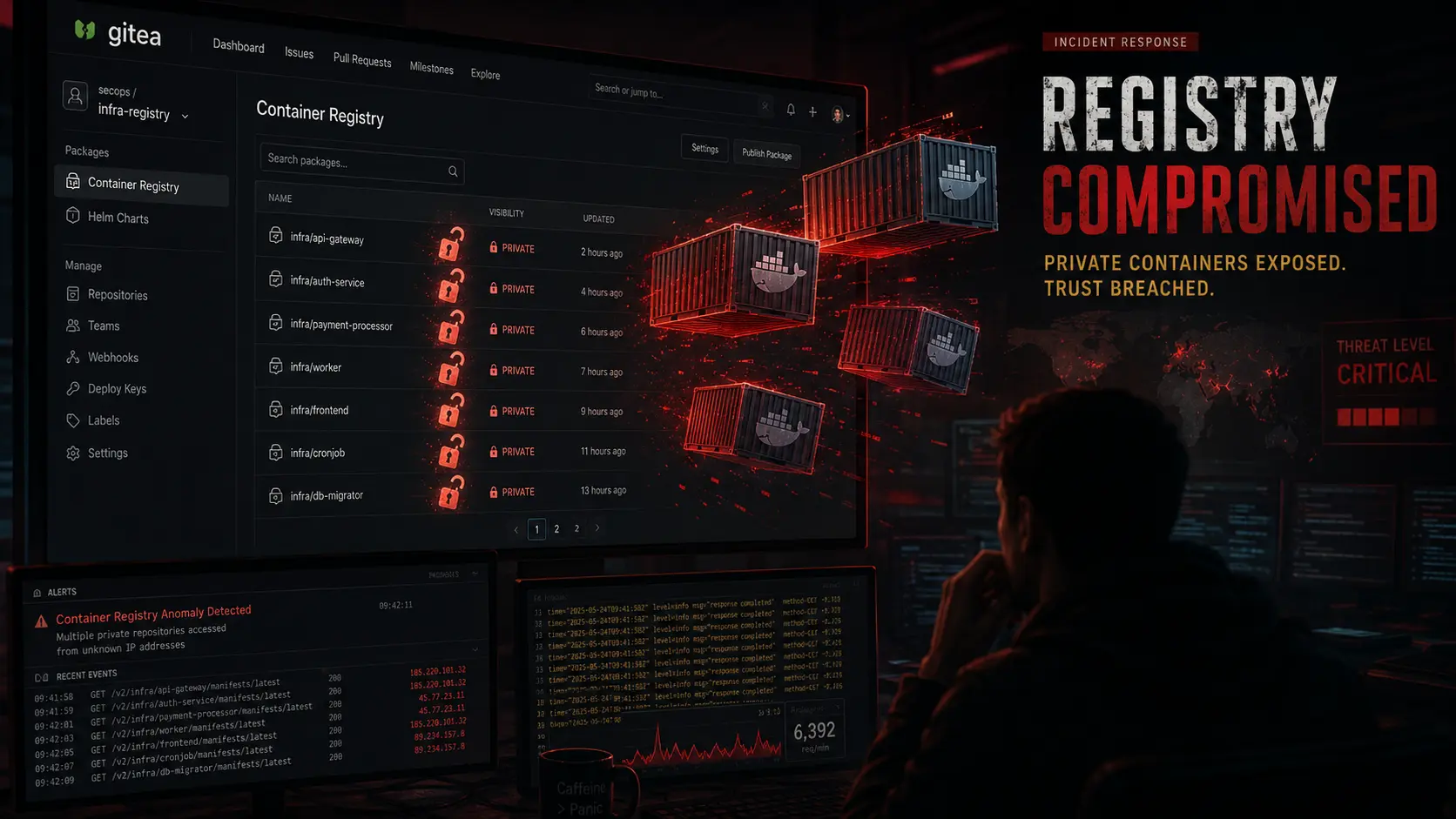
On May 27 2026, security researchers at Noscope disclosed CVE-2026-27771 — a critical authentication bypass in Gitea's container registry that lets an unauthenticated remote attacker pull any "private" container image without an account, password, or token. The flaw affects every Gitea version released since 2022 up to (but not including) 1.26.2. Noscope estimates 30,000+ exposed deployments across more than 30 countries, concentrated in China, the U.S., Germany, France, and the U.K., spanning healthcare, aerospace, retail infrastructure, and ISPs. If you self-host Gitea and have ever pushed an OCI image to it — your code, your secrets, your base layers — assume someone else has already pulled them.
1. What broke, plainly
Gitea's container registry exposed an OCI registry API (the standard Docker / Helm / OCI pull protocol). When a repository was marked "private," the UI and the higher-level REST surface enforced that correctly. The registry endpoint did not. The "private" flag was checked at the repository metadata layer but not at the blob/manifest serving layer. Anyone who knew (or guessed) the manifest URL — and the URL convention is public, documented OCI — could docker pull the image as if it were public.
This is a textbook example of an authorization check missing on one of several paths to the same resource. It is also the exact class of bug AI-driven code auditing finds extremely well, which is part of why we are seeing 18-year-old NGINX flaws and four-year-old Gitea flaws being disclosed in the same month.
2. Why this is worse than a typical CVE
Three multipliers.
The exposure is silent. A pull leaves no obvious trace if the attacker uses standard docker pull against the public OCI endpoint. Your access logs will show an image-fetch request from an arbitrary IP. Without registry-level audit logging — which most self-hosted Gitea operators do not enable — you cannot tell after the fact who pulled what.
Container images carry secrets. Most developer teams have at some point baked an API key, a database URL, a .env, or a service-account JSON into an image during local development and pushed it "just to my private registry." The "private" assumption is now retroactively false.
The window has been open for four years. A vulnerability that has been silently exploitable since 2022 has, statistically, been silently exploited. There is no honest version of "we are probably fine" here. The right question is "what did we push, when, and what's in those layers?"
3. The 30-minute response runbook
Minute 0–5: Patch or close. Upgrade to Gitea 1.26.2 (or later). If you cannot upgrade right now, set [service].REQUIRE_SIGNIN_VIEW=true in app.ini and restart. This is a temporary mitigation and breaks any genuinely public images — accept the tradeoff for the next 24 hours.
Minute 5–15: Inventory. Run gitea admin packages list-by-type container (or the equivalent SQL query against package and package_version) and produce a full list of every image and tag pushed to private repos. Mark anything pushed before the patched version was deployed as "potentially leaked."
Minute 15–25: Rotate. For every image marked "potentially leaked," rotate every secret that has ever appeared in any layer of that image. AWS keys, GCP service accounts, database passwords, Stripe keys, OAuth client secrets, JWT signing keys — all of it. Don't try to grep for secrets first; assume they exist and rotate. Re-grep later.
Minute 25–30: Notify. If your Gitea instance was internet-reachable, write a one-paragraph incident note to your security stakeholders and (where required) your regulator. Honesty up front is much cheaper than honesty in three weeks under questioning.
4. Why self-hosters are now the highest-risk segment in 2026
The pattern this year — laravel-lang supply chain, NGINX Rift, SharePoint deserialization, now Gitea — is consistent: critical bugs are being found in widely-used self-hosted infrastructure at a pace that outstrips a typical sysadmin's ability to keep up. Managed-SaaS competitors patch within hours of disclosure. Self-hosters patch within days at best, weeks at typical, months at worst.
The cost-of-self-hosting math has shifted. In 2022, self-hosting Gitea saved you $4 per developer per month vs. GitHub Enterprise. In 2026, when you add a realistic share of one full-time engineer doing security maintenance — patch tracking, CVE response, audit logging, base-image hygiene, certificate rotation — the breakeven has moved meaningfully toward managed.
This does not mean self-hosting is wrong. It means the honest budget for self-hosting in 2026 includes a named owner and a real maintenance allocation. If you have neither, you are accumulating a Gitea-CVE-shaped liability every quarter.
5. The defensive controls that would have caught this earlier
Three controls, in order of cost-to-deploy:
Network segmentation. Self-hosted dev infrastructure (Gitea, internal CI runners, container registries) should not be on the public internet unless there is a defended reason. Put them behind a VPN or a zero-trust gateway. The 30,000 exposed Gitea instances are largely instances that did not need to be exposed in the first place.
Registry-level audit logging. Forward every pull and push to a SIEM (Loki, Splunk, even an S3 bucket with a daily rollup). The marginal storage cost is trivial; the forensic value when the next CVE drops is enormous.
Secret scanning at push time. Tools like trufflehog, gitleaks, and the newer LLM-assisted scanners (Snyk's, GitHub Advanced Security, Anthropic-powered open-source equivalents) cost approximately nothing to run in CI and would have caught most of what is now leaking.
My Take
CVE-2026-27771 is the third bug this year in widely-deployed self-hosted infrastructure where the operator-facing answer is "you needed someone whose job was to watch for this, and you didn't have one." That role has a name now: ecosystem maintainer in the open-source case (see the new PHP Foundation security team), platform-engineering owner in the corporate case. If you self-host and you have neither, your roadmap for Q3 should include hiring or contracting the role — not as luxury, as basic hygiene. The era of "we set up Gitea five years ago and forgot about it" is over. The bills for that posture are now being mailed every two weeks.
Sources
- Gitea Vulnerability Exposes Private Container Images without Authentication — The Hacker News
- Gitea instances exposing private container images — Noscope
- Gitea CVEs and Security Vulnerabilities — OpenCVE
- Gitea Configuration Cheat Sheet — REQUIRE_SIGNIN_VIEW
- Known Exploited Vulnerabilities Catalog — CISA