When a business owner first tells us "I want to build an internal management system," there's usually a shared backstory: employees buried in Excel, orders lost in a LINE group, paper forms piling up unsigned, and a single data lookup taking three phone calls. The pain is clear; the solution space is wide — packaged SaaS, low-code platforms, custom development, or hybrid stacks, each fitting a different scenario.
The "Custom Information Management System (MIS)" service we offer targets a very specific zone: larger than what packaged SaaS can cover, more complex than low-code can sustain, but smaller than the volume that justifies an in-house engineering team. Here's our full pipeline from initial contact to delivery, and what we confirm with the client at each critical milestone.
Phase 1: Requirements Discovery and Feasibility (Weeks 1–2)
We don't take "just send me a quote" engagements. Phase 1 requires sit-down or video interviews with 3–5 actual system users — frontline operators, line managers, and someone from finance or accounting (because every internal system eventually hits reconciliation). Deliverables:
- Current-state process map — every action, every form, every data hand-off, drawn in BPMN or a simplified flow diagram.
- Pain-point priority matrix — sorted by Impact × Frequency; only the top 5 enter MVP scope.
- Role-permissions matrix — what each role can see, do, and not do.
- Integration inventory — every external system the MIS must talk to (accounting, ERP, ecommerce, invoicing, payments, logistics, e-signature platforms).
At the end of this phase the client receives a "scope document" and a "phased roadmap" — not a price quote. Quoting only becomes meaningful once scope and phases are agreed.
Phase 2: Architecture Design and Tech Stack Selection (Week 3)
Our default stack is Laravel + MySQL + Vue/Inertia + Nginx, with Flutter added on the mobile side when needed. Every engagement re-evaluates against three factors:
- Data volume — under 100K new records/month: default stack works; over 1M/month: evaluate PostgreSQL, read/write splitting, a caching layer.
- Concurrent users — under 50 concurrent: single 4-core 8GB box suffices; over 200 concurrent: plan load balancing and shared session storage.
- Compliance and security — PII, financial, or healthcare verticals get added: data-at-rest encryption, audit logs, 2FA, IP allowlisting.
Once the stack is set, the client receives an Architecture Decision Record (ADR) explaining the rationale for each choice and the alternatives considered. Three years later, when a second-generation engineer takes over, this document is what saves them.
Phase 3: Iterative Development with Weekly Demos (Weeks 4–7)
No waterfall "we'll show you the finished product in three months." Every Friday afternoon, scheduled demo of the actual running system (not mockups). The client can give change requests on the spot. Priorities can be re-ordered weekly, with one rule: scope changes go to backlog without bumping committed work.
During development we:
- Commit daily to a Git repo the client has access to (GitHub or GitLab) — the client's IT lead can check progress at any time.
- Deliver a weekly status report ("done this week" + "planned next week").
- Maintain three independent environments (dev / staging / production); the client can break things freely in staging.
Phase 4: Pre-Launch Preparation and Data Migration (Week 8)
The most failure-prone phase. Our standard procedure:
- Data cleanup — 80% of the client's legacy data has problems (duplicates, missing columns, format inconsistency). We deliver a "data cleanup recommendation" and supervise 1–2 rounds of cleaning.
- User training — split into a manager session (30 minutes, focused on permissions and reports) and a frontline session (90 minutes, with hands-on practice). Recordings plus SOP documents delivered.
- Two-week parallel run — old and new systems run side by side, with daily reconciliation.
- Cutover — chosen on a low-traffic day (usually a Saturday), with 8-hour on-site standby after the switch.
Phase 5: Post-Launch Operations and Annual Health Checks
Many agencies treat "go-live" as the finish line. We treat it as the starting line. Standard operations include:
- 24×7 system monitoring (uptime, error rate, response time) with 15-minute incident alert.
- Daily off-site automated backup, weekly restore test.
- Monthly security scan plus written report.
- Quarterly "usage health check" — which features are heavily used, which are unused, which need an upgrade.
- Annual architecture review with next-year capacity and expansion recommendations.
Caveats: Three Client Misconceptions We Address Upfront
First misconception: "Just give me a system like Company X's." Every company's process, authority structure, and culture is different — copy-pasting always misfires. We spend the time to make this point land.
Second misconception: "Our requirements are simple." Without exception — what's described as "simple" in week one averages 2.5x scope growth by week two of interviews. We flag this in our quote and recommend phased launches.
Third misconception: "Once the system is built, we don't need to spend anymore." Any live system needs maintenance. Annual ops budget typically runs 15–20% of original build cost. Skip this budget and within three years the system turns into "the black box nobody dares to touch."
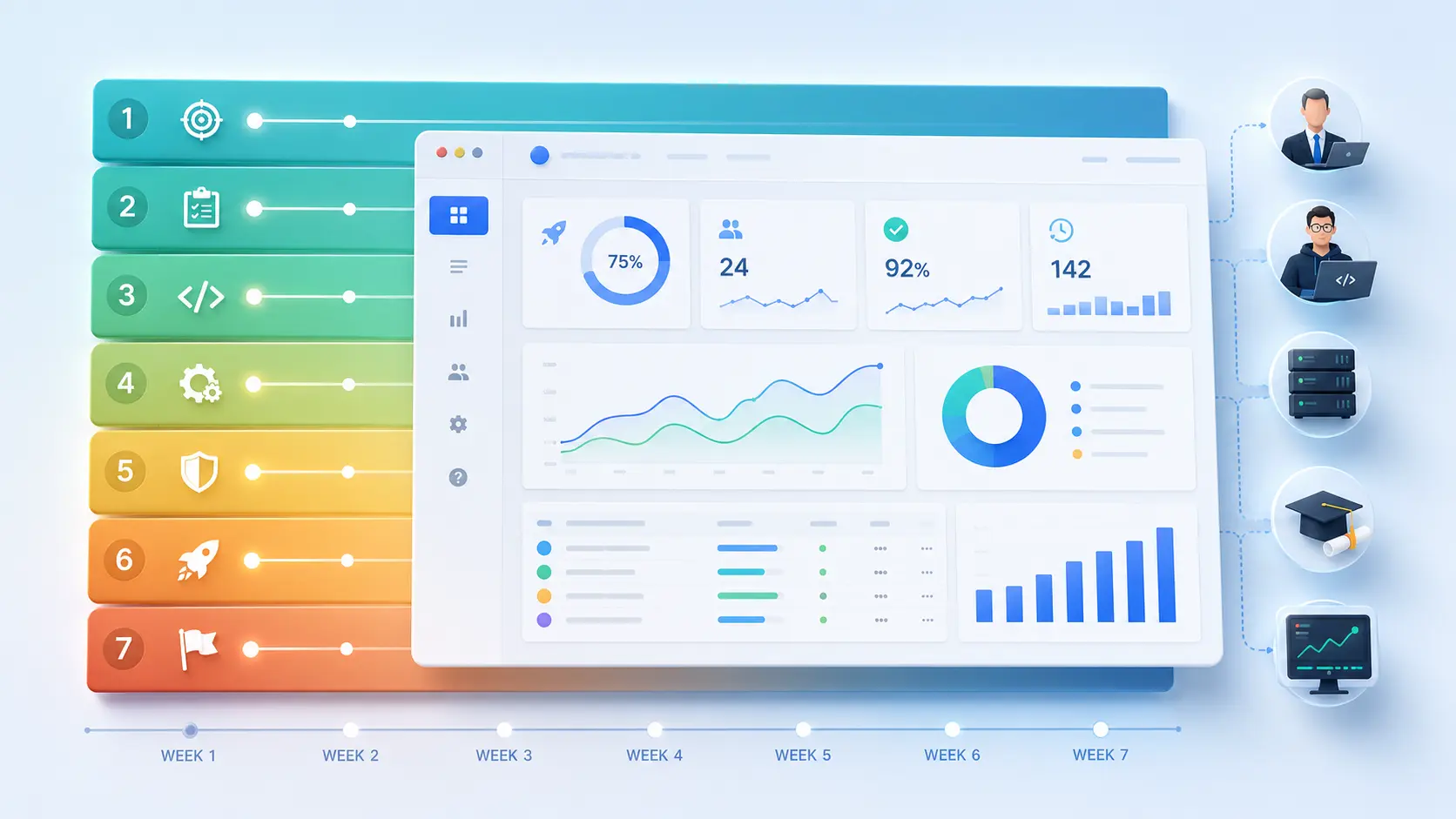
We call this the "seven-week methodology." Custom MIS projects delivered with this process over the past three years have hit a three-year retention rate of 92%, well above the industry's 70% benchmark. A system isn't successful because it was built — it's successful because it was designed, trained on, and operated with care.