For two years the pitch has been uniform: deploy AI, reap rewards. Every vendor, every keynote, every consultant slide deck has promised broadly distributed productivity gains. PwC's 2026 AI Performance Study, published in mid-April, quietly dismantles that narrative.
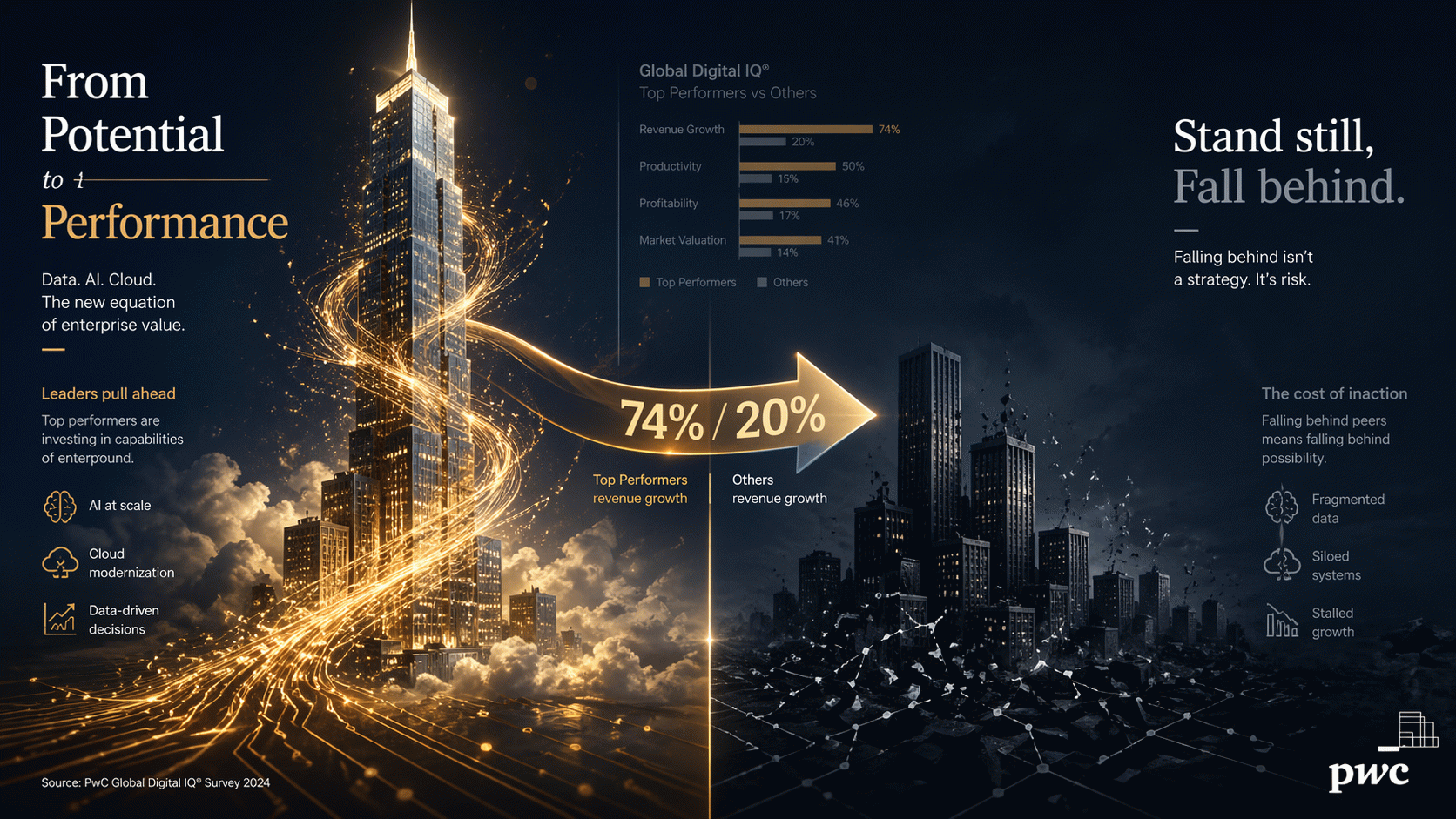
The headline number is brutal. 74% of AI's economic value is being captured by just 20% of companies. The top performers are generating 7.2 times more AI-driven revenue and efficiency gains than the average competitor. This is not a bell curve. It is a power law, and it is steeper than most executives have allowed themselves to believe.
PwC surveyed 1,217 senior executives, mostly at large publicly listed companies across 25 sectors. That sample matters. These are not startups experimenting with AI — they are organizations with capital, talent, and data at their disposal. And even among this elite group, four out of five companies are mostly losing, or at best treading water.
What the Winners Are Actually Doing Differently
The single most interesting finding is what the top 20% are not doing: chasing productivity.
Average companies deploy AI the way they would deploy any enterprise software upgrade — to reduce headcount, speed up existing processes, and cut costs. The winners do something different. They use AI as a wedge to enter adjacent markets, create new product categories, and pursue revenue that did not exist before the AI capability arrived.
A retail company that uses AI to write product descriptions faster saves money. A retail company that uses AI to generate personalized product lines for every micro-segment of its customer base creates a new business. The first gets a productivity line on its earnings report. The second rewrites its industry.
PwC's data show the winners also invest disproportionately in three foundations most companies treat as afterthoughts: data infrastructure, governance, and internal trust mechanisms. They build evaluation harnesses before they deploy models. They instrument AI decisions so humans can audit them. They run red-team exercises. These are unsexy, slow, and organizationally expensive — and they are exactly what separates an AI pilot from an AI system that can be trusted to run in production.
Why This Is Going to Get Worse Before It Gets Better
The uncomfortable truth is that the gap PwC documented is self-reinforcing. Winning with AI generates data. More data trains better models. Better models produce better outcomes. Better outcomes fund bigger AI investments. The flywheel has already started turning for the leaders, and the lag for the other 80% is not closing — it is widening.
Companies waiting for AI to "mature" before committing are making a strategic error that will not show up in their financials for another two years. By then, their competitors will have compounded a five-year lead. Turnarounds from that position are possible, but they require something most boards have not yet had to do: make large, uncomfortable bets on capabilities that do not yet show a clear ROI.
My Take
We have been told that AI is a tide that lifts all boats. PwC's data shows that AI is in fact a tide that lifts 20% of boats, floods another 30%, and leaves the rest stranded on the mud.
The good news is that the gap is not explained by size, budget, or geography. It is explained by strategic posture. A mid-sized company with a clear thesis about how AI changes its industry can and does outperform enterprises ten times its size. The variables that matter are leadership clarity, willingness to redesign workflows, and a genuine investment in the unglamorous infrastructure of trust.
The companies that succeed in the second half of this decade will not be the ones that bought the best AI. They will be the ones that gave the clearest answer to a simpler question: what new business can we build that was impossible before?