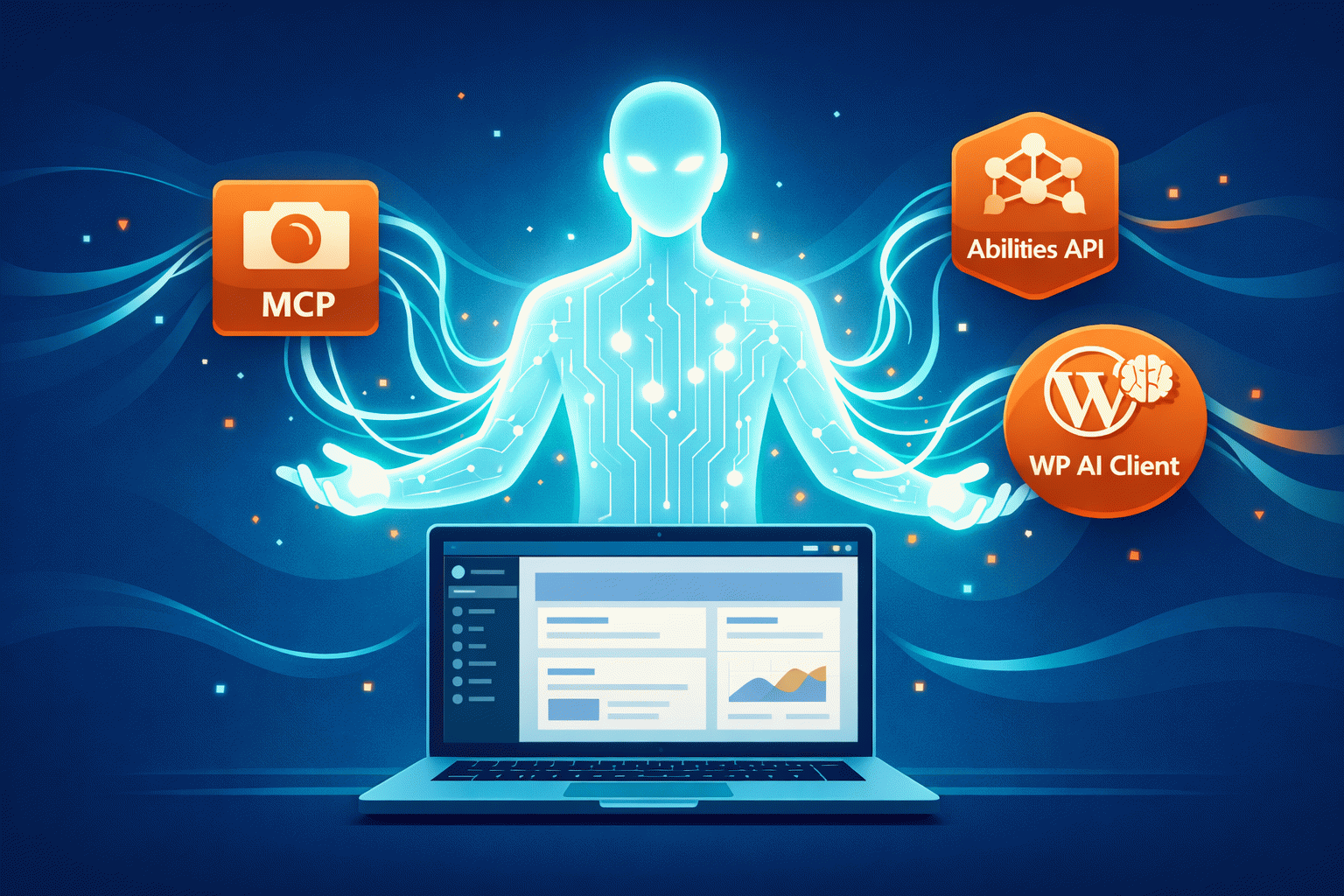
On April 9, 2026, WordPress 7.0 shipped. On the surface it looked like another version bump for the CMS that powers more than 40% of the web. Look closer, and it is something much stranger: a PHP application voluntarily handing the keys to AI agents.
For the first time, WordPress core includes three pieces of AI infrastructure that fundamentally change what it means to "manage a website." The WP AI Client provides a provider-agnostic layer that works with OpenAI, Anthropic, Google, and anyone else who follows standard API patterns. The Abilities API declares, in a structured way, what actions a given WordPress site can perform. And the MCP Adapter exposes those abilities as tools that any Model Context Protocol client — Claude, ChatGPT, Cursor, or a homemade agent — can discover and call remotely.
The practical consequence is almost comical. Starting this spring, an AI agent running on another continent can draft a post, publish a page, moderate a comment thread, bulk-edit media metadata, or install a plugin on your WordPress site without ever opening a browser. It just sends MCP requests. The site sends structured responses. The entire surface area of WordPress administration has become programmable by language models.
If you are a PHP developer, this is the news of the year, and probably the decade.
From Theme Wars to Ability Design
For two decades, the center of gravity in WordPress development was the theme and the plugin. You wrote PHP to hook into actions, you wrote templates to render content, and you spent a lot of time fighting the quirks of the_content() filters. The shape of the job was "render and hook."
WordPress 7.0 quietly moves the center of gravity to ability design. The critical question for a plugin author is no longer only "how does my code render a widget," but "what abilities should my plugin expose, to which agents, with what boundaries?" A well-designed plugin is one whose abilities compose cleanly with other abilities and that an agent can reason about safely. A badly designed plugin is one where an agent can accidentally publish a draft, delete a customer record, or overwrite the homepage because the developer never modeled the write path as a first-class ability.
This is a shift comparable to the move from procedural PHP to object-oriented PHP in the 2000s, or the move from jQuery soup to component frameworks in the 2010s. The people who learn to think in abilities first will define the next generation of WordPress work. The people who keep thinking in page templates will be maintaining legacy.
The Database Question No One Is Asking Yet
What I find most interesting, as someone who watches the data layer, is the database implication that the WordPress 7.0 release notes barely touch.
When humans managed a WordPress site, writes were slow, occasional, and funneled through a small number of editors. When agents manage a WordPress site, writes become continuous, batched, and unpredictable. A single Claude session can draft thirty posts, attach twenty images, and tag a thousand categories in the time it takes a human editor to log in. The traditional wp_posts and wp_postmeta schema was not designed for that cadence. Neither were most shared MySQL hosts.
Expect the next eighteen months to be full of surprise 503 errors, unexplained table-lock incidents, and panicked hosting-provider emails — all because nobody told the database that a language model was now the most active author on the site.
My Take
WordPress 7.0 is the most honest version of the future I have seen so far. It does not pretend AI is a feature in a sidebar. It rewires the platform so that AI agents are first-class operators, with scoped permissions and discoverable tools. That is the right architectural bet.
But it also means PHP developers need to urgently learn two new skills: writing Abilities that are safe under adversarial agent behavior, and auditing MCP calls the way we used to audit SQL. The next generation of "WordPress security plugin" will not block spam comments. It will block rogue agent actions.
If you are a WordPress developer and you are not reading the MCP spec this weekend, you are already behind.